





How to Scale Production with Sachet Packaging Machines
- Selecting the Right Machine to Increase Throughput
- Understanding sachet packaging machine types
- Throughput and speed calculations
- Key components that affect performance
- Designing a Production Line for Scaled Sachet Output
- Integrating upstream equipment: mixers and feeders
- Multi-lane and modular line strategies
- Automation, sensors and Industry 4.0
- Material, Quality, and Regulatory Considerations
- Choosing the right films and barrier properties
- Hygiene, traceability and regulatory compliance
- Quality control and in-line inspection
- Operation, Maintenance and Return on Investment
- Changeover, flexibility and SKU management
- Preventive maintenance and spare parts strategy
- Estimating costs and ROI
- Comparing Machine Options: Single-lane vs Multi-lane
- References and Further Reading
- FAQ
- Q: How do I estimate the right sachet packaging machine size for my growth plan?
- Q: Can sachet packaging machines handle both powders and liquids?
- Q: What are the main causes of downtime on high-speed sachet lines?
- Q: How do I maintain product traceability on sachets at scale?
- Q: Do I need special certifications for sachet machines in food and pharma industries?

Scaling production with sachet packaging machines demands a practical mix of equipment selection, line design, material science, and quality systems. This article gives actionable guidance for operations managers, engineers, and procurement teams looking to ramp up single-serve and small-dose packaging using sachet packaging machine technology, including tips on throughput calculations, multi-lane systems, automation integration, and compliance with food and pharmaceutical standards.
Yuanyang sachet packaging machine is a kind of automatic equipment, mainly used for measuring, filling, and sealing small bag packing materials. The sachet packing machine has become an indispensable piece of equipment in modern production for food, medicine, chemicals, and other fields.
Features:
⦁ Microcomputer controlled;
⦁ Automated fast speed;
⦁ Multi-function integration.
Selecting the Right Machine to Increase Throughput
Understanding sachet packaging machine types
There are several common types of sachet packaging machines. Choosing the right one is the first step in scaling production:
- Vertical form-fill-seal (VFFS) sachet machines — common for powders, granules, and liquids with simple film reels.
- Pre-made pouch sachet machines — use pre-cut film pouches for products requiring special laminates or zipper/tear features.
- Stick pack machines — produce slim stick-shaped sachets ideal for single-serve powders and beverages.
- Multi-lane sachet machines — multiply output by running several lanes in parallel on one frame.
Each machine class supports different product viscosities, particulate sizes, and barrier film requirements. When scaling, consider whether adding lanes or upgrading to a faster model gives the best capacity-to-cost ratio.
Throughput and speed calculations
To plan capacity you must calculate realistic throughput. Use this simple formula:
Throughput (units/hour) = machine speed (bags/min) × 60 × lanes × efficiency factor
Example: a 100 bags/min single-lane machine at 85% efficiency produces 100 × 60 × 1 × 0.85 = 5,100 bags/hour. A 4-lane equivalent at the same lane speed yields 20,400 bags/hour.
Key factors that reduce theoretical speed include: product dosing time, film unwind and splicing, product settling, operator changeovers, and downstream packing (cartoning) limitations. Always apply an efficiency factor (typically 0.75–0.9) to account for real-world losses.
Key components that affect performance
Critical subsystems determine machine capability and should inform purchases:
- Dosing system: auger fillers for powders, positive displacement pumps for viscous liquids, piston fillers for accurate single-dose liquids.
- Film handling: servo-driven film unwinds and tension control reduce variability at high speeds.
- Sealing system: rotary heat sealers vs. stationary jaws — rotary systems often handle higher speeds with less film distortion.
- Control and HMI: PLCs with recipe management speed changeovers and reduce operator errors.
Designing a Production Line for Scaled Sachet Output
Integrating upstream equipment: mixers and feeders
Scaling output requires synchronization between upstream processing (e.g., industrial mixers) and the sachet packaging machine. Common integration points include:
- Continuous feeders: volumetric or gravimetric feeders coupled to mixers for uniform dosing.
- Buffer hoppers: provide short-term storage to decouple batch mixing cycles from continuous filling.
- Weighing and gravimetric control: inline check-weighers and loss-in-weight systems maintain accurate fills at high speeds.
Connectors and dosing conveyors should match the product form: powders need dust control and agitation, while liquids require drip-free manifolds. For guidance on mixer selection and its effect on downstream packaging, consult industrial mixing best practices and equipment datasheets.
Multi-lane and modular line strategies
When single-lane capacity limits output, consider multi-lane systems or modular additions. Advantages include:
- Higher throughput without a proportionate increase in floor space.
- Ability to run multiple SKUs in parallel with lane isolation.
- Reduced per-unit labor when compared to adding separate single-lane machines.
Design considerations for multi-lane setups:
- Ensure upstream product distribution is equal across lanes (manifolds or multi-port feeders).
- Use synchronized servo drives and a unified PLC to maintain lane-to-lane timing.
- Plan for maintenance access and spare lane redundancy to avoid full-line downtime.
Automation, sensors and Industry 4.0
Automation reduces variability and labor costs. Useful features for scaling include:
- Recipe-based PLC control to switch between bag sizes and fill weights quickly.
- Inline vision systems for seal inspection, fill-level checks, and code verification.
- Remote monitoring and OEE dashboards for proactive maintenance and throughput optimization.
Connecting packaging equipment to an MES or IoT platform helps you spot bottlenecks and schedule production to meet demand peaks.
Material, Quality, and Regulatory Considerations
Choosing the right films and barrier properties
Film selection directly impacts shelf life, machinability, and consumer acceptance. When scaling sachet production consider:
- Barrier requirements: oxygen, moisture, and light protection depending on product sensitivity.
- Sealability: multi-layer laminates with compatible sealant layers reduce sealing defects at high speeds.
- Film thickness and stiffness: ensure the film runs smoothly without wrinkles or stretching at target speeds.
Work with film suppliers to test prototypes in your actual machine at target speeds; small differences in film coefficient of friction or thickness can cause unacceptable scrap rates at scale.
Hygiene, traceability and regulatory compliance
Food and pharmaceutical sachets must meet safety and traceability standards. Important references include the U.S. Food and Drug Administration (FDA) guidance on food packaging (FDA – Packaging Food) and international food safety guidance from the World Health Organization (WHO – Food Safety).
Key compliance actions:
- Use food-contact rated materials and maintain supplier declarations.
- Design hygienic equipment with minimal crevices and easy-to-clean surfaces.
- Implement lot-level traceability and integrate codes/QRs during packaging for recalls and supply chain visibility.
For medical sachet packaging, consult ISO standards for medical device packaging and sterilization where applicable (ISO – Packaging standards).
Quality control and in-line inspection
To maintain quality at high output:
- Install in-line check-weighers, metal detectors, and X-ray where product protection requires.
- Use vision systems for print accuracy and seal integrity checks; reject mechanisms should keep line speed stable.
- Track scrap and downtime metrics through an OEE system to continuously improve yields.
Operation, Maintenance and Return on Investment
Changeover, flexibility and SKU management
Rapid changeovers are essential when scaling to higher SKU counts. Best practices include:
- Standardize pouch sizes and film widths where possible to reduce tooling swaps.
- Use quick-change forming tubes, sealing jaws, and modular dosing heads.
- Document changeover procedures and train operators with job-specific recipes and checklists.
Reducing changeover time directly increases effective production capacity without new capital investment.
Preventive maintenance and spare parts strategy
Downtime becomes more costly at scale. Implement a preventive maintenance program that includes:
- Scheduled inspections for wear parts (seals, knives, belts) and critical components (servos, PID controllers).
- Stocking critical spares to avoid long lead-time repairs.
- Using vibration and temperature sensors for predictive maintenance on motors and gearboxes.
Estimating costs and ROI
Consider capital expenditure (machine, installation) and operating expenses (labor, film, energy, maintenance). A simple ROI model:
Annual benefit = (additional units produced per year) × (margin per unit)
Payback period = Capital cost / Annual benefit
Example calculation (simplified):
| Item | Value |
|---|---|
| Additional capacity (units/year) | 8,000,000 |
| Average margin per unit | $0.02 |
| Annual benefit | $160,000 |
| Machine + integration cost | $480,000 |
| Payback period | 3 years |
This is a conservative example; actual payback depends on reduced labor, lower scrap, and improved shelf-life leading to less waste.
Comparing Machine Options: Single-lane vs Multi-lane
Below is a concise comparison to help choose between scaling by speed vs adding lanes.
| Feature | Single-lane high-speed | Multi-lane (parallel) |
|---|---|---|
| Typical max output | Up to 400 bags/min (varies by product) | 100–200 bags/min per lane × multiple lanes |
| Footprint | Smaller footprint per lane | Higher density output per footprint |
| Complexity | Simpler mechanics, harder to achieve at extreme speeds | More complex distribution and synchronization |
| Changeover | Relatively fast | Potentially more complex, but lane isolation helps |
| Best for | High-volume single SKU runs | High-mix production and very large volumes |
References and Further Reading
- Packaging (Wikipedia) — overview of packaging principles and types.
- FDA — Packaging Food — guidance on packaging materials and food safety considerations.
- WHO — Food Safety — international food safety information relevant for packaging.
- ISO — Packaging Standards — reference for medical and critical packaging standards.
FAQ
Q: How do I estimate the right sachet packaging machine size for my growth plan?
A: Start with your target annual volume and convert to required hourly throughput using operating hours. Apply an efficiency factor (0.75–0.9). Compare whether a single higher-speed unit or a multi-lane machine delivers required throughput while fitting floor space and budget. Use the throughput formula in this article and consult machine vendors with your product specifications for trial runs.
Q: Can sachet packaging machines handle both powders and liquids?
A: Many sachet machines are adaptable, but dosing systems change. Powders typically use auger or vibratory dosing; liquids use piston or peristaltic pumps. Machines designed with modular dosing heads can switch between product types more easily, but dedicated dosing equipment often yields better accuracy and uptime for each product class.
Q: What are the main causes of downtime on high-speed sachet lines?
A: Common causes include film splices or web breaks, inconsistent dosing (bridging in feeders), sealing problems (improper temperature/pressure), and downstream blockages. Address these with robust film handling, proper feeder design, inline sensors, and preventive maintenance.
Q: How do I maintain product traceability on sachets at scale?
A: Use inline printers or laser coders to add batch codes and expiry. Integrate vision systems to validate print quality and connect coders to your MES to record batch-to-machine mappings. QR codes work well for consumer traceability and recalls.
Q: Do I need special certifications for sachet machines in food and pharma industries?
A: Machines for food and pharma should be constructed from food-grade materials (typically stainless steel), support hygienic design, and comply with relevant regional regulations (e.g., FDA for the U.S.). Medical or sterile products may require compliance with ISO medical packaging standards. Always check local regulatory requirements for your market.
If you would like to evaluate a specific model, request performance data, or schedule a trial run with your product, please contact our sales team or view our product page for Sachet Packaging Machine for Sale.
Top 10 drink powder mixer Manufacturers and Supplier Brands in France
How to start the vacuum emulsifying mixer business ?
Top 5 homogenizing collagen mixers Company List and Products Compared
Custom mini sealing machine Manufacturers and Suppliers in Europe
Sachet Packaging Machine for Granules
Is the sachet packing machine equipped with conveyor ?
Yes, the standard sachet packaging machine is with a conveyor for transferring the finished bags.
Homogneizer mixer tank
How long does the liquid soap mixer take to produce a batch?
It usually takes 0.5-1 hours or longer based quality requirement and formula.
Cosmetic
What maintenance and support do you provide for the equipment?
We provide detailed equipment maintenance guides and offer regular maintenance services to ensure long-term optimal performance. Additionally, we offer quick-response after-sales technical support to resolve any unexpected issues.
Liquid Mixing Tank
What’s the maximum temperature it can get?
Steam heating: 100~180℃; electric heating: use water 100℃, use thermal oil 260℃.
Powder Sachet Packaging Machine
Can the plastic powder packing machine print barcode also?
No, the standard type of coding machine on this packing machine for powders can only print date. To print barcode, customize service will recommend client another separated jet printer.
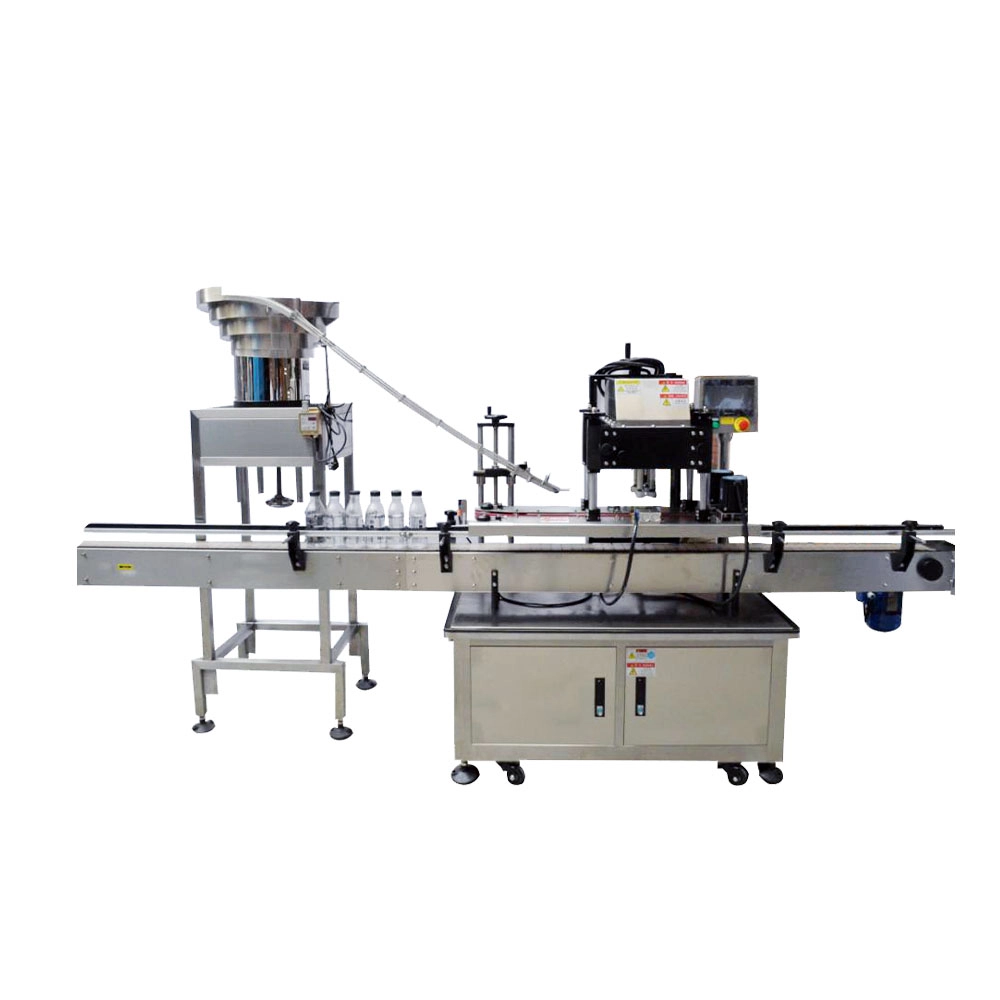
Automatic Plastic Caps Capping Machine with Vibrating Cap Feeder for Sale
Yuanyang automatic screw capping machine is a kind of four-wheel bottle capping machine. The automatic screw capper is often used to close lids of containers such as bottles and jars, especially for plastic bottles, which are widely used in food, medicine, chemical, cosmetic, and other industries for mass production and continuous production lines.
Features:
⦁ Full pneumatic drive;
⦁ Automated fast speed;
⦁ Suitable for various screw caps, pumps, and spray bottles.
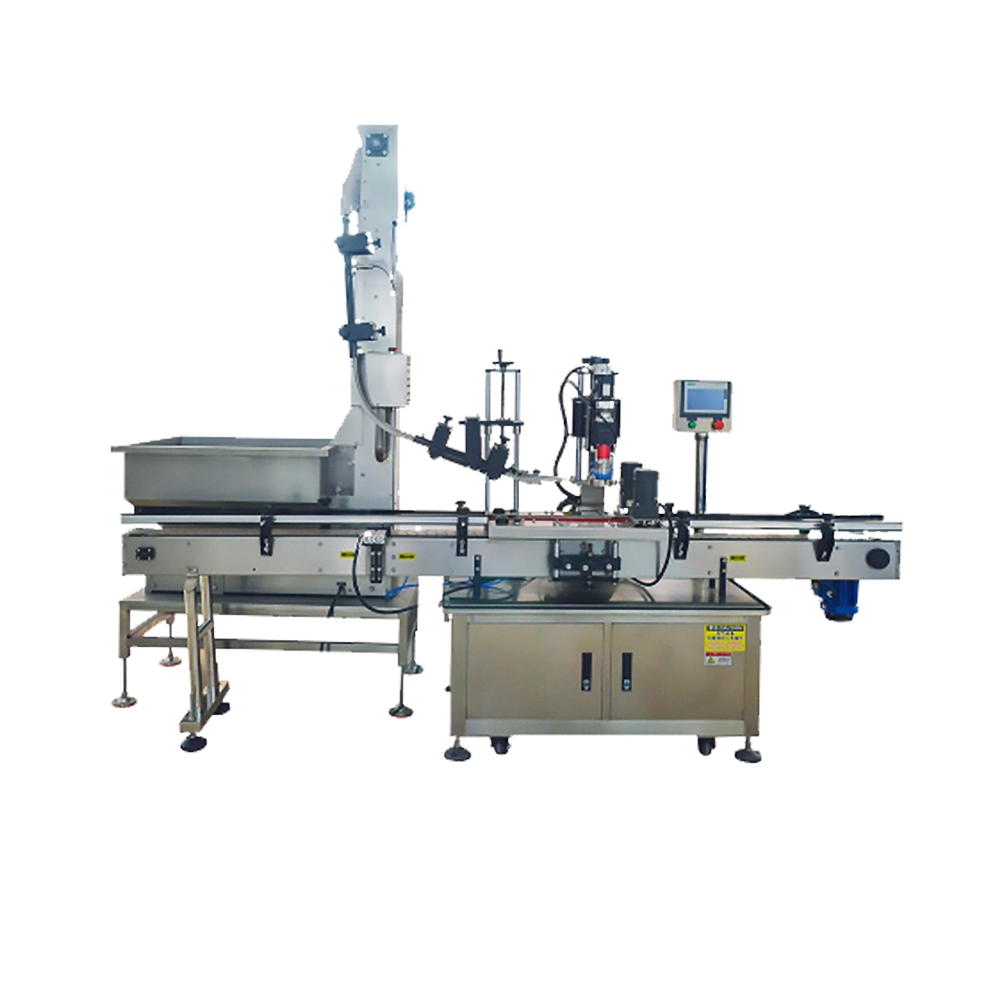
Automatic Metal Caps Capping Machine for Sale
Yuanyang automatic metal cap capping machine is a bottle capper for bottles with metal caps, which is often used to close lids of containers such as bottles and jars. The glass bottle metal capping machine is widely used in food, medicine, chemical, cosmetic, and other industries for mass production and continuous production line .
Features:
⦁ Pneumatic and electric drive;
⦁ Automated fast speed;
⦁ Suitable for glass bottles with metal caps.
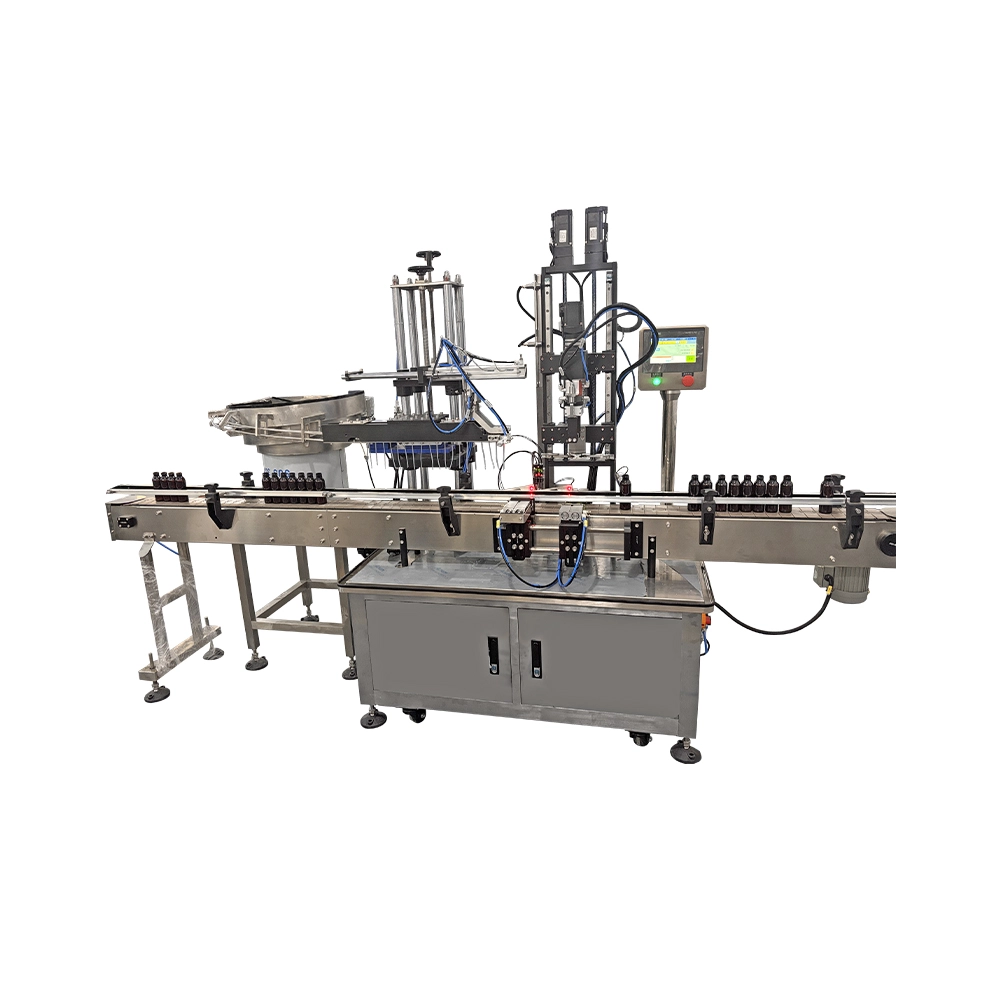
Automatic Pump Head Feeding and Capping Machine for Sale
Yuanyang automatic pump head feeding and capping machine is a bottle cap sorter and capper for bottles with pump heads, which is often used to close lids of containers such as nail polish, sprayers, and shampoo. The capping machine with a pump head feeder is widely used in food, medicine, chemical, cosmetic, and other industries for mass production and continuous production line .
Features:
⦁ Pneumatic and electric drive;
⦁ Automated fast speed;
⦁ Suitable for various types of caps.
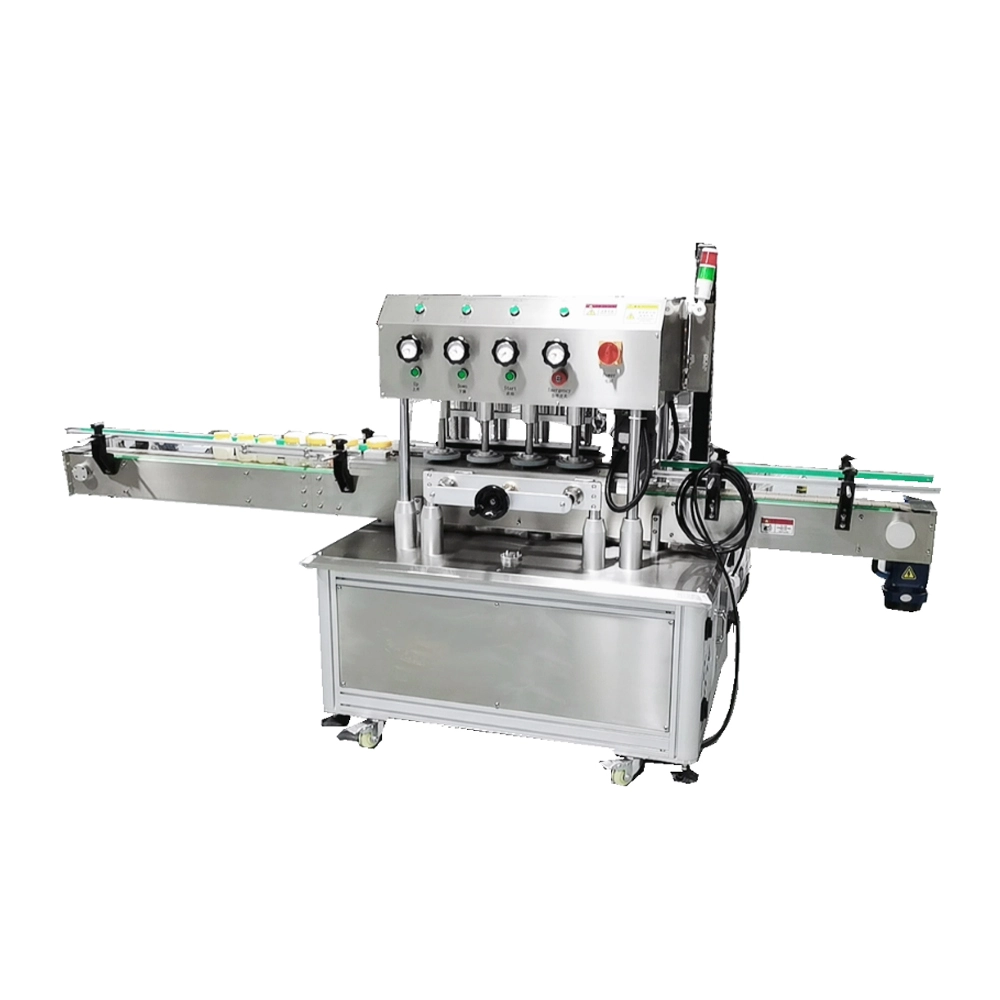
Automatic High Speed Capping Machine for Sale
The Yuanyang automatic high-speed capping machine is a kind of 8-wheel bottle-capping machine with fast working efficiency. The automatic capper is often used to close lids of containers such as bottles and jars, especially for plastic bottles, which are widely used in food, medicine, chemical, cosmetic, and other industries for mass production and continuous production lines.
Features:
⦁ Electric drive;
⦁ Automated fast speed;
⦁ Suitable for various screw caps, pumps, and spray bottles.
 Scan QR Code
Facebook
YouTube
LinkedIn
Whatsapp: +8613434139712
Guangzhou Yuanyang Machinery