





Choosing the Right Emulsifying Machine for Small Batches
- Choosing the Right Emulsifying Machine for Small Batches
- Why selecting the right emulsifying machine matters for small-batch producers
- Understand your small-batch production needs when buying an emulsifying machine
- Key technical features to look for in an emulsifying machine for small batches
- Why the 50L Hydraulic Lift Vacuum Emulsifier is a strong choice for small-batch emulsification
- Performance metrics that matter: particle size, mixing time, and energy
- Notes on the table
- Material compatibility and GMP considerations for small-batch emulsifying machines
- Operational considerations: cleaning, maintenance, and scale flexibility
- Cost versus value: evaluating purchase and operational return on investment
- How to evaluate suppliers when you plan to buy an emulsifying machine
- Yuanyang brand advantages for small-batch emulsifying machine buyers
- FAQ: Choosing and using an emulsifying machine for small batches
- Contact us and view product
- References
Choosing the Right Emulsifying Machine for Small Batches
Why selecting the right emulsifying machine matters for small-batch producers
Choosing the correct emulsifying machine is a critical decision for manufacturers producing small batches of creams, lotions, sauces, pharmaceuticals, or specialty chemicals. Small-batch production emphasizes flexibility, product quality, low waste, and repeatability. An inappropriate emulsifying machine can produce unstable emulsions, poor texture, inconsistent particle size, and costly downtime. When searching to buy an emulsifying machine or decide between models, focus on process control, cleaning, and scale-matching to preserve product integrity and keep costs predictable.
Understand your small-batch production needs when buying an emulsifying machine
Before evaluating machines, clarify your production profile. Key questions include: typical batch size, range of viscosities you must handle, target particle size or texture, temperature sensitivity, production frequency, and clean-in-place requirements. For small-batch work, flexibility is essential: your equipment should reliably handle a range of viscosities from thin lotions to heavier creams and maintain control for batches typically between 5L and 100L. Embedding the keyword emulsifying machine naturally when discussing needs helps align specification searches and supplier conversations.
Key technical features to look for in an emulsifying machine for small batches
Not all emulsifying machines are the same. For small-batch applications, look specifically for the following features that directly affect product quality and operational efficiency:
- Vacuum capability to remove trapped air and prevent oxidation and foam, important for cosmetics and high-purity formulations.
- Effective homogenization such as rotor-stator systems or high-shear heads to achieve a uniform particle size distribution.
- Hydraulic lift and tilting pot that simplify loading, unloading, and cleaning—key for frequent small runs.
- Accurate temperature control since many emulsions require controlled heating and cooling ramps for stability.
- Recipe memory and electric control system for repeatability and reduced operator error.
- Material and surface finish compatible with your product and regulatory requirements (commonly 316L stainless steel with polished interior surfaces).
Each of these features reduces risk: vacuum reduces bubbles, homogenization improves stability, hydraulic lids speed turnaround, and control systems ensure repeatable quality — all central to buying an emulsifying machine that suits small-batch needs.
Why the 50L Hydraulic Lift Vacuum Emulsifier is a strong choice for small-batch emulsification
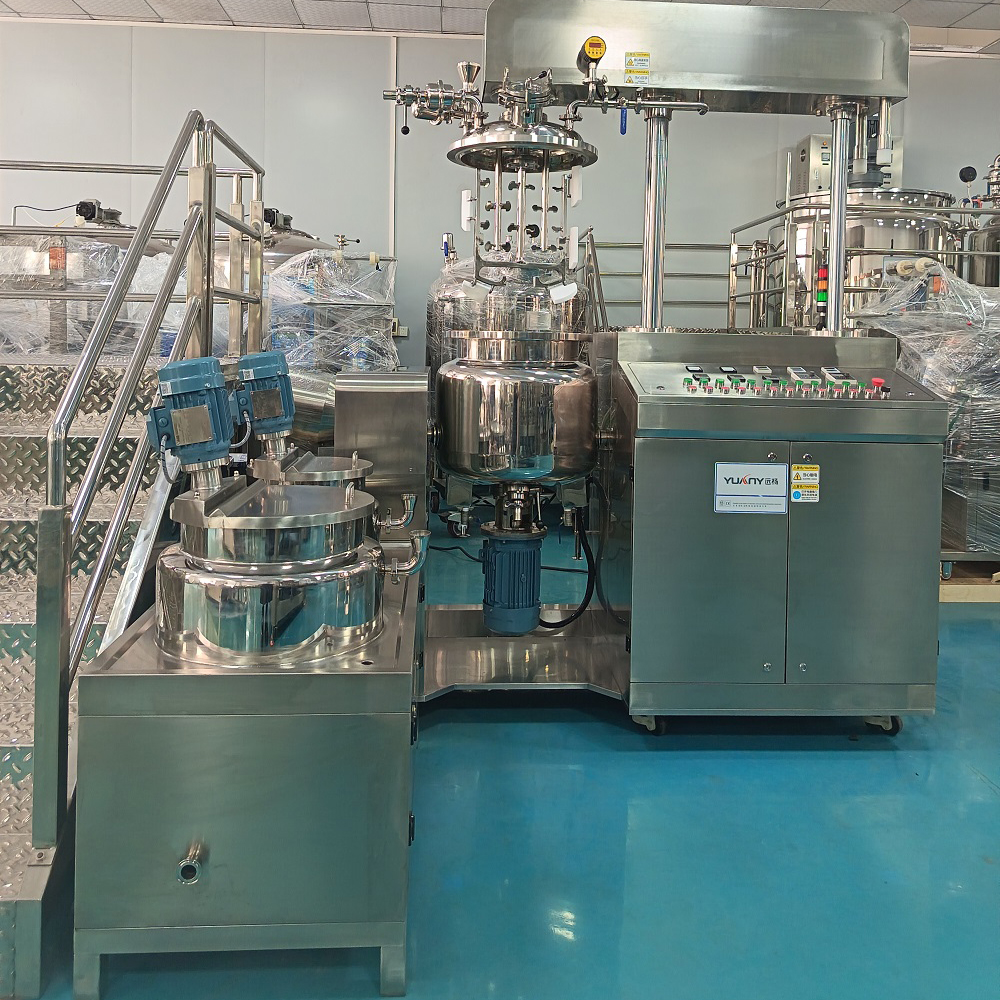
When evaluating a small-batch emulsifier, the 50L Hydraulic Lift Vacuum Emulsifier is designed specifically to bridge laboratory flexibility and production readiness. Below is the product overview and features as provided:
Yuanyang hydraulic lift vacuum emuslifier is a combined mixing equipment with a main vacuum homogenizer tank, a water tank, and an oil tank, which is an integrated equipment with a mixing, dispersing, homogenizing, emulsifying, vacuumizing and powder absorption system that is widely used in cosmetics, food, pharmaceutical, and chemical fields.
Features:
⦁ With a hydraulic lift lid & tilting pot, vacuum system, and electric control system.
⦁ Suitable for products of 10,000~50,000 cps viscosity.
⦁ Perfect particle size of 2 microns and evenly distributed.
This configuration is well-suited to small-batch producers because the 50L scale is large enough to produce several retail-sized batches but small enough for flexibility and quick changeovers. The integrated water and oil tanks increase efficiency by enabling parallel heating and metering, while the vacuum homogenizer core provides the particle size control expected in cosmetics and pharmaceutical formulations.
Performance metrics that matter: particle size, mixing time, and energy
For small-batch emulsifying machines, three measurable metrics often determine whether a machine fits your process:
- Target particle size: Smaller, consistent droplet sizes (for example, the 2 micron target advertised for the 50L model) improve emulsion stability, sensory feel, and visual appearance.
- Processing time: Fast emulsification reduces thermal exposure and cycle time. Rotor-stator designs typically produce target droplet sizes quickly for small volumes.
- Energy per batch: Efficient mixing reduces operating cost; for small-batch facilities, look for machines optimized for lower RPM or variable-speed drives to fine-tune energy delivery.
Below is a comparison table to help you evaluate common small-batch emulsification technologies. Sources listed in references explain the characteristics further.
| Technology | Best for | Typical particle size | Pros | Cons |
|---|---|---|---|---|
| Rotor-stator (high-shear) | Lotions, creams, pastes | 1-10 microns | Fast, compact, good for small batches | Limited to moderate viscosity ranges |
| High-pressure homogenizer | Emulsions needing very fine droplets | <1 micron possible | Very fine and uniform droplets | Higher capex and maintenance, less efficient for tiny batches |
| Ultrasonic | Specialized nano-emulsions | sub-micron to nano | Very fine emulsions | Scale-up complexity, heat generation |
Notes on the table
This comparison shows why an integrated vacuum homogenizer with rotor-stator technology, like the 50L Hydraulic Lift Vacuum Emulsifier, is often the best compromise for small-batch production: it delivers fine droplets (around 2 microns), operates efficiently for small volumes, and keeps maintenance and footprint manageable.
Material compatibility and GMP considerations for small-batch emulsifying machines
Regulated industries require specific material and surface standards. For cosmetics, pharmaceuticals, and food products, choose machines with 316L stainless steel wetted parts, mirror polish interior finishes, sanitary welds, and reliable seals that tolerate CIP. Vacuum capability should be compatible with your degassing requirements and be designed to prevent contamination during operation. Ensure the supplier can provide material certificates and, where needed, validation support to meet GMP expectations.
Operational considerations: cleaning, maintenance, and scale flexibility
Small-batch facilities often run many SKUs, so equipment must enable quick changeovers and low downtime. The 50L Hydraulic Lift Vacuum Emulsifier’s hydraulic lift lid and tilting pot minimize manual handling and make emptying and cleaning faster. Look for modular agitators, easy-access mechanical seals, and straightforward removal of the homogenizing head. Control systems with recipe storage reduce operator training and contamination risk. Routine maintenance needs to be predictable—confirm spare part availability and recommended service intervals with the vendor before purchase.
Cost versus value: evaluating purchase and operational return on investment
Buying an emulsifying machine is about total cost of ownership, not just purchase price. For small-batch operations, quantify the following when calculating ROI:
- Expected throughput and batch frequency
- Changeover and cleaning time saved by features like hydraulic lift and tilting pot
- Reduced product waste due to vacuum degassing and precise homogenization
- Energy consumption per batch and required utilities
- Downtime impact and service costs
Often, a mid-range machine with the right features (vacuum, good homogenization, easy cleaning) yields a better ROI for small-batch producers than the cheapest option that lacks process controls.
How to evaluate suppliers when you plan to buy an emulsifying machine
Supplier evaluation should focus on three things: technical fit, support infrastructure, and evidence of performance. Ask prospective suppliers for:
- Factory acceptance test reports and videos of similar SKU runs
- References from customers in your industry
- Spare parts lead times and local service capability
- Documentation: material certificates, wiring and control diagrams, and validation support
Arrange product trials where possible: provide your formulation and ask the supplier to run a trial so you can evaluate droplet size, texture, process time, and cleaning. This step is often decisive when choosing between seemingly similar emulsifying machines.
Yuanyang brand advantages for small-batch emulsifying machine buyers
When evaluating brands, consider three strengths Yuanyang brings for small-batch customers:
- Integrated small-batch design: The 50L Hydraulic Lift Vacuum Emulsifier integrates mixing, dispersing, homogenizing, vacuumizing and powder absorption systems, reducing the need for separate equipment.
- Operator-friendly features: Hydraulic lift lid and tilting pot, plus electric controls, make frequent changeovers and cleaning faster and safer.
- Product quality: The machine targets perfect particle size of 2 microns and supports viscosities between 10,000 and 50,000 cps, addressing many cosmetics and pharmaceutical small-batch needs.
Combined, these factors reduce hands-on time, improve repeatability, and help teams scale formulations from lab to production without wholesale equipment changes.
FAQ: Choosing and using an emulsifying machine for small batches
Q1: Is a 50L emulsifying machine too big for lab-scale work?
A1: It depends on your lab needs. A 50L machine is a common choice for pilot and small production runs because it can produce multiple retail units per batch while still being compact. For very small R&D-only work, benchtop 1-10L units may be preferable.
Q2: Can the 50L Hydraulic Lift Vacuum Emulsifier handle both low and high viscosity products?
A2: Yes. This model is specified for products of 10,000 to 50,000 cps viscosity. For formulations outside that range, consult the vendor for custom rotor-stator options or alternative homogenization heads.
Q3: How important is vacuum capability?
A3: Vacuum is important for removing entrained air and preventing oxidation or foam. It also helps prevent inclusion of bubbles that can spoil texture and shelf appeal, particularly in creams and some pharmaceutical suspensions.
Q4: What maintenance is typical for small-batch emulsifiers?
A4: Regularly inspect seals and mechanical gland packs, validate electrical and control systems, clean and polish wetted surfaces to prevent cross-contamination, and adhere to the supplier’s scheduled preventive maintenance plan. Keep spare seals and homogenizer head parts on hand to reduce downtime.
Q5: Can I scale up a formulation developed on a 50L emulsifier?
A5: Yes, provided you document processing parameters (shear profile, temperature ramps, vacuum level, and mixing times). Scale-up often requires geometric and dynamic similarity, but many manufacturers use a 50L as a pilot scale that translates well to larger commercial vessels with similar homogenizing head designs.
Contact us and view product
During equipment selection, many formulators compare technologies, so understanding vacuum emulsifier vs homogenizer: which suits your product helps avoid costly mismatches.If you are ready to evaluate or purchase an emulsifying machine for small batches, contact our sales team to schedule a trial run with your formulation or to request a quotation for the 50L Hydraulic Lift Vacuum Emulsifier. For product brochures, technical drawings, and factory acceptance documentation, ask for our data pack and service agreement options. Call or email our sales representatives, or request a demo at the factory. Our team can also advise ROI calculations and utility sizing for installation.
References
- Yuanyang product specifications and technical documentation for the 50L Hydraulic Lift Vacuum Emulsifier (manufacturer data).
- Journal of Dispersion Science and Technology, technical reviews on high-shear and homogenization technologies for emulsions.
- ASTM D2196, Standard Test Method for Rheological Properties of Non-Newtonian Materials by Rotational Viscometer, for viscosity measurement norms.
- U.S. Food and Drug Administration (FDA) guidance on cosmetics and manufacturing considerations, and general GMP principles for small-scale production environments.
How to start a semi auto labeling machine business in Europe
Everything You Need to Know About pharmaceutical filling machines
Grain Sieve Machine: Types, Uses & Selection Guide
How to Choose the plastic tube sealing machine manufacturer and supplier ?
High shear homogneizer
What’s the working principle of high shear homogenizer?
The shear mixer mainly through the high-speed relative rotation of the rotor and the stator to produce a strong shear force to achieve the refinement and homogenization of the material.
Sachet Packaging Machine for Granules
Is the sachet packing machine equipped with a feeder also?
The standard quote is not included with a feeder, but we can add a feeder especially for the bag packaging machine if client need.
Automatic powder feeder machine
Do you also supply powder or granules packing machine?
Yes,Yuany supplies different type of packing machines for powder, granules and liquids. Please contact customers services with details.
Liquid Mixing Tank
My products need specified paddle type to mixer,can you customize?
Yes,we can customized different mixing paddle type upon requirement. Just send your design to us to check.
Homogneizer mixer tank
Can I use city water to produce liquid detergent?
As you know, water takes 70-99% proportion of raw materials for liquid detergent production. So the quality of water is quite important to produce qualified liquid cleaning products. The raw water should be treated before taking into tank.
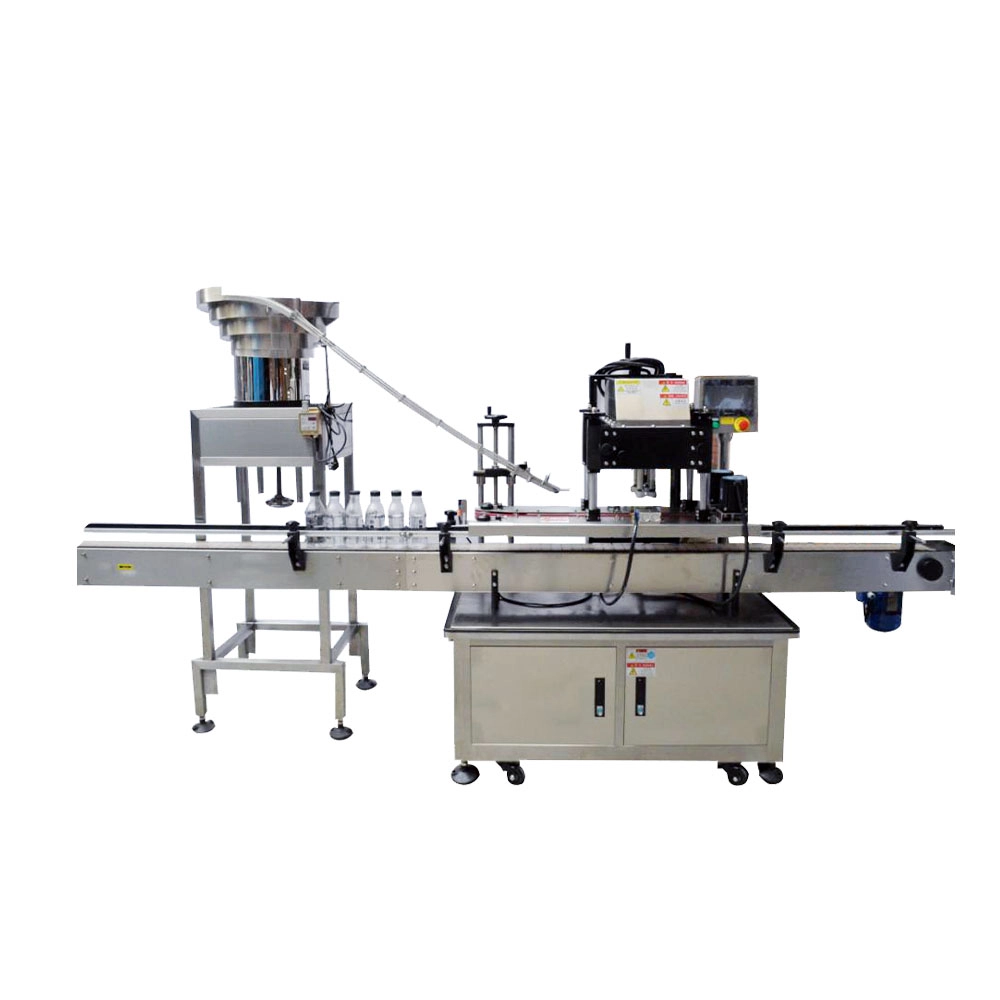
Automatic Plastic Caps Capping Machine with Vibrating Cap Feeder for Sale
Yuanyang automatic screw capping machine is a kind of four-wheel bottle capping machine. The automatic screw capper is often used to close lids of containers such as bottles and jars, especially for plastic bottles, which are widely used in food, medicine, chemical, cosmetic, and other industries for mass production and continuous production lines.
Features:
⦁ Full pneumatic drive;
⦁ Automated fast speed;
⦁ Suitable for various screw caps, pumps, and spray bottles.
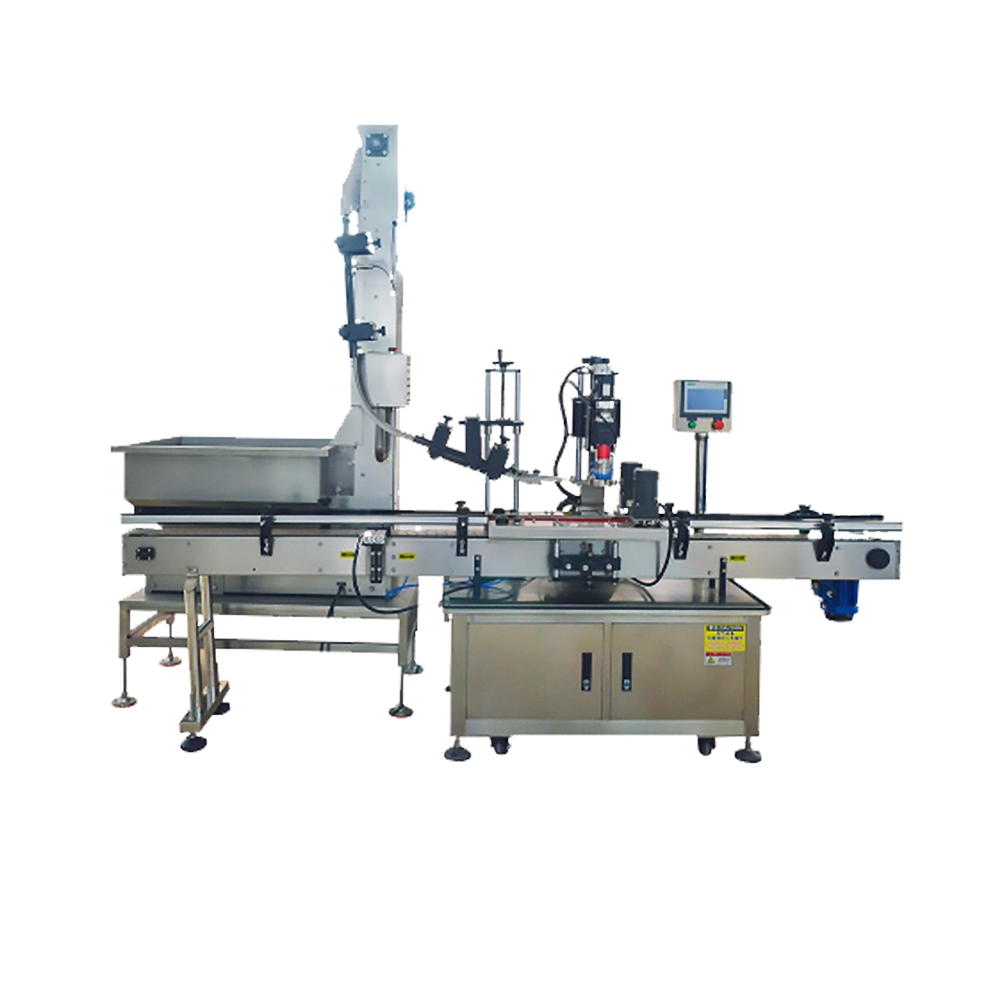
Automatic Metal Caps Capping Machine for Sale
Yuanyang automatic metal cap capping machine is a bottle capper for bottles with metal caps, which is often used to close lids of containers such as bottles and jars. The glass bottle metal capping machine is widely used in food, medicine, chemical, cosmetic, and other industries for mass production and continuous production line .
Features:
⦁ Pneumatic and electric drive;
⦁ Automated fast speed;
⦁ Suitable for glass bottles with metal caps.
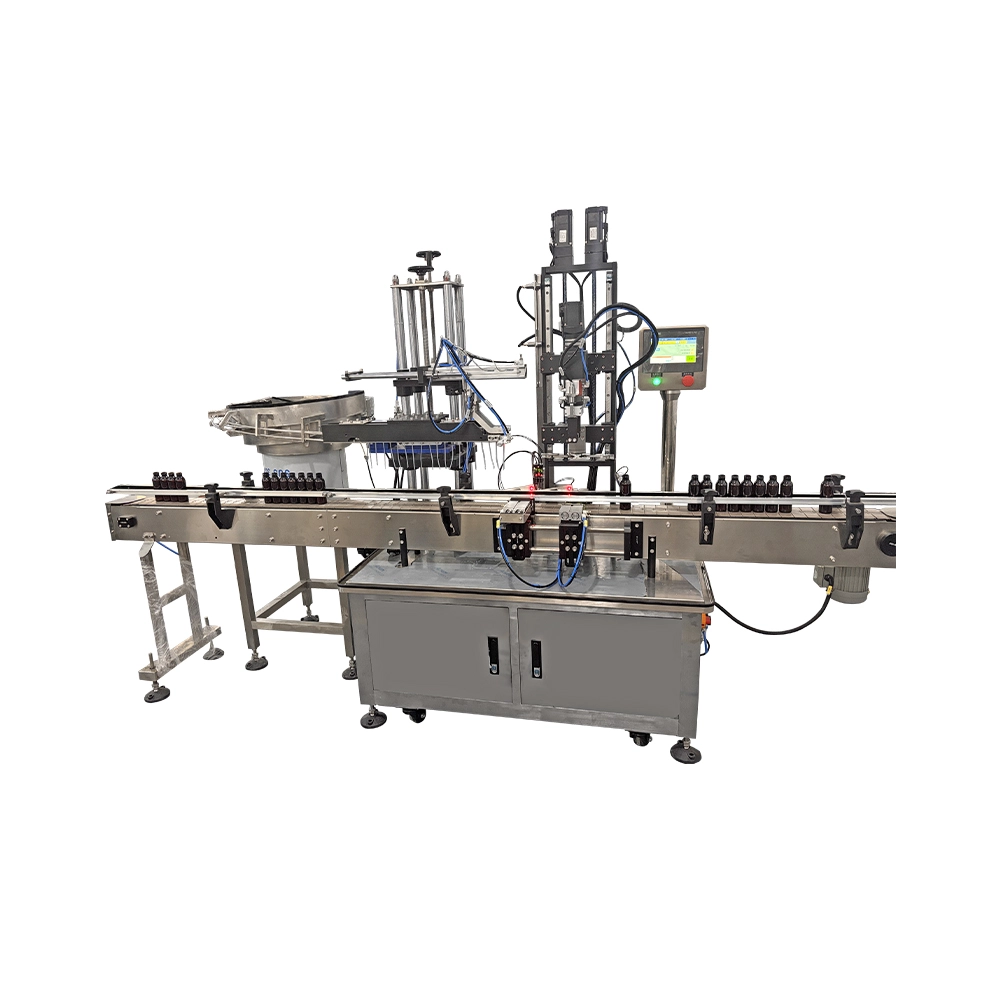
Automatic Pump Head Feeding and Capping Machine for Sale
Yuanyang automatic pump head feeding and capping machine is a bottle cap sorter and capper for bottles with pump heads, which is often used to close lids of containers such as nail polish, sprayers, and shampoo. The capping machine with a pump head feeder is widely used in food, medicine, chemical, cosmetic, and other industries for mass production and continuous production line .
Features:
⦁ Pneumatic and electric drive;
⦁ Automated fast speed;
⦁ Suitable for various types of caps.
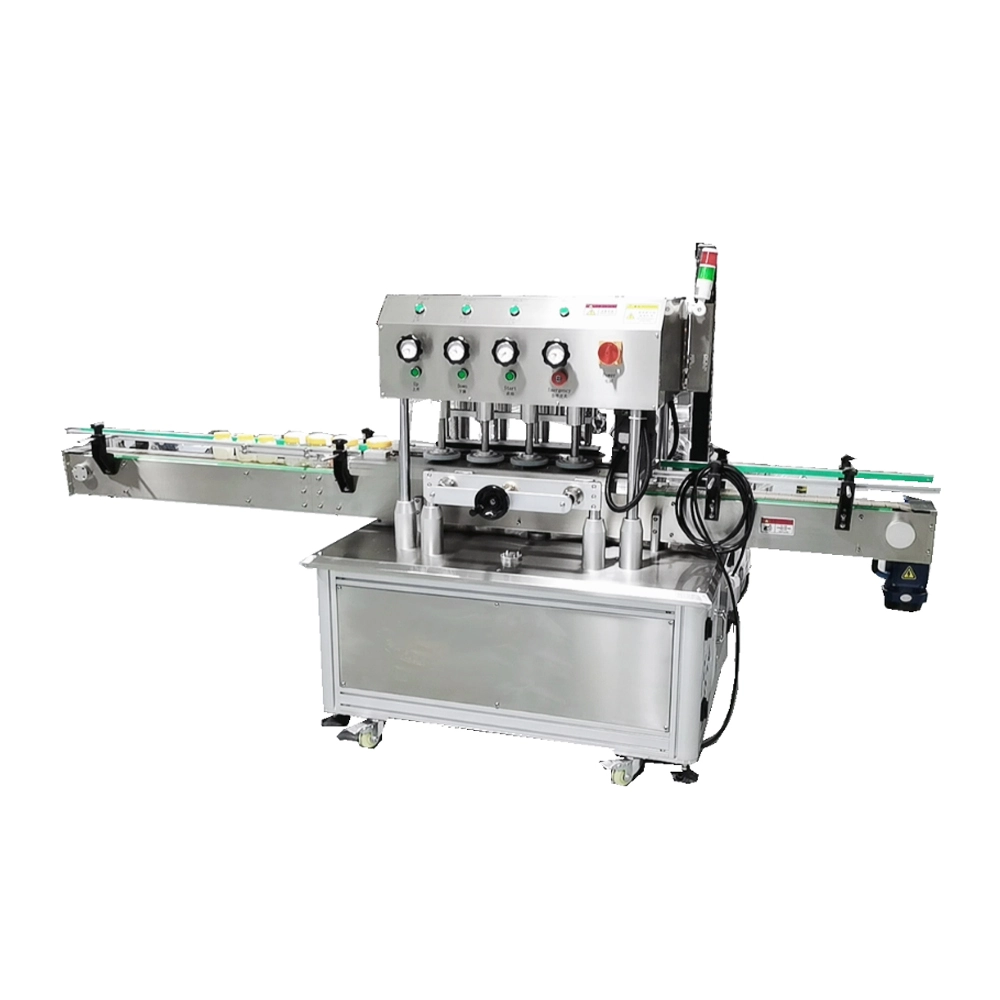
Automatic High Speed Capping Machine for Sale
The Yuanyang automatic high-speed capping machine is a kind of 8-wheel bottle-capping machine with fast working efficiency. The automatic capper is often used to close lids of containers such as bottles and jars, especially for plastic bottles, which are widely used in food, medicine, chemical, cosmetic, and other industries for mass production and continuous production lines.
Features:
⦁ Electric drive;
⦁ Automated fast speed;
⦁ Suitable for various screw caps, pumps, and spray bottles.
 Scan QR Code
Facebook
YouTube
LinkedIn
Whatsapp: +8613434139712
Guangzhou Yuanyang Machinery