





Vacuum Emulsifier vs Homogenizer: Which Suits Your Product?
- Vacuum Emulsifier vs Homogenizer: Which Suits Your Product?
- Why the right emulsifying machine matters
- How a Vacuum Emulsifier works — core principle of this emulsifying machine
- How a Homogenizer works — role as an emulsifying machine
- Key differences: Vacuum Emulsifier vs Homogenizer (emulsifying machine)
- Interpretation of the comparison for buyers of an emulsifying machine
- When to choose a Vacuum Emulsifier (emulsifying machine)
- When a Homogenizer is preferable (emulsifying machine)
- Operational considerations for selecting an emulsifying machine
- Scale and viscosity: match machine to product (emulsifying machine)
- Cleaning, validation and compliance for your emulsifying machine
- About the 50L Hydraulic Lift Vacuum Emulsifier — product overview
- How the 50L unit fits into production as an emulsifying machine
- Typical outputs and performance metrics (emulsifying machine)
- Maintenance, troubleshooting and lifecycle for an emulsifying machine
- Common trouble points and quick fixes (emulsifying machine)
- Cost, ROI and procurement tips for an emulsifying machine
- Procurement checklist for selecting an emulsifying machine
- Brand strengths: Why consider Yuanyang for your emulsifying machine needs
- FAQ — Frequently Asked Questions about Vacuum Emulsifier vs Homogenizer (emulsifying machine)
- Contact / View Product — get expert help selecting your emulsifying machine
- Authoritative references and further reading
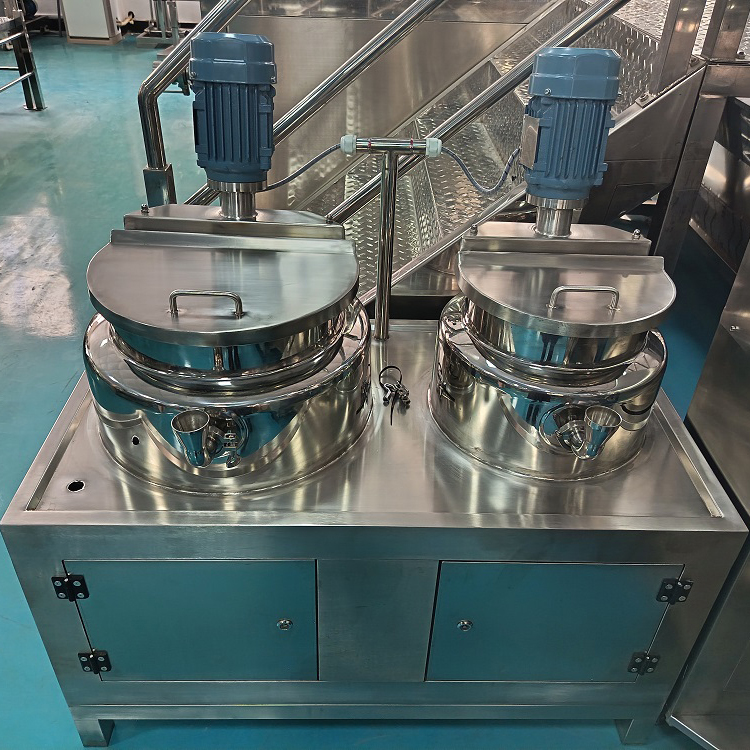
Vacuum Emulsifier vs Homogenizer: Which Suits Your Product?
Why the right emulsifying machine matters
Choosing the correct emulsifying machine affects product stability, texture, safety and manufacturing cost. Whether you produce creams, sauces, suspensions or pharmaceutical ointments, a mismatch between process equipment and formulation often leads to poor particle distribution, air entrapment, contamination risk and higher rework. This article provides a practical comparison between vacuum emulsifiers and homogenizers and explains when each emulsifying machine is the better fit for your product. After selecting the appropriate system, process consistency depends heavily on settings—this is where optimizing emulsification parameters for stable emulsions becomes essential.
How a Vacuum Emulsifier works — core principle of this emulsifying machine
A vacuum emulsifier is an integrated mixing system that combines heating/cooling, high-shear dispersion, homogenization and vacuum deaeration in one unit. The vessel usually has an agitator for bulk mixing and a high-speed rotor–stator homogenizing head connected to the tank. Under vacuum, the system draws ingredients and powders into the liquid phase while removing trapped air. The vacuum environment also helps prevent oxidation and microbial contamination during processing. As an emulsifying machine, vacuum emulsifiers excel at producing stable emulsions and smooth textures for creams, lotions and food spreads.
How a Homogenizer works — role as an emulsifying machine
Homogenizers are designed primarily to reduce particle size and produce uniform dispersions by forcing product through narrow gaps at high shear or high pressure (in high-pressure homogenizers). The core function of a homogenizer as an emulsifying machine is to break droplets or particles into much smaller sizes to stabilize emulsions or suspensions. Homogenizers are widely used in dairy, beverage, pharmaceutical and chemical industries where particle size control is paramount.
Key differences: Vacuum Emulsifier vs Homogenizer (emulsifying machine)
Below is a concise comparison table highlighting practical differences you should consider when selecting an emulsifying machine for your process.
| Criteria | Vacuum Emulsifier | Homogenizer |
|---|---|---|
| Primary function | Mixing + emulsifying + vacuum deaeration + heating/cooling | Particle/droplet size reduction and uniform dispersion |
| Typical applications | Cosmetics, creams, ointments, lotions, gels, food spreads | Dairy, beverages, pharma suspensions, nano emulsions |
| Best for | Air-free, smooth, stable emulsions & powder incorporation | Achieving sub-micron droplets and narrow particle-size distribution |
| Particle size capability | Typically down to ~1–5 microns depending on homogenizing head | Can reach <2 microns (high-pressure systems often <1 micron) |
| Vacuum capability | Built-in — removes entrained air and gases | Usually none — may be paired with vacuum vessels upstream |
| Powder handling | Designed to absorb powders under vacuum effectively | Not ideal for powder incorporation without special feeders |
| Complexity & footprint | Integrated system — medium footprint, multi-functional | May be compact for bench models or large for high-pressure units |
| Cost considerations | Higher initial cost for integrated features but saves process steps | Cost depends on pressure rating and capacity; high-pressure units pricier |
Interpretation of the comparison for buyers of an emulsifying machine
If your product requires powder absorption, deaeration, controlled heating/cooling and a smooth final texture, a vacuum emulsifier as your emulsifying machine is typically the best fit. If the primary goal is extreme particle-size reduction to stabilize nano- or sub-micron emulsions, a dedicated high-pressure homogenizer may be required — sometimes used in tandem with a vacuum emulsifier.
When to choose a Vacuum Emulsifier (emulsifying machine)
Opt for a vacuum emulsifier when your product or process includes one or more of the following: sensitive ingredients prone to oxidation, powder charging, products that must be air-free (cosmetics, creams), or when you need a single integrated unit to combine mixing, heating/cooling, homogenizing and vacuum deaeration. A vacuum emulsifier reduces process steps and cross-contamination risk by doing multiple processes in one vessel.
When a Homogenizer is preferable (emulsifying machine)
Choose a homogenizer when your main objective is to achieve very small droplet or particle sizes for improved stability, mouthfeel or absorption — typical for pharmaceutical suspensions, beverages and some food emulsions. High-pressure homogenizers and microfluidizers can produce very narrow particle size distributions that a standard vacuum emulsifier may not reach without a specialized homogenizing head.
Operational considerations for selecting an emulsifying machine
Selecting the right emulsifying machine requires evaluating production scale, viscosity range, batch vs continuous process, CIP (clean-in-place) needs, material contact surface finish, and regulatory requirements. Viscosity capability matters: many vacuum emulsifiers handle products in the 10,000–50,000 cps range — a common target for creams and ointments — so make sure the machine you consider matches your product rheology.
Scale and viscosity: match machine to product (emulsifying machine)
Small R&D batches may be served by lab-scale homogenizers or mini vacuum emulsifiers. For production, check the emulsifying machine's capacity and torque: high-viscosity products require stronger agitators and more robust homogenizing heads. The 50L Hydraulic Lift Vacuum Emulsifier is designed for mid-scale manufacturing and suits viscosities between 10,000 and 50,000 cps.
Cleaning, validation and compliance for your emulsifying machine
For food and pharma applications, ease of cleaning and documentation for validation are critical. Choose an emulsifying machine with sanitary design (smooth welds, drainability), CIP capability if required, and material certificates (e.g., 316L stainless steel contact parts). Vacuum operation also reduces contamination risk because powder and liquids are introduced under controlled conditions.
About the 50L Hydraulic Lift Vacuum Emulsifier — product overview
Below is the product description for the 50L Hydraulic Lift Vacuum Emulsifier that demonstrates a real-world emulsifying machine option for mid-scale production:
Yuanyang hydraulic lift vacuum emuslifier is a combined mixing equipment with a main vacuum homogenizer tank, a water tank, and an oil tank, which is an integrated equipment with a mixing, dispersing, homogenizing, emulsifying, vacuumizing and powder absorption system that is widely used in cosmetics, food, pharmaceutical, and chemical fields.
Features:
⦁ With a hydraulic lift lid & tilting pot, vacuum system, and electric control system.
⦁ Suitable for products of 10,000~50,000 cps viscosity.
⦁ Perfect particle size of 2 microns and evenly distributed.
How the 50L unit fits into production as an emulsifying machine
The 50L Hydraulic Lift Vacuum Emulsifier is positioned for mid-scale manufacturers who need one integrated emulsifying machine for R&D to pilot-to-production scaling. The hydraulic lid and tilting pot simplify loading and discharge. The vacuum system and powder absorption capability are especially valuable for cosmetic creams and pharma ointments where air entrainment and powder dispersion must be controlled.
Typical outputs and performance metrics (emulsifying machine)
In practice, expect uniform particle sizes around 2 microns with well-controlled process parameters. The unit's design supports viscosities in the 10,000–50,000 cps window, making it suitable for many creams, gels and pastes. Cycle times depend on formulation and heating/cooling demands but integrating multiple functions into a single emulsifying machine often reduces total processing time compared to separate steps.
Maintenance, troubleshooting and lifecycle for an emulsifying machine
Planned maintenance increases uptime and extends the usable life of any emulsifying machine. Key routines include checking seals and vacuum lines, lubricating hydraulic and mechanical parts, inspecting rotor–stator wear, verifying temperature control accuracy and keeping homogenizing heads within tolerance for particle-size performance. Proper spare parts inventory (seals, bearings, gaskets, homogenizing stators) reduces downtime.
Common trouble points and quick fixes (emulsifying machine)
Typical issues include loss of vacuum (check leaks and seals), increased particle size (inspect homogenizer wear), overheating (check cooling jacket and sensors), and inconsistent powder incorporation (confirm vacuum suction and powder feed settings). Documenting process parameters when the product is successful helps speed troubleshooting.
Cost, ROI and procurement tips for an emulsifying machine
When evaluating cost, consider total cost of ownership: equipment price, utilities (power, vacuum), spare parts, labour, cleaning time and regulatory compliance. Because vacuum emulsifiers combine multiple steps, they can reduce labor and contamination risk and shorten the production footprint, often improving ROI despite higher capital costs compared to a basic mixer plus separate homogenizer.
Procurement checklist for selecting an emulsifying machine
- Confirm viscosity and batch size compatibility with machine specs.
- Verify vacuum performance and powder feed design if powder handling is required.
- Request particle-size reports or case studies showing the claimed micron performance.
- Check sanitary design, materials (316L), and certification relevant to your market.
- Confirm after-sales support, spare parts availability and local service capability.
Brand strengths: Why consider Yuanyang for your emulsifying machine needs
Yuanyang's experience in combined vacuum emulsifying machines offers mid-scale manufacturers a reliable integrated solution. Key advantages include hydraulic lifting and tilting for safer handling, built-in vacuum and powder absorption for clean product introduction, and homogenization capability tuned to achieve ~2 microns particle size — a practical target for many cosmetic and pharmaceutical emulsions. For organizations seeking to reduce process complexity while maintaining product quality, such an emulsifying machine can be a compelling option.
FAQ — Frequently Asked Questions about Vacuum Emulsifier vs Homogenizer (emulsifying machine)
Q1: Can a vacuum emulsifier replace a homogenizer?
A1: It depends on your particle size target. For many cosmetic and pharmaceutical creams requiring 1–5 micron droplets, a vacuum emulsifier with a capable homogenizing head can be sufficient. For ultra-fine sub-micron or nano-emulsions, a dedicated high-pressure homogenizer may still be necessary.
Q2: Is vacuum necessary for all emulsifying processes?
A2: No. Vacuum is essential when you need to remove entrained air, prevent oxidation or incorporate powders cleanly. If your formulation tolerates air and powder handling is not required, a non-vacuum homogenizer may suffice.
Q3: What maintenance does the 50L Hydraulic Lift Vacuum Emulsifier require?
A3: Routine maintenance includes inspecting seals and vacuum lines, keeping hydraulic systems serviced, checking homogenizer rotor/stator wear, and verifying temperature and vacuum sensors. Maintain spare parts for wear components.
Q4: Can I scale up from the 50L unit?
A4: Yes. Design your formulation and process parameters on the 50L as pilot data; most manufacturers offer larger-scale vacuum emulsifiers with similar design principles to support scale-up.
Q5: What industries benefit most from vacuum emulsifying machines?
A5: Cosmetics, food products (spreads, sauces), pharmaceuticals (topicals), and specialty chemicals that require stable emulsions, controlled particle size and clean powder incorporation.
Contact / View Product — get expert help selecting your emulsifying machine
If you are evaluating emulsifying machines for your production line, contact our sales team for a specification sheet, process consultation, or to arrange a pilot trial with the 50L Hydraulic Lift Vacuum Emulsifier. Our technical experts can help match equipment to your formulation and production goals.
Authoritative references and further reading
- Emulsifier — Wikipedia: https://en.wikipedia.org/wiki/Emulsifier
- Homogenizer — Wikipedia: https://en.wikipedia.org/wiki/Homogenizer
- Emulsion — Wikipedia: https://en.wikipedia.org/wiki/Emulsion
- High-shear mixer — Wikipedia: https://en.wikipedia.org/wiki/High-shear_mixer
- U.S. FDA — Cosmetics: https://www.fda.gov/cosmetics
- International Council for Harmonisation (ICH) — Quality Guidelines: https://www.ich.org/page/quality-guidelines
- European Commission — Cosmetics: https://ec.europa.eu/health/cosmetics/overview_en
How to start the china dispersing machine manufacturer business ?

Sanitation and CIP Strategies for Stainless Steel Mixing Tanks
Top Applications of Homogenizer Mixers in Food and Pharma
Tips for buy pharmaceutical powder mixer
Homogneizer mixer tank
Do you supply a complete set of liquid soap production line?
Yes, we supply the complete set of liquid soap production line, such as water treatment, liquid soap making machine, transfer pumps, storage tanks, filling machine, capping machine, sealing machine and labeling machine, and coding machine.
Water Filling Machine
Does it have counting function?
On the desktop filling machine, there is counter displaying how many bottles have been filled.
FAQs
What’s the guarantee if we purchase from you?
All the equipment ordered from us will be provided with 2 years guarantee from the delivery date. If there is any wearing part broken within the warranty and isn’t caused by improper operation, we would offer the new parts for free.
Portable Storage Tank
Can you make the leg longer, I need a higher discharge outlet?
Yes, the tank legs length is customized as well as the discharge outlet height.
Single Layer Agitator Tank
What capacity do you provide for the mixing tank with agitator?
The steel tank with agitator has different capacity from 50L to 5000L.
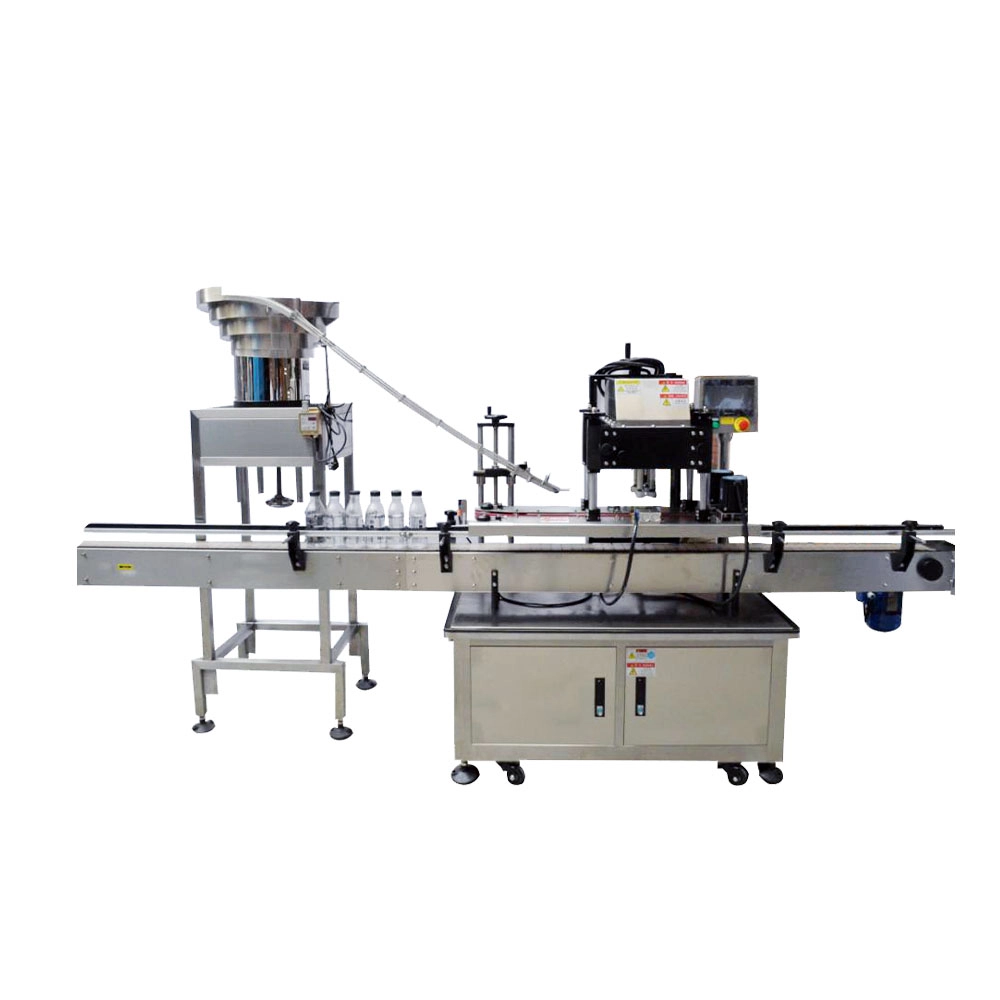
Automatic Plastic Caps Capping Machine with Vibrating Cap Feeder for Sale
Yuanyang automatic screw capping machine is a kind of four-wheel bottle capping machine. The automatic screw capper is often used to close lids of containers such as bottles and jars, especially for plastic bottles, which are widely used in food, medicine, chemical, cosmetic, and other industries for mass production and continuous production lines.
Features:
⦁ Full pneumatic drive;
⦁ Automated fast speed;
⦁ Suitable for various screw caps, pumps, and spray bottles.
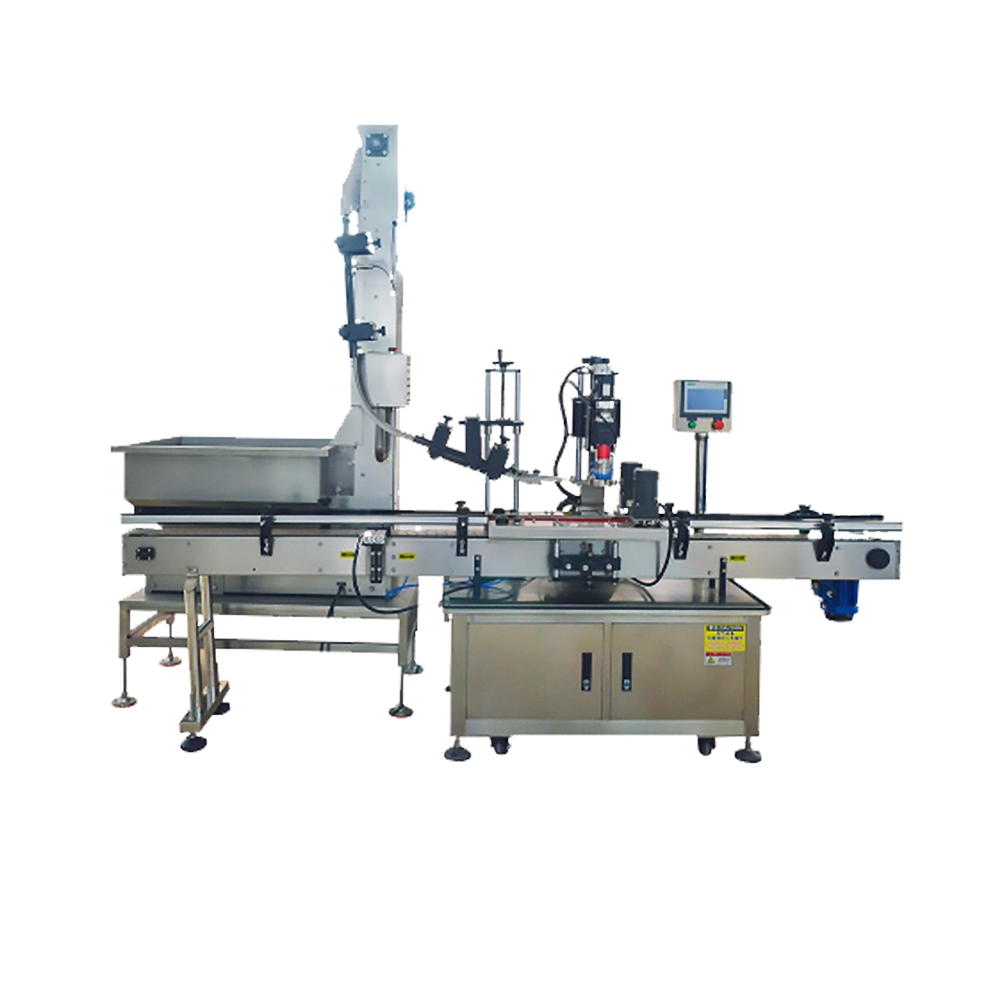
Automatic Metal Caps Capping Machine for Sale
Yuanyang automatic metal cap capping machine is a bottle capper for bottles with metal caps, which is often used to close lids of containers such as bottles and jars. The glass bottle metal capping machine is widely used in food, medicine, chemical, cosmetic, and other industries for mass production and continuous production line .
Features:
⦁ Pneumatic and electric drive;
⦁ Automated fast speed;
⦁ Suitable for glass bottles with metal caps.
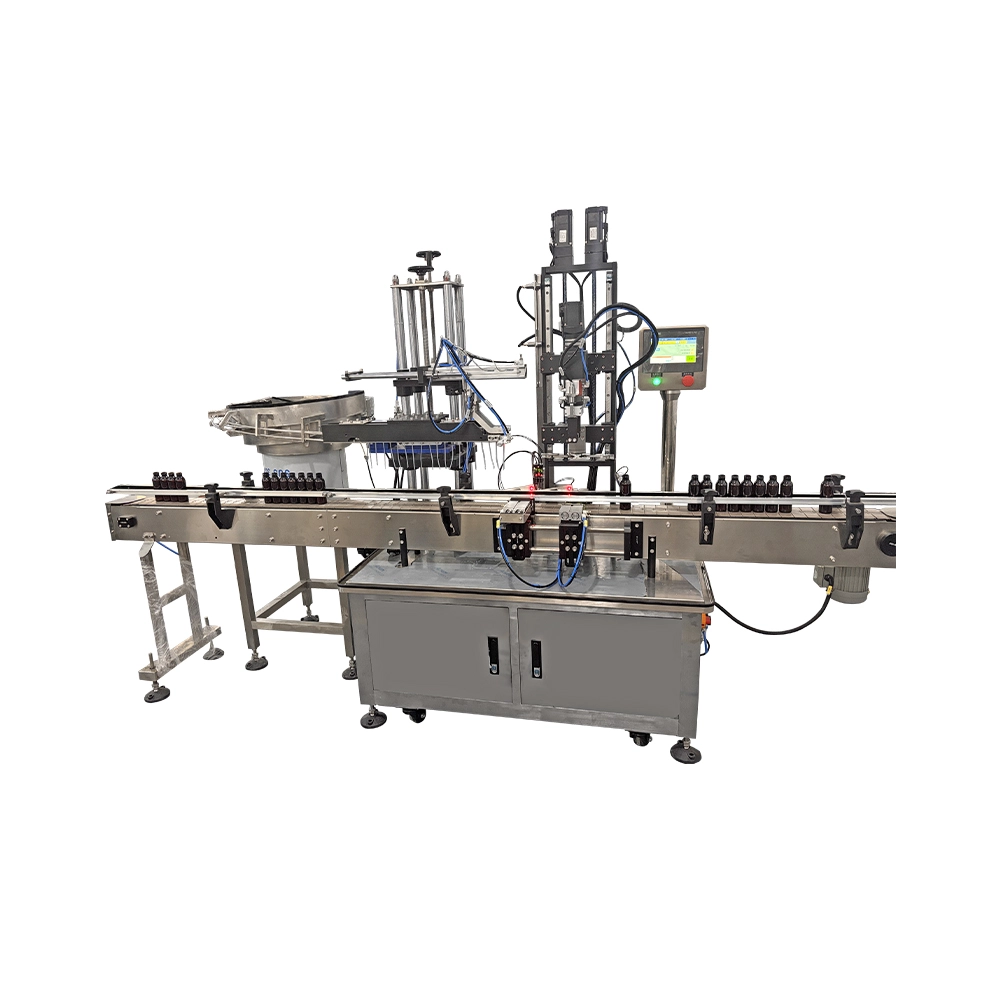
Automatic Pump Head Feeding and Capping Machine for Sale
Yuanyang automatic pump head feeding and capping machine is a bottle cap sorter and capper for bottles with pump heads, which is often used to close lids of containers such as nail polish, sprayers, and shampoo. The capping machine with a pump head feeder is widely used in food, medicine, chemical, cosmetic, and other industries for mass production and continuous production line .
Features:
⦁ Pneumatic and electric drive;
⦁ Automated fast speed;
⦁ Suitable for various types of caps.
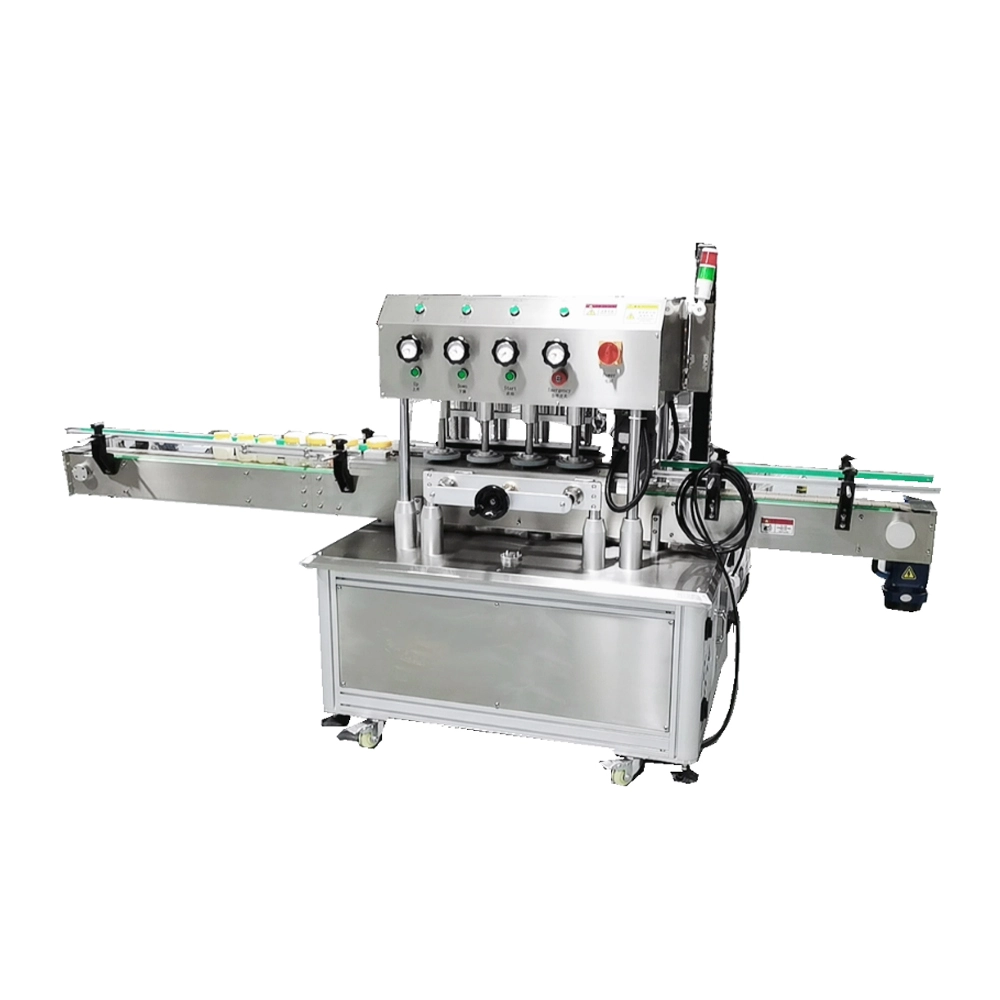
Automatic High Speed Capping Machine for Sale
The Yuanyang automatic high-speed capping machine is a kind of 8-wheel bottle-capping machine with fast working efficiency. The automatic capper is often used to close lids of containers such as bottles and jars, especially for plastic bottles, which are widely used in food, medicine, chemical, cosmetic, and other industries for mass production and continuous production lines.
Features:
⦁ Electric drive;
⦁ Automated fast speed;
⦁ Suitable for various screw caps, pumps, and spray bottles.
 Scan QR Code
Facebook
YouTube
LinkedIn
Whatsapp: +8613434139712
Guangzhou Yuanyang Machinery