





ROI and Lifecycle Cost Analysis for Liquid Soap Mixer Machines
- ROI and Lifecycle Cost Analysis for Liquid Soap Mixer Machines
- Introduction: Why ROI and Lifecycle Cost Matter for Liquid Soap Production
- Product Overview — Liquid Soap Mixer Machine for Sale
- Key Cost Components to Include in Lifecycle Analysis (TCO)
- Why Homogenizer Mixer Technology Changes the Equation
- Quantifying Benefits: Metrics to Track
- Simple ROI Formulas You Can Use
- Example Comparative Scenario: Conventional Mixer vs Homogenizer Mixer
- Interpreting the Example Numbers
- Example ROI Calculation (5-Year Horizon)
- Scenario A: Maintain Sales — Replace to Reduce Waste
- Scenario B: Expand Production — Monetize Higher Throughput
- Sensitivity and Risk Considerations
- Maintenance, Spare Parts, and Service Agreements
- Operational and Quality Benefits That Improve ROI (Beyond Direct Cost Savings)
- Decision Checklist: Selecting a Liquid Soap Homogenizer Mixer
- Yuanyang Brand Advantages and How They Affect Total Cost
- Practical Steps to Validate ROI Before Purchase
- Conclusion — Making Data-Driven Investments in Homogenizer Mixer Technology
- Frequently Asked Questions (FAQ)
- Q1: What is the typical payback period for a homogenizer mixer?
- Q2: Does a homogenizer mixer increase energy consumption?
- Q3: How much raw material saving can I expect?
- Q4: What maintenance is required for the homogenizer bottom stage?
- Q5: Is the Yuanyang mixer suitable for hand sanitizer and antibacterial products?
- Contact & Product CTA
- Authoritative References & Further Reading

ROI and Lifecycle Cost Analysis for Liquid Soap Mixer Machines
Introduction: Why ROI and Lifecycle Cost Matter for Liquid Soap Production
Choosing the right mixing equipment is one of the most important capital decisions for a liquid soap, shampoo, or detergent manufacturer. Beyond the purchase price, production managers must evaluate operating costs, product quality gains, downtime risk, and the equipment's expected lifetime. This article explains how to evaluate ROI and lifecycle costs for homogenizer mixer systems, with concrete examples and an applied case for the Yuanyang product offering.
Product Overview — Liquid Soap Mixer Machine for Sale
The Yuanyang liquid soap mixer machine is an industrial homogeneous mixer for liquid soap production. The mixer machine is mainly designed to produce such liquid products as shampoo, body wash, laundry detergent, dish soap, hand sanitizer and other thick liquids.
Features:
⦁ Flat top, half-open lid, electric control system.
⦁ Suitable for various liquid cleaning products and sauces.
⦁ PTFE wall scrapers stirring at top, high shear homogenizer at bottom.
Key Cost Components to Include in Lifecycle Analysis (TCO)
To calculate total cost of ownership (TCO) and ROI, include these components:
- Capital expenditure (CAPEX): purchase price, delivery, installation, commissioning, and site modifications.
- Operating expenditure (OPEX): energy consumption (kW), utilities (water/steam), raw material usage, cleaning chemicals, packaging impacts due to product quality.
- Maintenance and spare parts: preventive maintenance labor, mechanical seals, blades, homogenizer rotor/stator replacements, bearings.
- Downtime and reliability costs: lost production, expedited shipping, overtime.
- Training and control systems: PLC programming, operator training, process validation costs.
- Residual or salvage value at end of useful life.
Why Homogenizer Mixer Technology Changes the Equation
“Homogenizer mixer” systems combine high-shear homogenization at the bottom of the vessel with top scrapers and effective heat control. The technology impacts lifecycle cost and ROI in several ways:
- Improved product stability and uniformity, reducing rejects and rework.
- Higher yields and possible raw material savings due to better dispersion of active ingredients and thickeners.
- Shorter mixing cycles at target viscosity, increasing throughput.
- Potential for more efficient cleaning (reduced batching for cleanup & cross-contamination risk) when designed hygienically.
- Often higher initial CAPEX but lower effective cost per produced unit over time.
Quantifying Benefits: Metrics to Track
When building ROI models, track these measurable KPIs:
- Cycle time (minutes per batch)
- Yield rate (kg of saleable product per kg of raw material)
- Energy per batch (kWh)
- Maintenance hours (hours/month) and spare parts cost
- Reject rate (%) and rework costs
- Throughput (kg/day)
Simple ROI Formulas You Can Use
Core formulas applied in this
- Net Benefit over period = (Annual savings + incremental annual revenue) - incremental annual operating cost
- ROI (%) = (Net Benefit over period / Initial incremental investment) × 100
- Payback Period (years) = Initial incremental investment / Annual net cash flow
- TCO = CAPEX + Sum(Annual OPEX over useful life) - Salvage value
Example Comparative Scenario: Conventional Mixer vs Homogenizer Mixer
Below is a realistic example illustrating how to run numbers. Figures are representative—use your facility's actual data for procurement decisions.
| Item | Conventional Mixer | Homogenizer Mixer (Yuanyang) |
|---|---|---|
| Purchase Price (CAPEX) | $50,000 | $80,000 |
| Useful life (years) | 10 | 12 |
| Batch time (min) | 120 | 90 |
| Throughput (kg/day) | 4,800 | 6,400 |
| Energy per batch (kWh) | 40 | 45 |
| Reject rate | 3% | 0.8% |
| Raw material saving from better mixing | 0% | 1.5% |
| Annual maintenance & spares | $6,000 | $7,500 |
Interpreting the Example Numbers
Explanation and assumptions:
- Manufacturer produces 2 batches/day × 300 days = 600 batches/year.
- Average batch size assumed consistent; throughput differences come from shorter cycle times for homogenizer mixer.
- Raw material cost: $2.50/kg. Annual raw material usage improves with homogenization.
- Revenue improvements reflect increased sellable kg and lower reject rates.
Example ROI Calculation (5-Year Horizon)
Using the table's representative values, calculate a simplified 5-year ROI for switching to the Yuanyang homogenizer mixer.
| Item | Conventional | Homogenizer (Yuanyang) |
|---|---|---|
| Annual throughput (kg) | 4,800 × 300/ (4,800 daily is already daily) — use earlier throughput: 4,800/day × 300 days = 1,440,000 kg | 6,400/day × 300 days = 1,920,000 kg |
| Sellable output after rejects (kg) | 1,440,000 × (1 - 0.03) = 1,396,800 | 1,920,000 × (1 - 0.008) = 1,904,640 |
| Raw material cost (annual) | $2.50 × 1,440,000 = $3,600,000 | $2.50 × (1,920,000 × (1 - 0.015 raw saving)) = $2.50 × 1,891,200 = $4,728,000 |
| Annual energy cost (kWh × $0.10) | 600 batches × 40 kWh = 24,000 kWh × $0.10 = $2,400 | 600 batches × 45 kWh = 27,000 kWh × $0.10 = $2,700 |
| Annual maintenance | $6,000 | $7,500 |
Note: Because the homogenizer increases throughput, annual raw-material spend rises in absolute terms unless the business uses the extra capacity to increase sales. Therefore, when evaluating ROI, compare profit on increased production or use savings against the incremental investment. Below we model the scenario where the manufacturer maintains current sales and uses homogenizer benefits to reduce raw-material use and rejects or alternatively expands sales using higher throughput.
Scenario A: Maintain Sales — Replace to Reduce Waste
If the plant keeps annual sellable output fixed at ~1,396,800 kg and uses the homogenizer's improved yield to reduce raw material purchases, then:
- Required input with homogenizer to get 1,396,800 kg sellable = 1,396,800 / (1 - 0.008) ≈ 1,407,000 kg
- Raw material cost = 1,407,000 × $2.50 = $3,517,500 (savings vs $3.6M conventional = $82,500/yr)
- Energy and maintenance increase modestly ($300 + $1,500) = $1,800 extra
- Net annual operating savings ≈ $80,700
Incremental investment = $30,000. Payback ≈ $30,000 / $80,700 ≈ 0.37 years (~4.5 months). ROI over 5 years very strong in this simplified model.
Scenario B: Expand Production — Monetize Higher Throughput
If the manufacturer uses the homogenizer's greater throughput to sell more product, the added revenue matters. Example:
- Additional sellable product = 1,904,640 - 1,396,800 = 507,840 kg
- Assume gross margin $0.30/kg on finished product: additional annual gross profit ≈ $152,352
- Additional costs (packaging, distribution) reduce net; assume net incremental cash flow $100,000/yr
- Payback on $30,000 incremental investment = 0.3 years
Either way, improved product consistency and fewer complaints often justify High Quality pricing, stronger customer retention, and lower marketing costs — factors that can be hard to quantify but meaningful to ROI.
Sensitivity and Risk Considerations
When projecting ROI, run sensitivity analysis on the variables that matter most:
- Reject rate improvements (how certain are your assumed reductions?)
- Raw-material savings percentage
- Energy price per kWh
- Maintenance cost volatility and parts lead times
- Demand assumptions if you plan to increase production
Include a 10–20% contingency in financial projections for unexpected downtime, installation delays, or slower-than-expected process optimization.
Maintenance, Spare Parts, and Service Agreements
Lifecycle cost often depends on access to fast service and affordable spares. Evaluate suppliers on:
- Mean time to repair (MTTR) and availability of critical spares (rotor/stator, seals)
- Local vs remote service options and training availability
- Availability of preventive maintenance schedules and parts kits
- Options for extended warranties and service contracts
Operational and Quality Benefits That Improve ROI (Beyond Direct Cost Savings)
Homogenizer mixers like the Yuanyang unit can improve ROI through intangible but real benefits:
- Consistent viscosity and texture, enabling High Quality positioning and reduced customer complaints.
- Faster scale-up from R&D to production thanks to predictable mixing performance.
- Better incorporation of active ingredients (e.g., antimicrobial agents in hand sanitizer), improving product efficacy.
- Reduced need for corrective additives (thickeners, stabilizers), lowering formulation complexity.
Decision Checklist: Selecting a Liquid Soap Homogenizer Mixer
When evaluating machines, consider:
- Does the machine provide the target throughput with margin for growth?
- Is the homogenizer compatible with your formulations (abrasiveness, solids content, shear sensitivity)?
- Are hygienic design and cleanability (CIP) adequate for your product safety requirements?
- What are the real-world maintenance costs and part lifetimes?
- Does supplier offer local service, spare parts, and operator training?
- How does the machine integrate with your control systems and production line?
Yuanyang Brand Advantages and How They Affect Total Cost
Choosing a supplier matters. The Yuanyang Liquid Soap Mixer Machine for Sale offers features designed to reduce lifecycle cost and improve ROI:
- Integrated high-shear homogenizer at the vessel bottom for consistent dispersion and reduced rejects.
- PTFE wall scrapers reduce product buildup and minimize cleaning time — lowering downtime and cleaning chemical use.
- Flat top and half-open lid design simplifies access for inspection and maintenance, reducing labor time on service tasks.
- Electric control system compatible with modern PLCs for repeatable recipes and easy process validation.
- Robust design and materials aimed at a long useful life (improved salvage value and lower lifecycle cost).
These design choices directly affect operating costs and reliability, often delivering payback within a year in practical scenarios (as demonstrated in example calculations), depending on application and utilization.
Practical Steps to Validate ROI Before Purchase
1) Run pilot trials or request sample testing with your exact formulation. Quantify cycle time, energy, and reject rate changes.
2) Collect historical production KPIs and simulate the new machine’s performance using conservative assumptions.
3) Ask suppliers for references with similar products and confirm their uptime, parts lead time, and achieved savings.
4) Include installation, training, and start-up support costs in your CAPEX.
5) Create a 3–5 year TCO model with sensitivity ranges to capture upside and downside scenarios.
Conclusion — Making Data-Driven Investments in Homogenizer Mixer Technology
Homogenizer mixer systems typically have higher upfront costs than basic agitators, but their influence on yield, cycle time, product quality, and downtime often produces substantial lifecycle savings and attractive ROI. Using conservative, evidence-based assumptions and supplier-provided pilot data is key. For many liquid soap and personal-care manufacturers, the Yuanyang Liquid Soap Mixer Machine for Sale represents a balanced option with features aimed at reducing operating costs and increasing product consistency. After evaluating returns and long-term costs, buyers often reassess their original needs. Revisiting selecting a homogenizer mixer for high-volume liquid soap production helps confirm that performance goals align with budget expectations.
Frequently Asked Questions (FAQ)
Q1: What is the typical payback period for a homogenizer mixer?
A: Payback varies by application, but with common assumptions (reduced rejects, improved yield, and modest throughput gains) payback often ranges from 3–12 months. Use your own throughput, reject rate, and raw-material costs to model a precise figure.
Q2: Does a homogenizer mixer increase energy consumption?
A: High-shear stages can increase instantaneous energy demand, but overall energy per kg may be similar or slightly higher. Gains in shorter cycle time and reduced rework usually offset the marginal energy increase per batch.
Q3: How much raw material saving can I expect?
A: Typical savings are in the 0.5–3% range depending on your formula and baseline mixing efficiency. Request pilot trials to measure real-world savings for your products.
Q4: What maintenance is required for the homogenizer bottom stage?
A: Routine maintenance includes periodic replacement of rotor/stator elements, seal inspections, lubrication of bearings, and verification of alignment. Having spare rotor/stator kits and a preventive maintenance schedule minimizes downtime.
Q5: Is the Yuanyang mixer suitable for hand sanitizer and antibacterial products?
A: Yes. The Yuanyang unit is designed for viscous liquid cleaning products and sanitizers; hygienic materials and easy-clean features make it suitable for such formulations. Always validate compatibility with aggressive solvents or alcohol-based formulations.
Contact & Product CTA
Ready to evaluate ROI for your plant? Contact our sales and technical team to request a pilot trial, a tailored ROI model, or a quote for the Liquid Soap Mixer Machine for Sale. Email: [email protected] or visit our product page to view specifications and request a demo.
Authoritative References & Further Reading
- Homogenizer — Wikipedia: https://en.wikipedia.org/wiki/Homogenizer
- Mixing (process engineering) — Wikipedia: https://en.wikipedia.org/wiki/Mixing_(process_engineering)
- European Hygienic Engineering & Design Group (EHEDG): https://www.ehedg.org/
- International Society for Pharmaceutical Engineering (ISPE): https://ispe.org/
- U.S. Food and Drug Administration (FDA) — Cosmetics: https://www.fda.gov/cosmetics
- Occupational Safety and Health Administration (OSHA) — Machine Guarding: https://www.osha.gov/machine-guarding
YUANYANG Best professional auger filling machine powder manufacturers and supplier brands in Europe
Why choose YUANYANG as your filling capping labeling machine supplier
Drink Sealing Machines: Guide
Tips for buy 1000 liter mixing tank
Automatic Round Bottle Labeling Machine
How many bottles can this automatic labeling machine for bottles per minute?
Yes, this round bottle sticker labeling machine is suitable for sticking labels on glass bottles.
Vertical Filling Machine
How to adjust the filling weight?
There is weight regulator for client to refer. Just adjust several times until you get the accurate filling weight. Remember the reference number, next time directly use for the same materials and bottles.
Homogenizer Mixing Tank with Circulation System
Can I add a top disco plate mixing paddle? My products need it.
Yes, we can add top disperser/homogenizer/frame mixing/scrapers mixing paddle. Yuany provide flexible and practical solutions for clients.
Semi automatic powder filling machine
Do you supply the powder feeder for the powder filler machine?
Yes, we also supply powder feeding machine. It is recommended to purchase a complete set including the auger feeder machine.
FAQs
What’s your advantages
We have over than 15 years of manufacturing experience for complete set of production line machines with professional team and technical staffs. Our professional solutions,details-focused services,customization capability,strict quality control process, fast and patient response,which wins the trust of various overseas customers. Yuany Machinery is always one of your first choice for win-win cooperation.
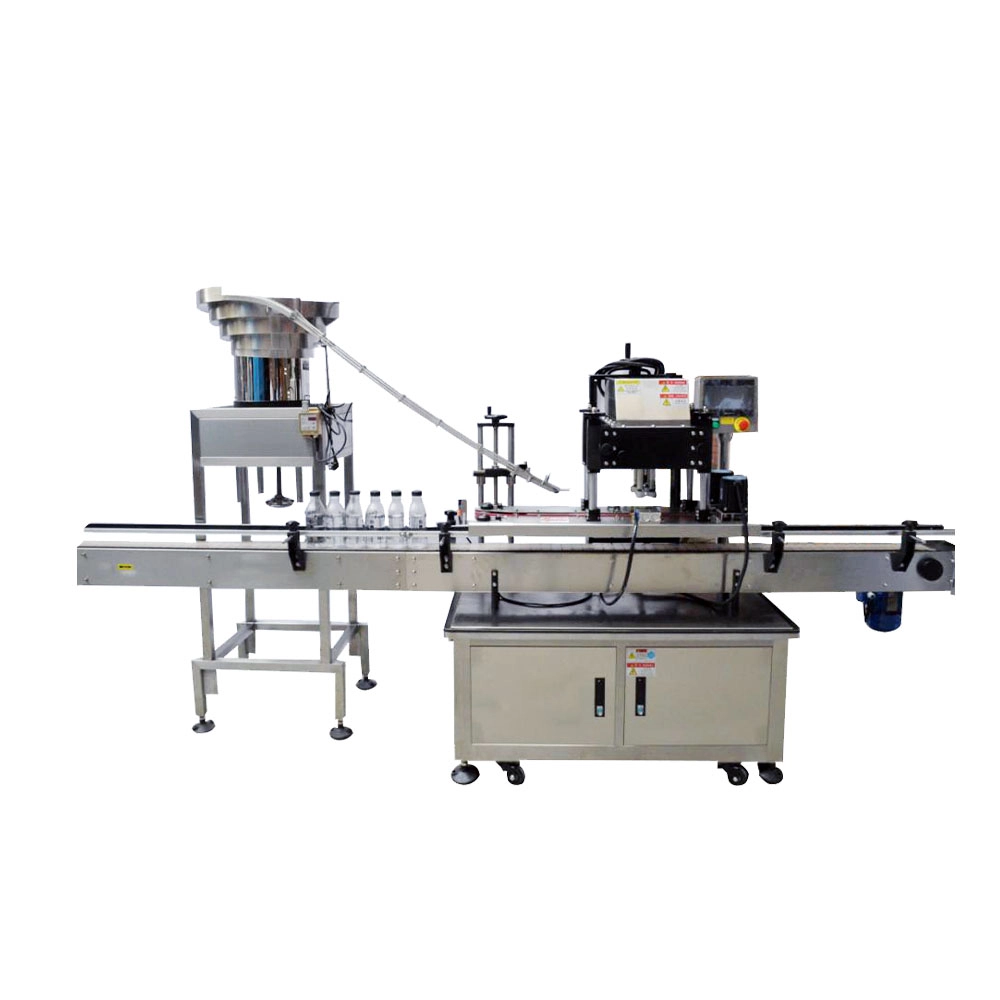
Automatic Plastic Caps Capping Machine with Vibrating Cap Feeder for Sale
Yuanyang automatic screw capping machine is a kind of four-wheel bottle capping machine. The automatic screw capper is often used to close lids of containers such as bottles and jars, especially for plastic bottles, which are widely used in food, medicine, chemical, cosmetic, and other industries for mass production and continuous production lines.
Features:
⦁ Full pneumatic drive;
⦁ Automated fast speed;
⦁ Suitable for various screw caps, pumps, and spray bottles.
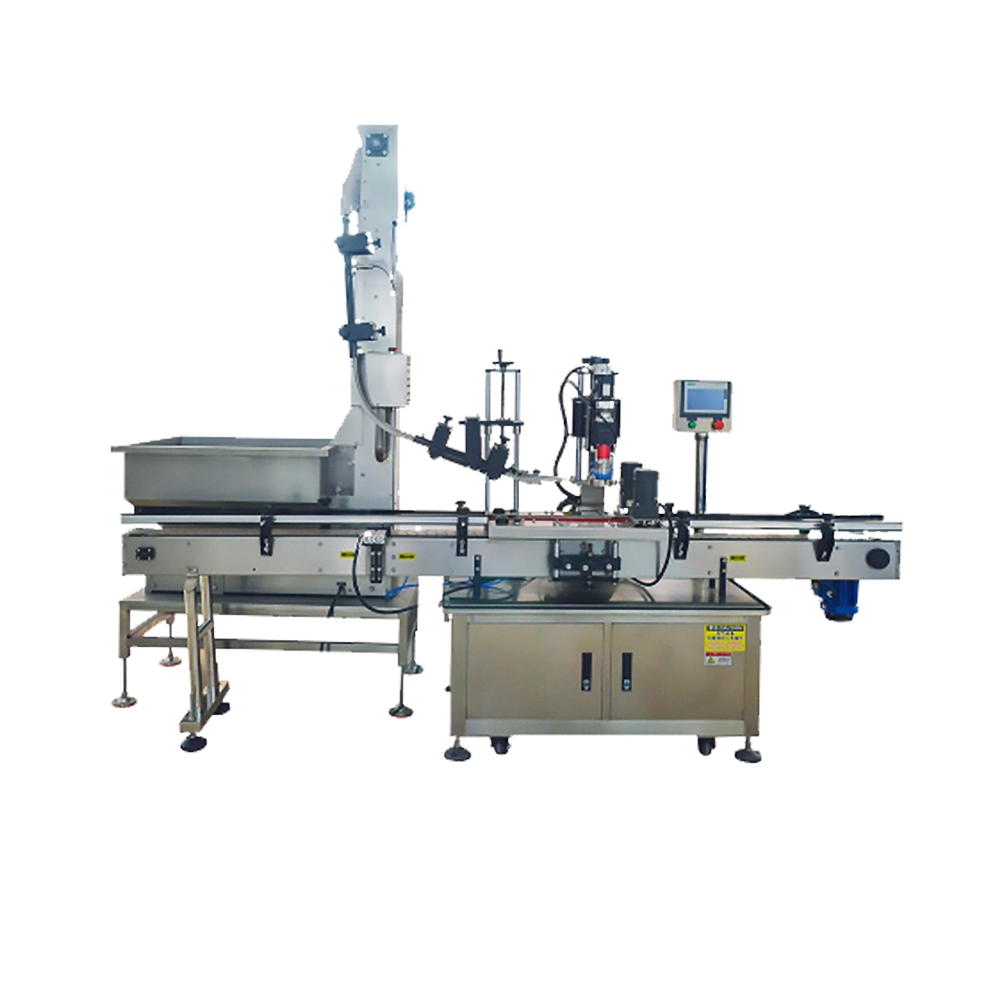
Automatic Metal Caps Capping Machine for Sale
Yuanyang automatic metal cap capping machine is a bottle capper for bottles with metal caps, which is often used to close lids of containers such as bottles and jars. The glass bottle metal capping machine is widely used in food, medicine, chemical, cosmetic, and other industries for mass production and continuous production line .
Features:
⦁ Pneumatic and electric drive;
⦁ Automated fast speed;
⦁ Suitable for glass bottles with metal caps.
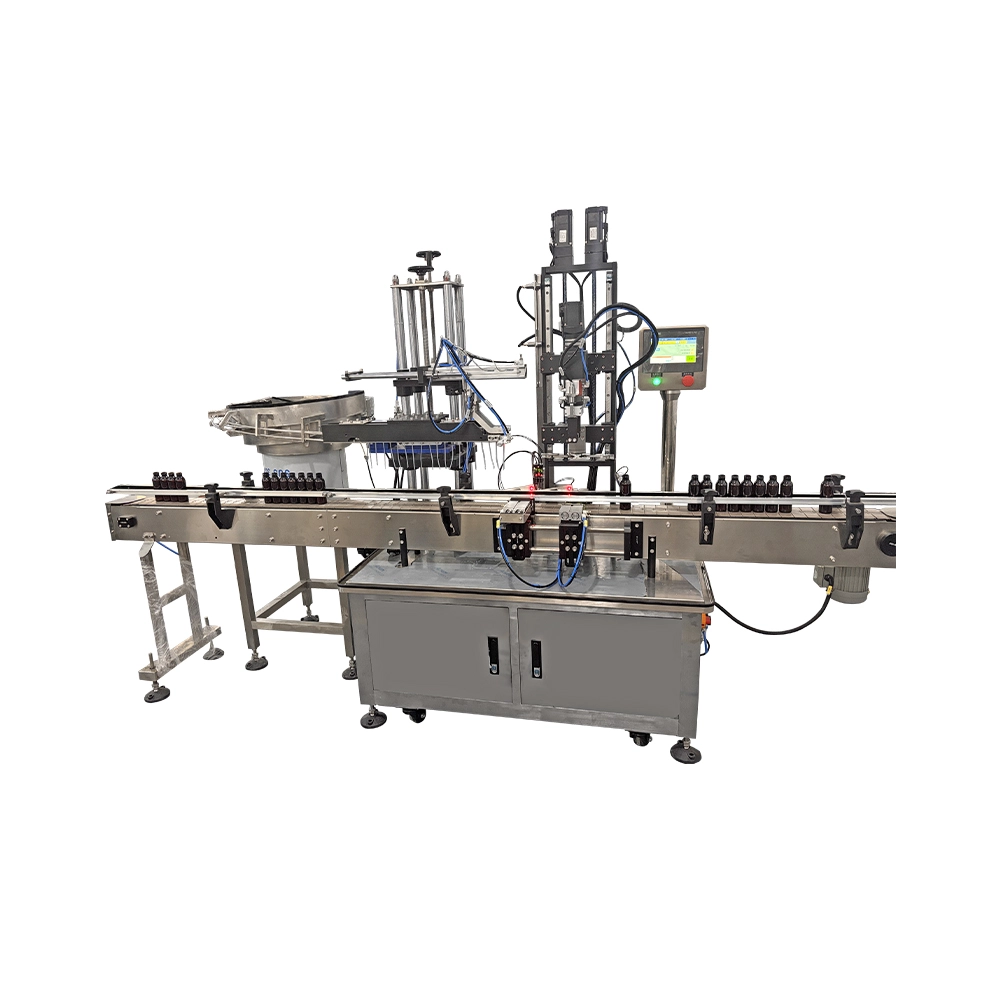
Automatic Pump Head Feeding and Capping Machine for Sale
Yuanyang automatic pump head feeding and capping machine is a bottle cap sorter and capper for bottles with pump heads, which is often used to close lids of containers such as nail polish, sprayers, and shampoo. The capping machine with a pump head feeder is widely used in food, medicine, chemical, cosmetic, and other industries for mass production and continuous production line .
Features:
⦁ Pneumatic and electric drive;
⦁ Automated fast speed;
⦁ Suitable for various types of caps.
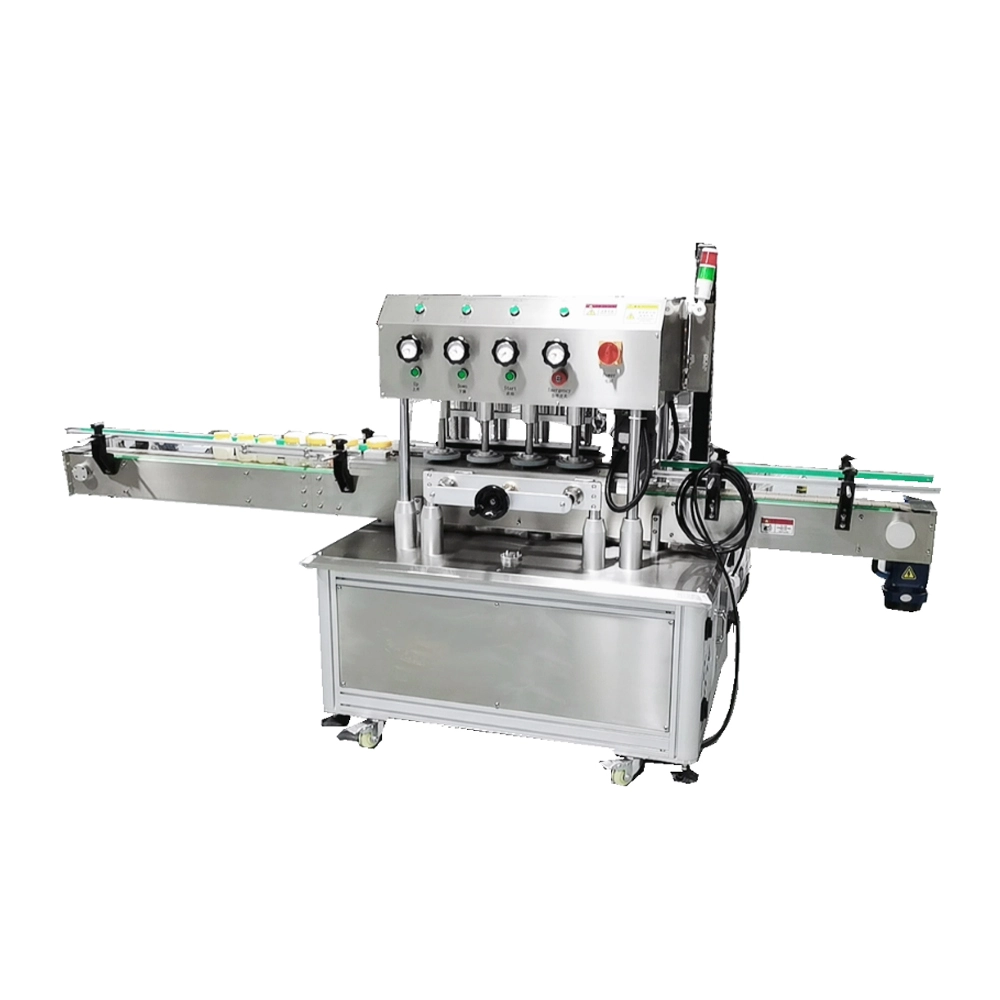
Automatic High Speed Capping Machine for Sale
The Yuanyang automatic high-speed capping machine is a kind of 8-wheel bottle-capping machine with fast working efficiency. The automatic capper is often used to close lids of containers such as bottles and jars, especially for plastic bottles, which are widely used in food, medicine, chemical, cosmetic, and other industries for mass production and continuous production lines.
Features:
⦁ Electric drive;
⦁ Automated fast speed;
⦁ Suitable for various screw caps, pumps, and spray bottles.
 Scan QR Code
Facebook
YouTube
LinkedIn
Whatsapp: +8613434139712
Guangzhou Yuanyang Machinery