





Selecting the Right Servo Drive for Sachet Machines
- Why Servo Drives Matter in Sachet Packaging
- Precision and Speed Requirements
- Repeatability and Quality Control
- Synchronization with PLC and Peripherals
- Key Technical Criteria for Selecting a Servo Drive
- Torque, Speed, and Inertia Matching
- Feedback Devices and Control Loops
- Communication Protocols and Integration
- Practical Considerations: Installation, Safety and Compliance
- Environment, Mounting and IP Rating
- Thermal Management, Harmonics and Regeneration
- Regulatory Compliance and Hygienic Design
- Vendor Selection, Tuning and Troubleshooting
- Evaluating Vendors and Total Cost of Ownership
- Commissioning and Practical Tuning Tips
- Common Failure Modes and How to Diagnose Them
- Application-Specific Recommendations for Sachet Packaging Machines
- Axis Prioritization
- Recommended Servo Drive Specifications (Guideline)
- Cost vs. Performance Trade-offs
- Case Example: Integrating a Drive with a Yuanyang Sachet Packaging Machine
- Quick Comparison: Servo Types for Sachet Machines
- Frequently Asked Questions (FAQ)
- Q: How do I size a servo drive for a dosing piston?
- Q: Which communication protocol is best for high-speed sachet lines?
- Q: Do I need regenerative braking on a sachet machine?
- Q: How frequently should I calibrate/verify encoder accuracy?
- Q: What standards should I consider for food-grade sachet packaging?
- Contact & Next Steps
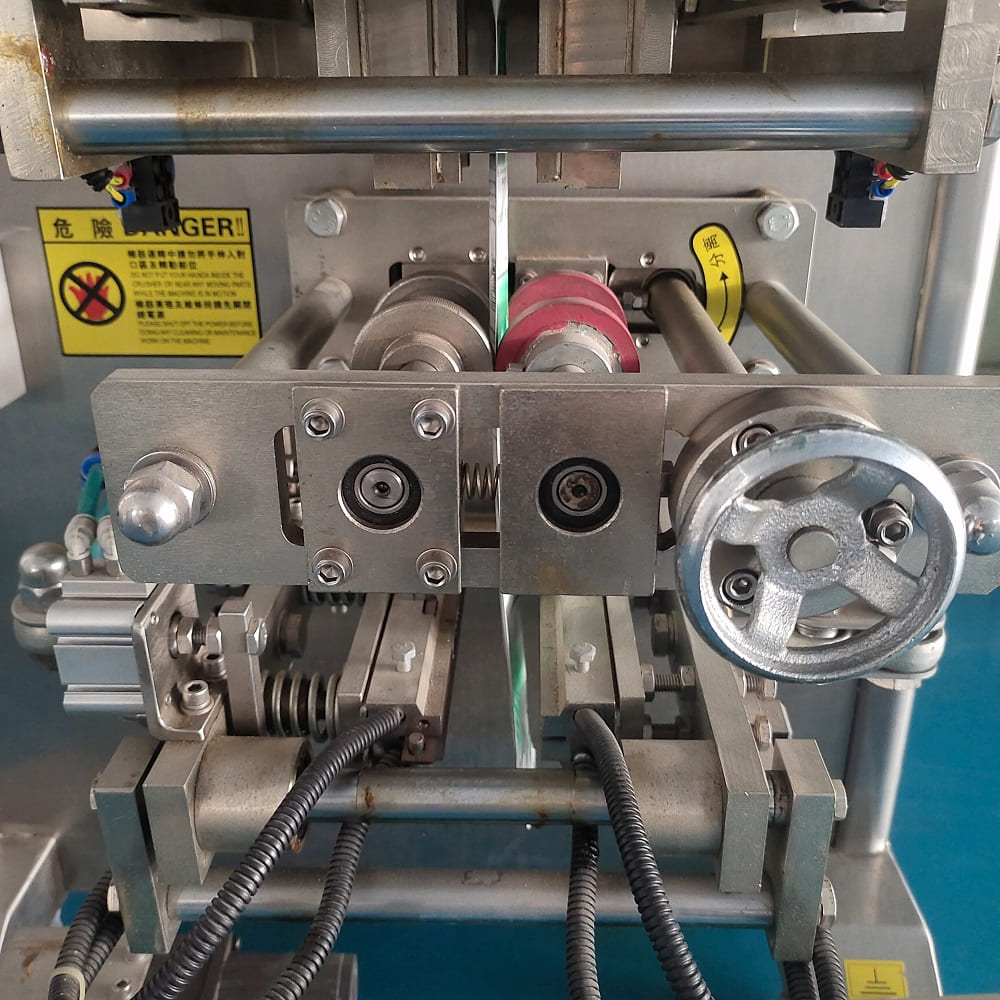
Efficient sachet packaging depends heavily on motion control: the servo drive is the bridge between control logic and mechanical motion. For manufacturers and integrators working with sachet packaging machine systems, selecting the right servo drive improves dosing accuracy, reduces film waste, and raises machine uptime—critical factors for food, pharmaceutical, and chemical packaging lines.
Why Servo Drives Matter in Sachet Packaging
Precision and Speed Requirements
Sachet packaging machines require fast, repeatable indexing and precise filling to maintain consistent weight and seal quality. Servo drives provide closed-loop control that directly affects the fill station, film transport, and sealing mechanisms. A mismatch in torque or control bandwidth can cause underfills, overfills, seal misalignment, and film tracking errors—leading to rejects and higher production costs. For background on servomotors and their role in motion control see the overview on servomotors (Wikipedia: Servomotor).
Repeatability and Quality Control
Modern sachet packing lines rely on repeatability (not just peak performance). A properly sized and tuned servo drive delivers consistent acceleration profiles and low overshoot, which keeps dosing within narrow tolerances and improves seal integrity. This is particularly important for microcomputer-controlled sachet machines that synchronize multi-axis functions such as filling piston, film pull, and jaw sealing.
Synchronization with PLC and Peripherals
Sachet Packaging Machine operations are typically coordinated by a PLC or machine controller that issues high-level commands. The servo drive must support compatible communication protocols (EtherCAT, ProfiNet, Modbus, EtherNet/IP) so motion commands, encoder feedback, and status signals are exchanged in real time. See the general category of packaging machinery for context (Wikipedia: Packaging machine).
Key Technical Criteria for Selecting a Servo Drive
Torque, Speed, and Inertia Matching
Start by calculating the required continuous torque and peak (acceleration) torque for each axis. Important steps:
- List moving masses and geometry to determine reflected inertia at the motor shaft.
- Estimate acceleration profiles (time to reach indexing speed) to compute peak torque.
- Select a servo drive and motor pair with continuous torque above the calculated continuous requirement and peak torque margin (typically 1.5–2×) for transient loads.
Matching inertia ratio (motor inertia : load inertia) helps avoid instability; ideal ratios vary but many systems aim for 0.5–5:1 depending on gearbox use.
Feedback Devices and Control Loops
Encoder resolution and feedback type (incremental vs. absolute, single-turn vs. multi-turn) determine position accuracy and homing behavior. For sachet machines:
- High-resolution encoders (e.g., 17–20 bit absolute or high PPR incremental) improve sealing and registration accuracy.
- Closed-loop velocity and position control with field-oriented control (FOC) or vector control provides smooth motion at low speeds like filling strokes.
Ensure the drive supports the encoder interface you choose (TTL, HTL, EnDat, SSI) and has sufficient servo loop update frequency for the application.
Communication Protocols and Integration
Select a drive compatible with your machine controller and network architecture. Common industrial protocols for high-speed packaging lines include EtherCAT and Profinet for deterministic, low-latency communication. Drives from major automation vendors will often support multiple protocols—see product families such as those from Siemens for reference (Siemens: Servo Drives).
Practical Considerations: Installation, Safety and Compliance
Environment, Mounting and IP Rating
Consider ambient conditions: dust, humidity, washdown frequency and temperature. Choose drives with appropriate IP ratings or install them in cabinets. For food and pharmaceutical lines where cleaning and cross-contamination are concerns, place drives in sealed enclosures and route cabling to minimize ingress.
Thermal Management, Harmonics and Regeneration
Servo drives dissipate heat and, during deceleration, can feed energy back to the DC bus. Decide whether you need:
- Regenerative units or braking resistors for frequent decelerations.
- Line filters or active front ends to mitigate harmonics and comply with supply regulations.
Proper thermal design prevents derating and unexpected downtime.
Regulatory Compliance and Hygienic Design
For food, pharmaceutical, and medical sachet packaging, ensure machine components and layout comply with applicable standards. Food safety management systems (like ISO 22000) are relevant for packaging lines handling food products (ISO: ISO 22000). For regulatory guidance on food contact and packaging practices consult the FDA's resources (FDA: Packaging & Food Contact).
Vendor Selection, Tuning and Troubleshooting
Evaluating Vendors and Total Cost of Ownership
When comparing servo drives for a Sachet Packaging Machine for Sale, evaluate more than unit price. Consider support availability, tuning tools, spare parts, and firmware lifecycle. Turnkey integration support and motion libraries for common packaging kinematics reduce commissioning time and risk.
Commissioning and Practical Tuning Tips
Best practices for commissioning:
- Use model-based tuning where available—enter mechanical inertia and friction to speed up setup.
- Start with conservative gains and increase loop bandwidth while monitoring for oscillation.
- Validate acceleration profiles to minimize film tension spikes and ensure seal jaws close during stable motion windows.
Common Failure Modes and How to Diagnose Them
Typical issues and checks:
- Axis hunting/oscillation — reduce loop gains or improve mechanical stiffness; verify encoder mounting.
- Underfills or inconsistent dosing — check backlash, ensure motor torque margin, and validate encoder resolution.
- Unexpected downtime — review thermal events, power quality, and bus voltage spikes; consider surge protection and line filtration.
Application-Specific Recommendations for Sachet Packaging Machines
Axis Prioritization
Not all axes require identical performance. Typically:
- Film pull and registration axes need high-speed response and accurate position repeatability.
- Dosing pistons or auger feeders require high torque at low speed and excellent low-speed smoothness.
- Sealing jaw axes need controlled dwell and repeatable positioning more than peak speed.
Recommended Servo Drive Specifications (Guideline)
Below is a guideline table you can use when specifying drives for a new sachet packaging machine. Use it as a starting point and refine based on detailed calculations.
| Axis Type | Key Specs | Suggested Encoder |
|---|---|---|
| Film transport / registration | High bandwidth, medium torque, continuous Response freq >1 kHz | Incremental 10k–20k PPR or absolute 17–20 bit |
| Dosing (piston/auger) | High low-speed torque, smooth control, torque margin 2× | Absolute encoder or high-resolution incremental |
| Sealing jaws | Precise positioning, moderate speed, reliable dwell timing | Incremental 5k–10k PPR |
Cost vs. Performance Trade-offs
High Quality servo drives offer advanced tuning, higher bus voltage, integrated safety I/O and multi-axis synchronization but cost more. For mid-volume sachet machines a balanced approach (well-supported mid-range drives with good local support) often yields the best total cost of ownership.
Case Example: Integrating a Drive with a Yuanyang Sachet Packaging Machine
Product highlight:
Sachet Packaging Machine for Sale
Yuanyang sachet packaging machine is a kind of automatic equipment, mainly used for measuring, filling, and sealing small bag packing materials. The sachet packing machine has become an indispensable piece of equipment in modern production for food, medicine, chemicals, and other fields.
Features:
⦁ Microcomputer controlled;
⦁ Automated fast speed;
⦁ Multi-function integration.
For a Yuanyang sachet machine with microcomputer control and multi-function integration, choose servo drives that support easy PLC interfacing and offer on-board motion profiles for indexing, camming and synchronous multi-axis moves. Ensure the drive vendor provides parameter recovery tools and spare parts for long-term maintenance.
Quick Comparison: Servo Types for Sachet Machines
| Drive Type | Advantages | Limitations |
|---|---|---|
| AC Servo | High torque density, excellent dynamic response, wide vendor support | Higher cost; requires good tuning |
| Brushless DC (BLDC) with closed-loop | High efficiency, good low-speed torque, compact | May need specific controllers; encoder required for closed-loop |
| Stepper (closed-loop/servo-like) | Lower cost for simple indexing; good for low-cost lines | Limited high-speed performance; less smooth at low speeds than servo |
Frequently Asked Questions (FAQ)
Q: How do I size a servo drive for a dosing piston?
A: Calculate the torque required to overcome friction and accelerate the piston mass to the required speed in the specified time. Include a safety margin (1.5–2×) for peak torque. Use inertia calculations to select a motor with an appropriate inertia ratio versus the load and consider gearboxes if you need torque multiplication.
Q: Which communication protocol is best for high-speed sachet lines?
A: For deterministic, high-speed motion control, EtherCAT and Profinet are commonly preferred. The choice should match your PLC/network architecture and the drive vendor's offerings. EtherCAT often provides the lowest latency for synchronized multi-axis motion.
Q: Do I need regenerative braking on a sachet machine?
A: If your axes frequently decelerate or your line has heavy moving masses that store kinetic energy, regenerative units or braking resistors are recommended to manage energy returned to the DC bus. This prevents overvoltage faults and improves reliability.
Q: How frequently should I calibrate/verify encoder accuracy?
A: Verification frequency depends on production criticality; monthly checks are common in high-precision lines, with full recalibration during preventive maintenance intervals or after component replacement. Monitor process metrics like fill weight and seal alignment to flag the need for recalibration.
Q: What standards should I consider for food-grade sachet packaging?
A: Relevant standards and guidance include food safety management systems such as ISO 22000 and regulatory guidance on food packaging from authorities like the U.S. FDA. Ensure materials that contact food meet local regulations and the machine layout supports hygienic cleaning.
Contact & Next Steps
If you are evaluating servo drives for a new sachet packaging line or upgrading an existing machine, our engineering team can help size drives, select encoders, and integrate the motion system with your PLC. To view product specifications or get a quotation for a Yuanyang Sachet Packaging Machine for Sale, contact our sales team or request a demo.
Contact Customer Service | View Product Details
References:
Best inkjet printer manufacturers and supplier brands
Where to Buy automatic liquid filling line china
Top 10 best stainless steel liquid mixing tank Manufacturers and Supplier Brands
Drink Sealing Machines: Guide
Ink Jet Printer
Can the dater printer spray all directions?
Yes, the spraying nozzle of the expiry date printer can be adjusted to all directions.
Industries
What is the production capacity range of the equipment?
Our equipment has a wide range of production capacity options, which can be customized according to specific requirements.
Homogneizer mixer tank
What function does the liquid washing homogenizer have?
The homogenizer is an integrated equipment with mixing, dispersing, homogenizing, heating system.
Vibrating sieving machine
Is the powder screening machine used for detergent powder?
Yes, this can be used for detergent powder. It is a detergent powder screening machine.
Vacuum Homogneizer
Is it necessary to clean for each batch production?
There is no need to clean quite often for the same products. But for different products, it is better to clean every time before the production of different products.
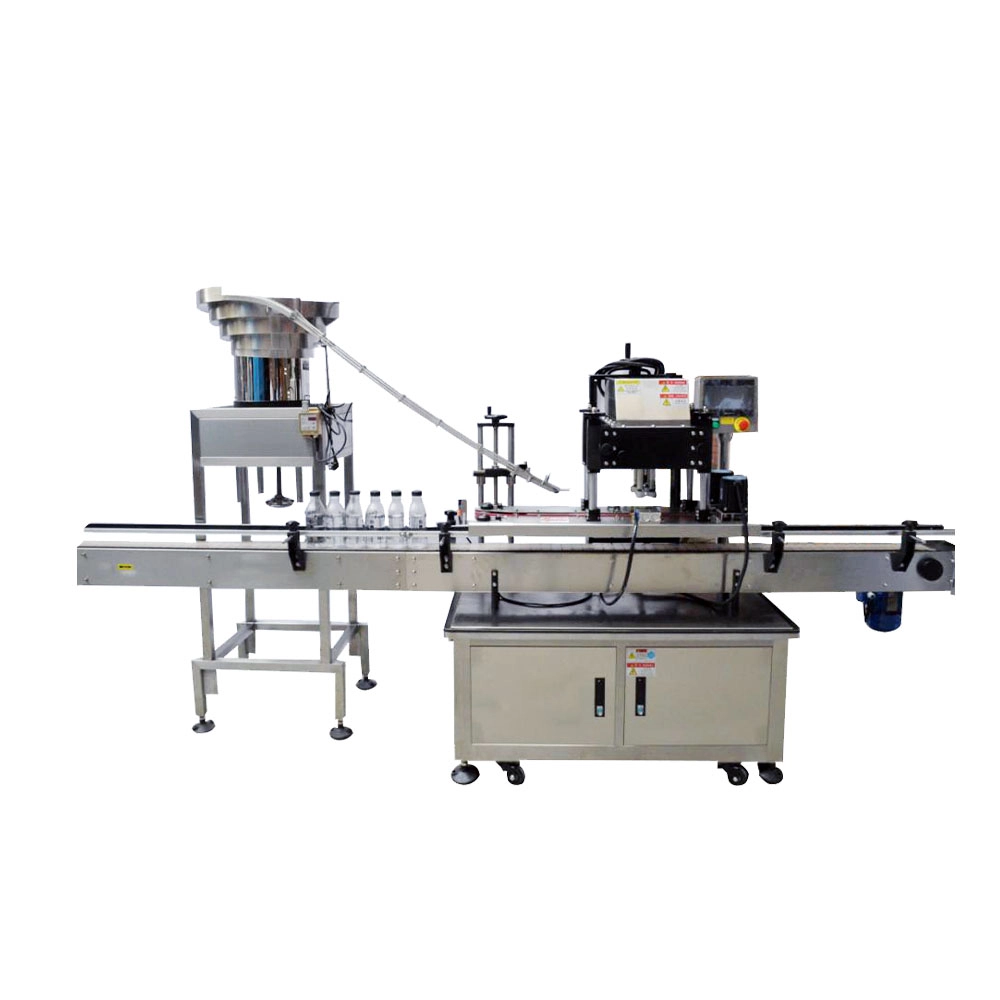
Automatic Plastic Caps Capping Machine with Vibrating Cap Feeder for Sale
Yuanyang automatic screw capping machine is a kind of four-wheel bottle capping machine. The automatic screw capper is often used to close lids of containers such as bottles and jars, especially for plastic bottles, which are widely used in food, medicine, chemical, cosmetic, and other industries for mass production and continuous production lines.
Features:
⦁ Full pneumatic drive;
⦁ Automated fast speed;
⦁ Suitable for various screw caps, pumps, and spray bottles.
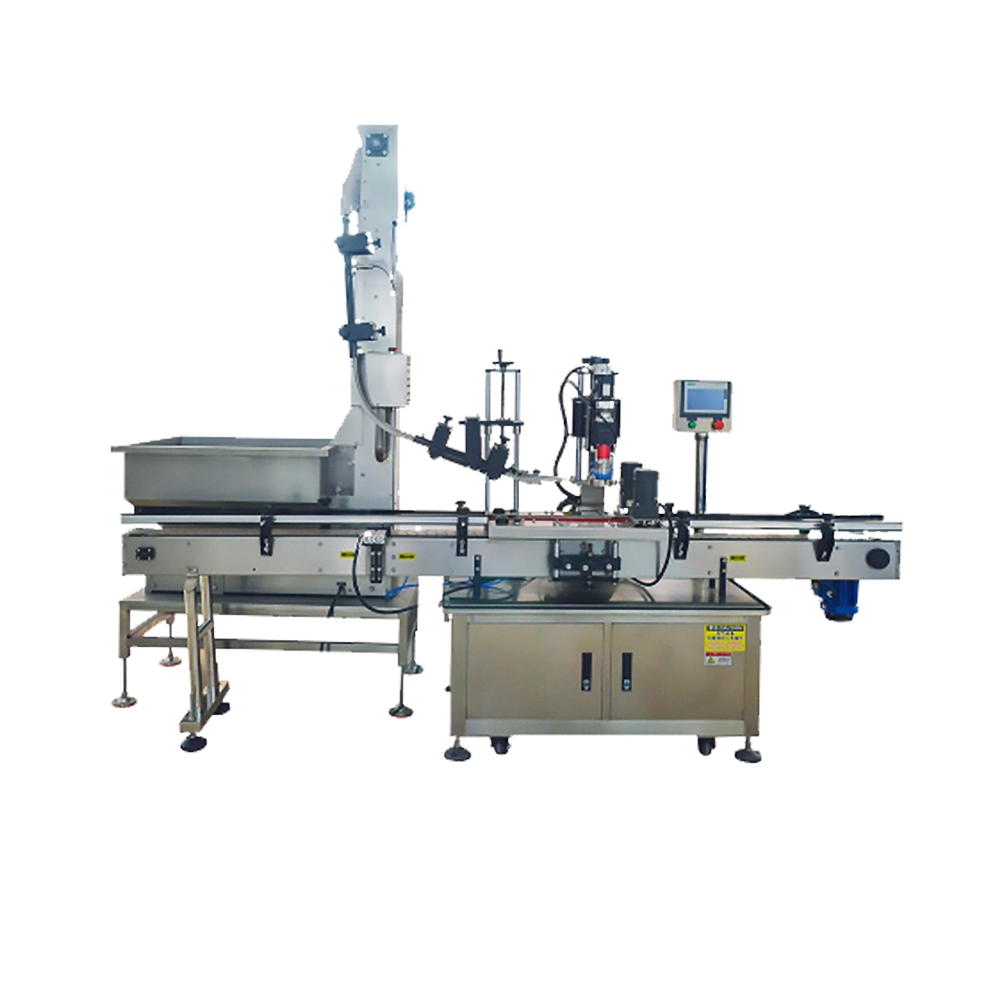
Automatic Metal Caps Capping Machine for Sale
Yuanyang automatic metal cap capping machine is a bottle capper for bottles with metal caps, which is often used to close lids of containers such as bottles and jars. The glass bottle metal capping machine is widely used in food, medicine, chemical, cosmetic, and other industries for mass production and continuous production line .
Features:
⦁ Pneumatic and electric drive;
⦁ Automated fast speed;
⦁ Suitable for glass bottles with metal caps.
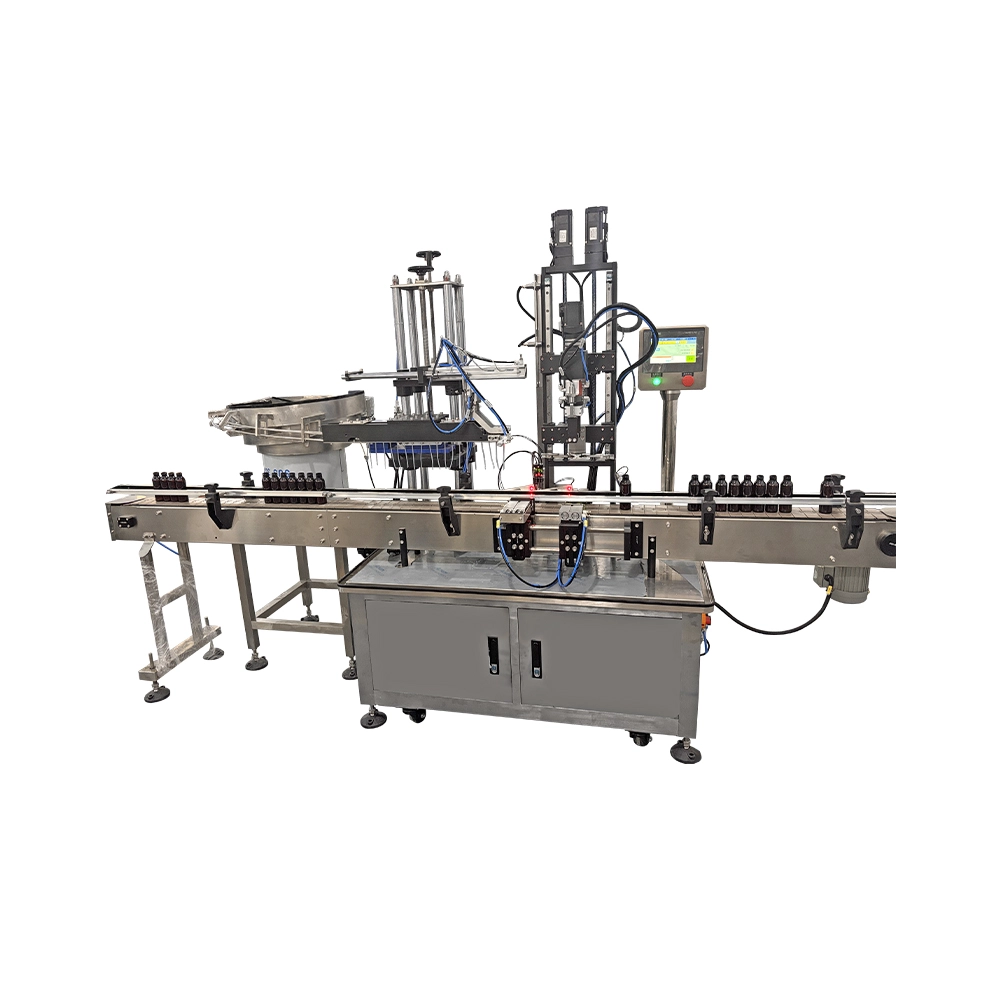
Automatic Pump Head Feeding and Capping Machine for Sale
Yuanyang automatic pump head feeding and capping machine is a bottle cap sorter and capper for bottles with pump heads, which is often used to close lids of containers such as nail polish, sprayers, and shampoo. The capping machine with a pump head feeder is widely used in food, medicine, chemical, cosmetic, and other industries for mass production and continuous production line .
Features:
⦁ Pneumatic and electric drive;
⦁ Automated fast speed;
⦁ Suitable for various types of caps.
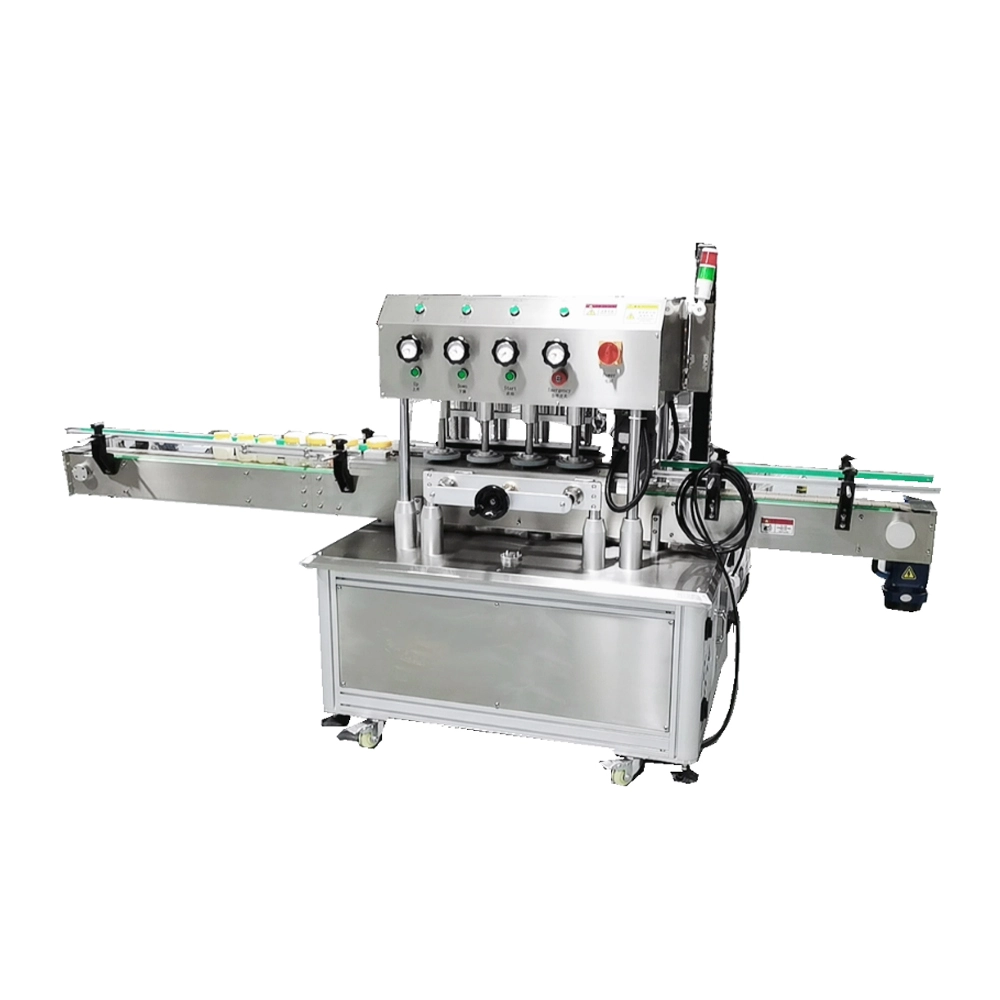
Automatic High Speed Capping Machine for Sale
The Yuanyang automatic high-speed capping machine is a kind of 8-wheel bottle-capping machine with fast working efficiency. The automatic capper is often used to close lids of containers such as bottles and jars, especially for plastic bottles, which are widely used in food, medicine, chemical, cosmetic, and other industries for mass production and continuous production lines.
Features:
⦁ Electric drive;
⦁ Automated fast speed;
⦁ Suitable for various screw caps, pumps, and spray bottles.
 Scan QR Code
Facebook
YouTube
LinkedIn
Whatsapp: +8613434139712
Guangzhou Yuanyang Machinery