





Sizing Emulsifying Mixers for Scalable Manufacturing
- Sizing Emulsifying Mixers for Scalable Manufacturing
- Why proper sizing of an emulsifying mixer matters for scalable production
- Understanding the product and process: what affects mixer size
- Key equipment elements to consider for an emulsifying mixer
- Calculating batch size and throughput
- Shear, rotor-stator and homogenization considerations
- Viscosity, heat transfer and vacuum requirements
- Materials, surface finish and cleaning (GMP considerations)
- Scale-up principles and practical rules of thumb
- Practical example: sizing a vacuum emulsifying mixer for a 500 kg/day cream
- Why choose a Vacuum Emulsifying Mixer for Sale for cosmetics production
- Installation, utilities and factory layout
- Cost, lifecycle and ROI analysis
- Brand advantages and why to consider Yuanyang Vacuum Emulsifying Mixer
- Frequently Asked Questions (FAQ)
- Q: How do I determine the correct vessel size for my production target?
- Q: Can a vacuum emulsifying mixer achieve a 2 micron particle size?
- Q: What is the difference between in-tank homogenization and in-line high-pressure homogenizers?
- Q: How does viscosity affect mixing time and power requirements?
- Q: What cleaning and regulatory considerations should I plan for?
- Contact and product call-to-action
- Authoritative references and further reading
Sizing Emulsifying Mixers for Scalable Manufacturing
Why proper sizing of an emulsifying mixer matters for scalable production
Choosing the correct emulsifying mixer is one of the most important decisions for manufacturers of creams, ointments, and emulsions. An undersized emulsifying mixer limits throughput, reduces product consistency, increases cycle times, and raises operational risk. An oversized unit raises capital cost, wastes floor space, and can complicate process control. The right balance enables predictable scale-up, consistent particle size distribution, efficient energy use, and compliant manufacturing — all essential for profitable, scalable operations.
Understanding the product and process: what affects mixer size
Sizing begins with the product formulation and desired outcomes. Key product/process parameters include:
- Batch size and target throughput (kg/hour or L/hour)
- Viscosity range of finished product (e.g., 10,000–50,000 cps)
- Target droplet/particle size (e.g., 2 microns and uniform distribution)
- Thermal sensitivity and heating/cooling needs
- Shear requirement (low-shear blending vs. high-shear emulsification/homogenization)
- Processing mode: batch, semi-batch, or continuous
- Cleaning and regulatory requirements (GMP, CIP)
These items directly influence vessel geometry, agitator type, motor power, homogenizer sizing, vacuum capability, and utility loads.
Key equipment elements to consider for an emulsifying mixer
An industrial emulsifying system typically combines multiple sub-systems that must be sized together:
- Main emulsifying pot (vessel volume, heating/cooling jackets)
- Oil and water pots for phase preparation
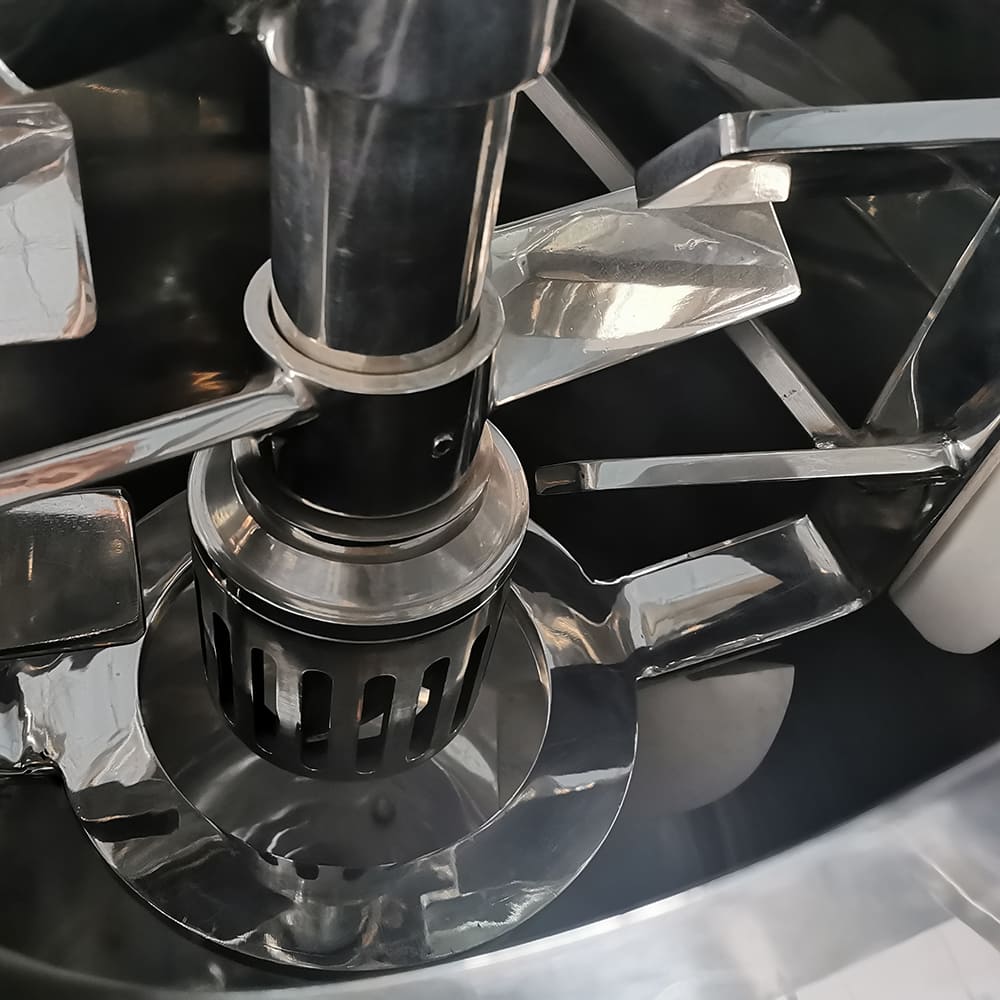
- Agitator(s): anchor, turbine, and high-shear rotor-stator or high-pressure homogenizer
- Vacuum system (rough vacuum pump capacity and vacuum level)
- Hydraulic lifting system, electric control system, and safety devices
- Utility requirements: steam/thermal oil, cooling water/chillers, compressed air, electrical power
Calculating batch size and throughput
Start with market and process targets:
- Daily production target in kg or liters
- Number of production shifts and net operating hours per day
- Target cycle time per batch (including charging, emulsification, deaeration, discharge, cleaning)
Batch volume = (Daily target) / (Number of batches per day). Select vessel volume with headspace (typically 15–30% extra) to allow for foaming, agitation, and safe handling.
Example rule-of-thumb: for a target throughput of 1000 kg/day with 8-hour shift and 4 batches per shift, choose batch size ≈ 250 kg; with product density ≈ 1, choose vessel ≈ 300 L (including 20% headspace).
Shear, rotor-stator and homogenization considerations
Desired droplet size and distribution typically drive the homogenization stage. For cosmetic creams targeting a 2 micron particle size, a robust high-shear rotor-stator or in-line high-pressure homogenizer is required. Consider:
- Type of emulsifier: in-tank rotor-stator (high-shear) vs. recirculation through a high-pressure homogenizer.
- Energy density (kW/m3) required — higher energy yields smaller droplets but raises temperature and wear.
- Tip speed and shear rate — these scale differently from volume; maintain similar tip speed or energy density during scale-up for consistent droplet sizes.
For many cream formulations, an integrated vacuum emulsifying mixer with a powerful in-pot homogenizer provides the combination of shear and deaeration necessary for uniform 2 µm particles and smooth texture.
Viscosity, heat transfer and vacuum requirements
Viscosity impacts mixing power and heat transfer. Products in the 10,000–50,000 cps range require:
- Robust agitators (anchor + scrapers) to prevent dead zones
- Efficient jacket design or internal coils for heating and cooling to handle exotherms and maintain product temperature
- Vacuum system rated to remove air at target viscosity (deaeration is slower in high-viscosity systems)
Heat transfer area must be sized for expected heating/cooling duty. Use conservative design margins for high-viscosity products because thermal conductivity is lower and convective heat transfer is reduced.
Materials, surface finish and cleaning (GMP considerations)
Material selection and surface finish influence product safety and cleanability. For cosmetics and topical products, stainless steel 304/316L with 2B or electropolished finishes is common. Key items:
- CIP (clean-in-place) compatible design and spray ball coverage
- Weld quality and polished internal surfaces to prevent product build-up
- Seals and gaskets compatible with formulation (FDA/EC-approved materials)
- Vacuum ports and valves designed to prevent cross-contamination
Scale-up principles and practical rules of thumb
Scale-up from lab or pilot to production should preserve process-critical variables. Common strategies:
- Geometric similarity: keep vessel proportions constant where possible.
- Maintain constant tip speed (RPM × impeller diameter) for turbulence-controlled processes.
- Maintain constant power per unit volume (P/V, kW/m3) for energy-driven emulsification.
- Maintain constant Reynolds or Froude numbers for hydrodynamic similarity when appropriate.
Rule-of-thumb table for selecting emulsifying mixer size based on batch size and process:
| Batch Volume (L) | Typical Vessel Size (including 20% headspace) | Recommended Homogenizer | Typical Motor Power (kW) |
|---|---|---|---|
| 5–50 | 10–60 L | Lab/Benchtop rotor-stator | 0.75–7.5 |
| 50–500 | 60–600 L | In-tank rotor-stator, 3–15 kW | 7.5–30 |
| 500–2000 | 600–2400 L | Industrial in-line homogenizer or large in-tank | 30–100+ |
| 2000+ | 2400+ L (tanks in parallel or continuous) | High-pressure homogenizer, multiple stages | 100–500+ |
Practical example: sizing a vacuum emulsifying mixer for a 500 kg/day cream
Assumptions:
- Target 500 kg/day, single shift (8 hr) operation
- 4 batches/day → 125 kg per batch → vessel ≈ 150–200 L with 20–50% headspace depending on foaming
- Viscosity ~20,000 cps; target particle size 2 µm
Recommended equipment: a 200–300 L Vacuum Emulsifying Mixer with integrated 7.5–15 kW in-tank homogenizer, hydraulic lifting and vacuum system capable of achieving required deaeration and 2 µm distribution. This configuration balances power, heat transfer, and cleaning needs.
Why choose a Vacuum Emulsifying Mixer for Sale for cosmetics production
Vacuum emulsifying mixers are designed for cosmetic and topical product manufacturing. Their integrated features — combined oil/water pots, hydraulic lifting, vacuum capability, and electric control — enable consistent high-quality formulations and efficient production. A well-specified unit supports viscosities in the 10,000–50,000 cps range and can deliver perfect particle sizes around 2 microns with uniform distribution, which is essential for texture, appearance, and stability.
Product spotlight:
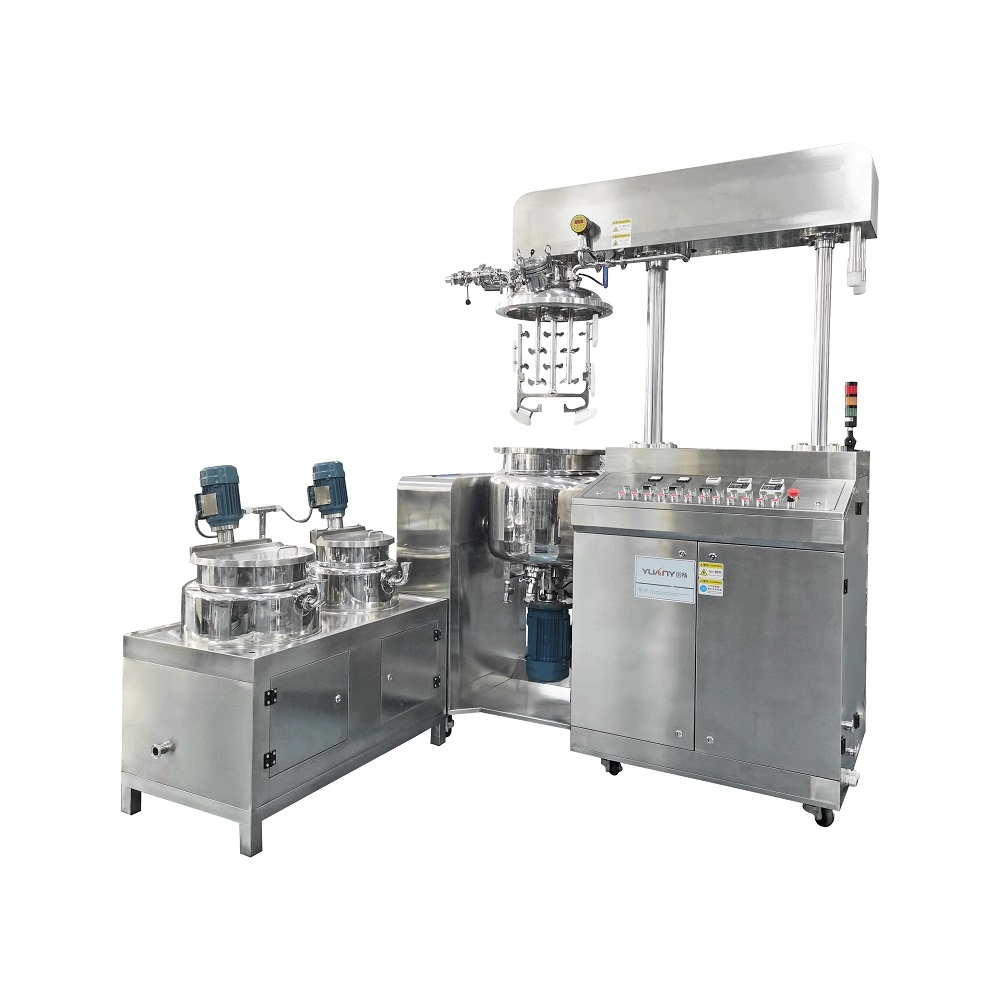
Yuanyang vacuum emulsifying mixer is a kind of emulsifier machine, the most popular cosmetics production equipment for making cream, skin-care products, ointment, paste, and emulsions.
Features:
⦁ Composed of a main emulsifying pot, a water pot, and an oil pot.
⦁ With a hydraulic lifting system, vacuum system, and electric control system.
⦁ Suitable for products of 10,000~50,000 cps viscosity.
⦁ Perfect particle size of 2 microns and evenly distributed.
Installation, utilities and factory layout
Plan for space, utilities, and ergonomics. Consider:
- Clearance for hydraulic lifting, maintenance, and cleaning
- Utility supply: electrical service sized for motor start currents, steam or thermal oil for heating, chilled water or glycol for cooling, vacuum pump room with silencing
- Material handling: pumps for recirculation, transfer, and discharge; storage tanks for raw materials
- Safety: explosion-proofing if volatile solvents are used, proper ventilation, and safe electrical classifications
Cost, lifecycle and ROI analysis
Consider both capital and operating costs:
- CapEx: vessel, homogenizer, vacuum pumps, motors, controls, installation
- OpEx: energy (motors and vacuum pumps), utilities (steam/chill), maintenance, spare parts (rotor-stator wear rings), labor
- Throughput improvements can reduce per-unit cost; better particle distributions can increase product High Quality
Perform ROI using conservative throughput gains, replacement intervals for wear parts, and utility consumption. Often investing in slightly higher homogenizer capacity avoids rework and returns faster.
Brand advantages and why to consider Yuanyang Vacuum Emulsifying Mixer
When selecting a supplier, consider experience, proven performance, after-sales support, and compliance with industry standards. Key competitive advantages to look for:
- Proven performance achieving 2 µm particle size with uniform distribution
- Integrated design (oil, water, main pots) that minimizes footprint and simplifies operations
- Hydraulic lifting and automated electric control for repeatable, safe operation
- Capability to handle 10,000–50,000 cps viscosities typical for high-quality creams and ointments
- Easy-to-service rotor-stator systems and availability of spare parts and technical support
Yuanyang's Vacuum Emulsifying Mixer for Sale is positioned as a purpose-built solution for cosmetic manufacturers seeking predictable scale-up, compliant construction, and a balance of performance and cost.
Frequently Asked Questions (FAQ)
Q: How do I determine the correct vessel size for my production target?
A: Calculate daily production divided by number of batches you plan per day to determine batch mass. Convert mass to volume using product density, then add 15–30% headspace to allow for mixing and foaming. Also consider future growth — select the next standard vessel size if you expect higher throughput.
Q: Can a vacuum emulsifying mixer achieve a 2 micron particle size?
A: Yes. With appropriate homogenizer selection (power, rotor-stator design or high-pressure in-line homogenizer), process control, and formulation optimization, a vacuum emulsifying mixer can reliably produce 2 µm particle sizes with even distribution.
Q: What is the difference between in-tank homogenization and in-line high-pressure homogenizers?
A: In-tank rotor-stator systems provide high shear within the vessel and are simple to operate for many formulations. In-line high-pressure homogenizers can deliver finer and more consistent droplet sizes for demanding products but add capital and require recirculation or continuous flow. Choice depends on droplet size target, throughput, and budget.
Q: How does viscosity affect mixing time and power requirements?
A: Higher viscosity increases required mixing power and reduces convective heat transfer. Expect longer mixing times and choose more robust agitator designs (anchors, scrapers) and higher motor power when viscosities approach 50,000 cps.
Q: What cleaning and regulatory considerations should I plan for?
A: Make systems CIP-capable, use approved gasket materials and sanitary finishes, and design to minimize dead legs. Follow applicable GMP standards (e.g., ISO 22716 for cosmetics) and document cleaning validation and maintenance plans.
Contact and product call-to-action
With correct sizing, energy usage becomes a key concern; optimizing energy efficiency of vacuum emulsifying mixers can significantly reduce operational costs.If you are sizing a new production line or upgrading equipment, our technical team can help specify the correct Vacuum Emulsifying Mixer for Sale to meet your throughput, viscosity, and particle-size targets. Contact our sales engineers to request a capacity calculation, process trial, or quotation.
Contact us: [email protected] | Request product brochure and quote
Authoritative references and further reading
- Emulsion — Wikipedia: https://en.wikipedia.org/wiki/Emulsion
- Mixing (process engineering) — Wikipedia: https://en.wikipedia.org/wiki/Mixing_(process_engineering)
- Homogenization (chemistry) — Wikipedia: https://en.wikipedia.org/wiki/Homogenization_(chemistry)
- U.S. Food & Drug Administration — Cosmetics: https://www.fda.gov/cosmetics
- European Commission — Cosmetics: https://ec.europa.eu/growth/sectors/cosmetics/
- ISO 22716: Cosmetics — Good Manufacturing Practices (publisher page): https://www.iso.org/standard/36437.
Authorship: this guide is written by an industry practitioner with experience in emulsification equipment selection and process scale-up for cosmetics and topical formulations, combining engineering best practices and commercial equipment considerations to help manufacturers make informed decisions.
Tips for Wholesale filling and sealing machines in America
YUANYANG Best professional industrial disperser manufacturers and supplier brands in America
Cleaning and CIP Tips for 50L Vacuum Emulsifiers
Custom automatic bottle capping machine Manufacturers and Suppliers in France
FAQs
What’s the guarantee if we purchase from you?
All the equipment ordered from us will be provided with 2 years guarantee from the delivery date. If there is any wearing part broken within the warranty and isn’t caused by improper operation, we would offer the new parts for free.
Sachet Packaging Machine for Granules
What’s the sealing method of this type of sugar bag packing machine?
There are common 3 types of sealing method: back sealing, three sides sealing, four sides sealing.
Is the sachet packing machine equipped with conveyor ?
Yes, the standard sachet packaging machine is with a conveyor for transferring the finished bags.
Single Layer Agitator Tank
What capacity do you provide for the mixing tank with agitator?
The steel tank with agitator has different capacity from 50L to 5000L.
Open Lid Storage Tank
Is the material of the cosmetic tank anti-corrosive?
Yes, the tank is made of stainless steel 304 or 316L, it can store corrosive chemicals. But it is recommend to use PP storage tank if the liquid is strong acid, alkali and corrosive chemical liquid
Automatic Plastic Caps Capping Machine with Vibrating Cap Feeder for Sale
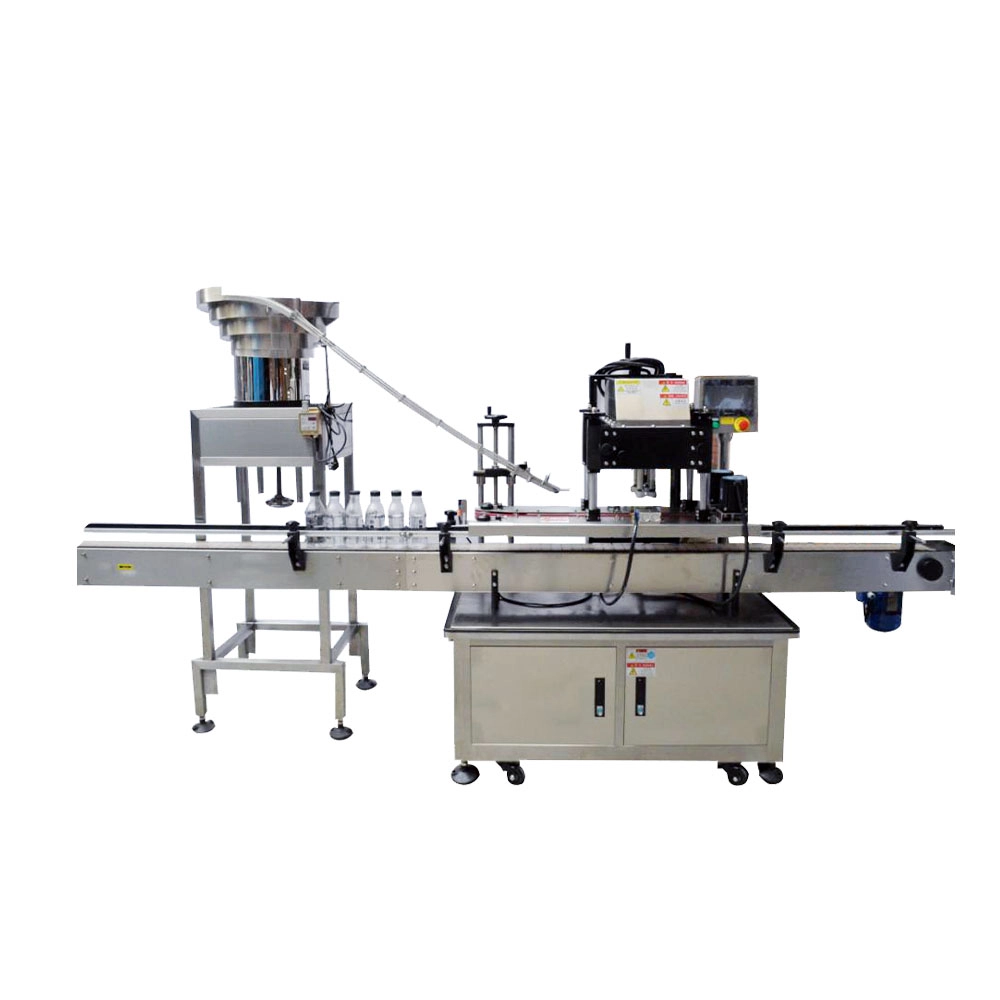
Yuanyang automatic screw capping machine is a kind of four-wheel bottle capping machine. The automatic screw capper is often used to close lids of containers such as bottles and jars, especially for plastic bottles, which are widely used in food, medicine, chemical, cosmetic, and other industries for mass production and continuous production lines.
Features:
⦁ Full pneumatic drive;
⦁ Automated fast speed;
⦁ Suitable for various screw caps, pumps, and spray bottles.
Automatic Metal Caps Capping Machine for Sale
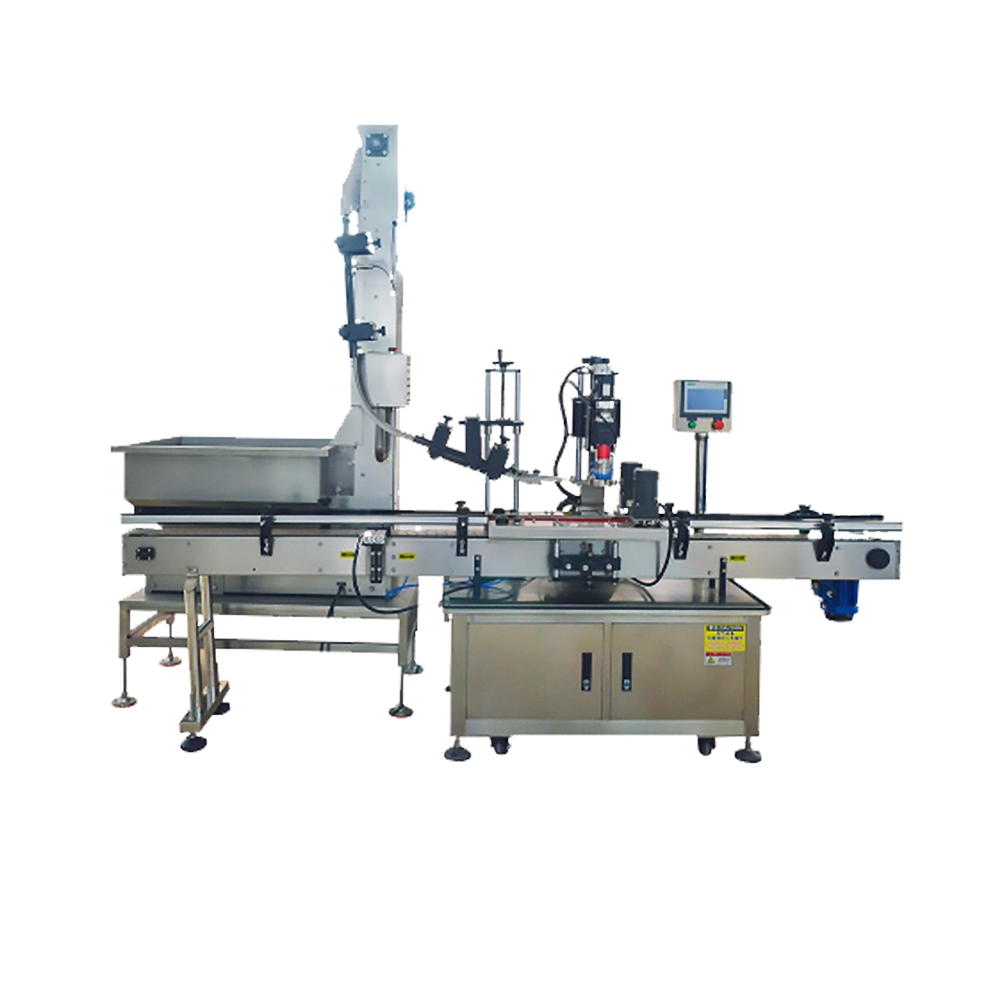
Yuanyang automatic metal cap capping machine is a bottle capper for bottles with metal caps, which is often used to close lids of containers such as bottles and jars. The glass bottle metal capping machine is widely used in food, medicine, chemical, cosmetic, and other industries for mass production and continuous production line .
Features:
⦁ Pneumatic and electric drive;
⦁ Automated fast speed;
⦁ Suitable for glass bottles with metal caps.
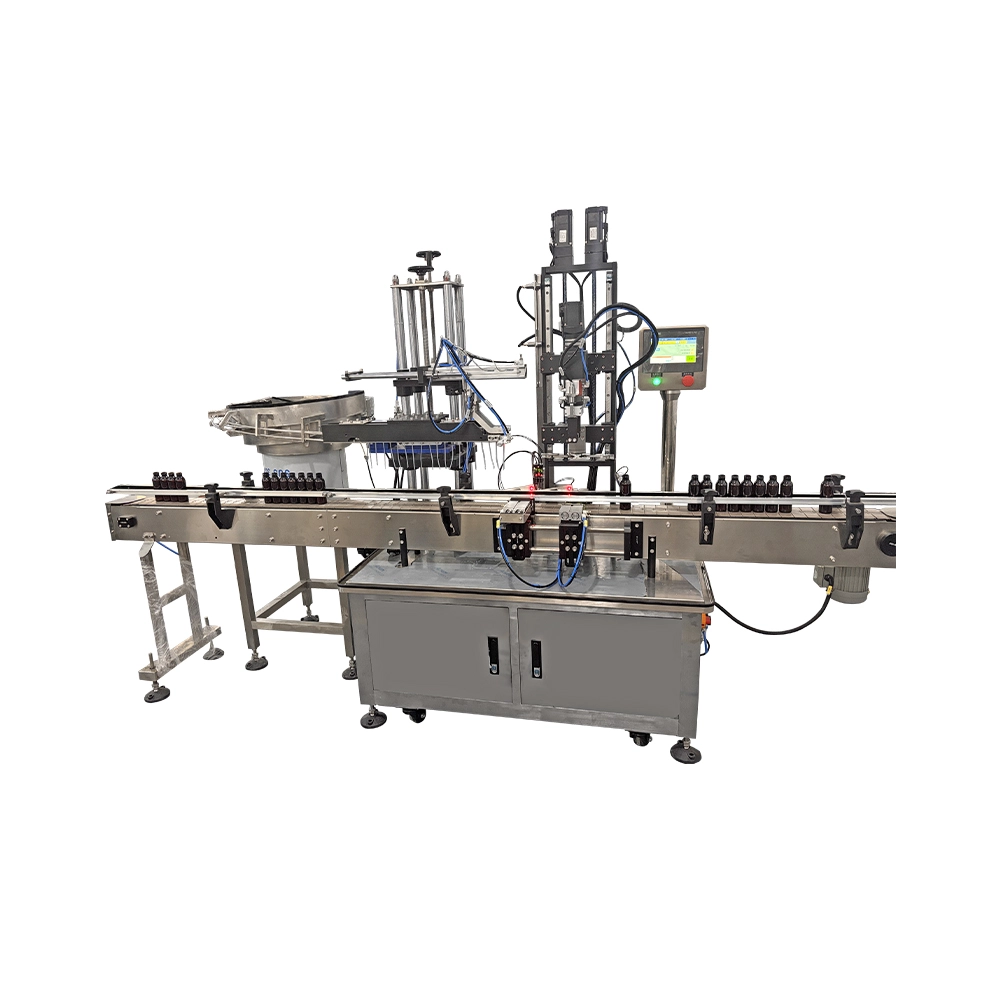
Automatic Pump Head Feeding and Capping Machine for Sale
Yuanyang automatic pump head feeding and capping machine is a bottle cap sorter and capper for bottles with pump heads, which is often used to close lids of containers such as nail polish, sprayers, and shampoo. The capping machine with a pump head feeder is widely used in food, medicine, chemical, cosmetic, and other industries for mass production and continuous production line .
Features:
⦁ Pneumatic and electric drive;
⦁ Automated fast speed;
⦁ Suitable for various types of caps.
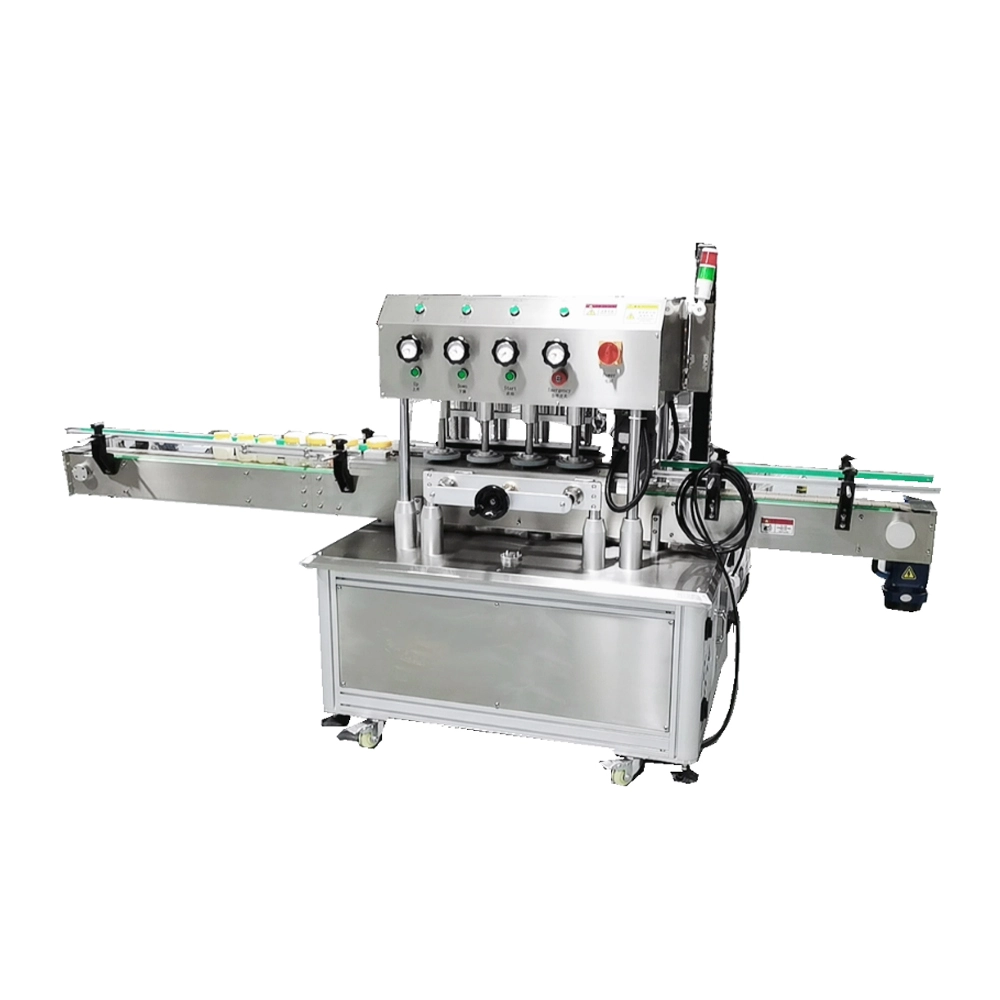
Automatic High Speed Capping Machine for Sale
The Yuanyang automatic high-speed capping machine is a kind of 8-wheel bottle-capping machine with fast working efficiency. The automatic capper is often used to close lids of containers such as bottles and jars, especially for plastic bottles, which are widely used in food, medicine, chemical, cosmetic, and other industries for mass production and continuous production lines.
Features:
⦁ Electric drive;
⦁ Automated fast speed;
⦁ Suitable for various screw caps, pumps, and spray bottles.
 Scan QR Code
Facebook
YouTube
LinkedIn
Whatsapp: +8613434139712
Guangzhou Yuanyang Machinery