





Improving Energy Efficiency of Vacuum Emulsifying Mixers
- Improving Energy Efficiency of Vacuum Emulsifying Mixers
- Why energy efficiency matters for emulsifying mixer operations
- Overview of Vacuum Emulsifying Mixer for Sale — Product Introduction
- Identify the major energy consumers in an emulsifying mixer system
- Optimize motor and drive systems (use of VFDs and high-efficiency motors)
- Optimize vacuum system operation and select efficient pumps
- Reduce thermal losses: insulation, accurate heating control and heat recovery
- Reduce cycle time through process and recipe optimization
- Implement intelligent control and monitoring (data-driven energy management)
- Maintenance, sealing and mechanical efficiency
- Design choices and procurement tips when buying a Vacuum Emulsifying Mixer for Sale
- Comparison of common energy-saving measures: expected savings and payback
- Practical implementation roadmap
- YUANYANG product and brand advantages when energy efficiency matters
- Operational tips for shop-floor teams
- Frequently Asked Questions (FAQ)
- Q1: How much energy can I realistically save on an emulsifying mixer?
- Q2: Will installing a VFD affect product quality?
- Q3: Is vacuum always required for emulsification?
- Q4: How does particle size (e.g., 2 microns) affect energy consumption?
- Q5: What simple first steps can reduce energy consumption this month?
- Contact and product call-to-action
- Authoritative references and further reading
Improving Energy Efficiency of Vacuum Emulsifying Mixers
Why energy efficiency matters for emulsifying mixer operations
Emulsifying mixers are central equipment in cosmetics, pharmaceutical, food and chemical production. As manufacturing scales up, energy consumption from mixing, heating, vacuum generation and auxiliary systems becomes a large component of operating cost and carbon footprint. For plants using an emulsifying mixer, improving energy efficiency reduces utility bills, lowers greenhouse gas emissions, improves competitiveness, and often increases throughput by reducing cycle times. This article explains practical, reliable measures to improve energy efficiency specifically for vacuum emulsifying mixers and helps procurement teams evaluate the benefits when choosing a Vacuum Emulsifying Mixer for Sale.
Overview of Vacuum Emulsifying Mixer for Sale — Product Introduction
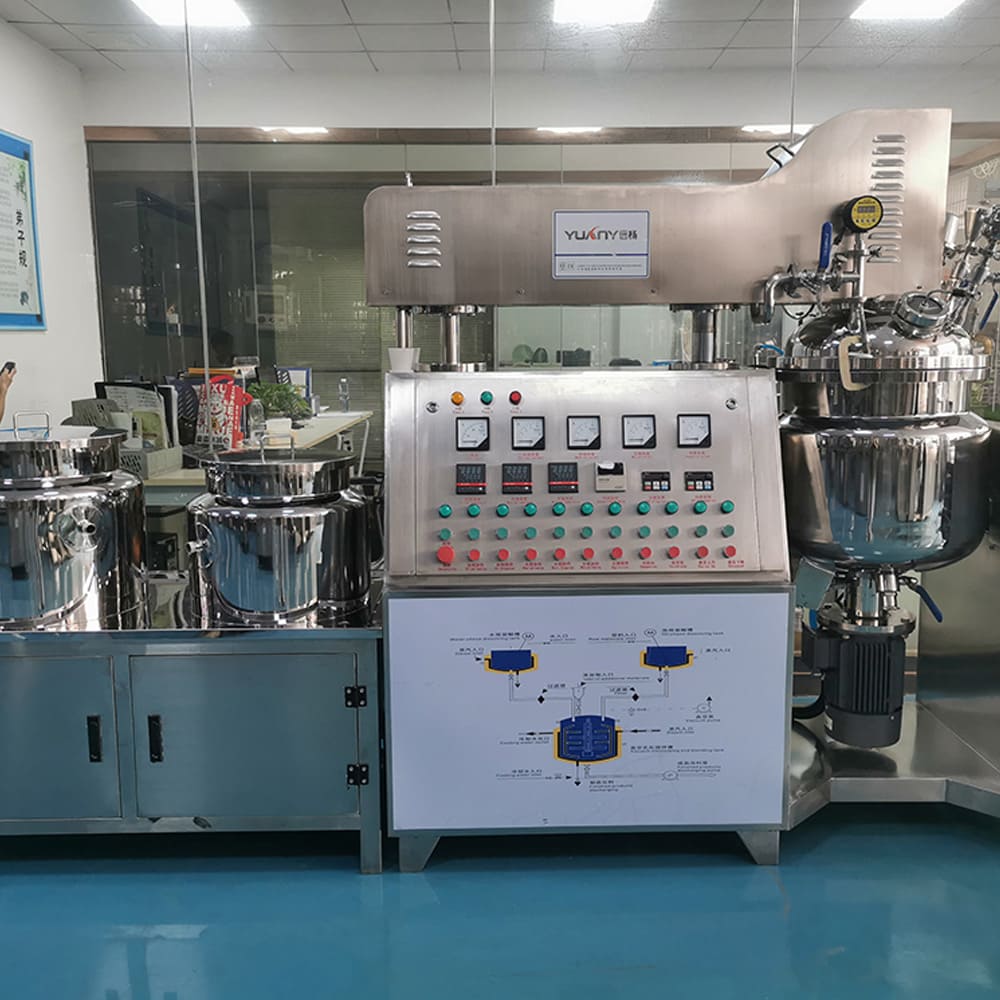
Yuanyang vacuum emulsifying mixer is a kind of emulsifier machine, the most popular cosmetics production equipment for making cream, skin-care products, ointment, paste, and emulsions.
Features:
⦁ Composed of a main emulsifying pot, a water pot, and an oil pot.
⦁ With a hydraulic lifting system, vacuum system, and electric control system.
⦁ Suitable for products of 10,000~50,000 cps viscosity.
⦁ Perfect particle size of 2 microns and evenly distributed.
This model is representative of modern vacuum emulsifying mixers used across the cosmetics industry. The guidance below applies to such machines and to plants evaluating a Vacuum Emulsifying Mixer for Sale with the same core systems: agitation/motor drive, heating/cooling jackets, vacuum pumps, hydraulic systems, and electrical controls.
Identify the major energy consumers in an emulsifying mixer system
To improve efficiency, first identify where energy is consumed. For a typical vacuum emulsifying mixer these are the main consumers:
- Mixing motor(s) and gearbox (mechanical agitation)
- Vacuum pump(s) for de-aeration and vacuum processing
- Heating and cooling systems (steam, hot water, electric heaters, chillers)
- Hydraulic lifting system and auxiliary pumps (for lids, loading systems)
- Electrical control and instrumentation (small but continuous)
Any energy-efficiency plan should address all of these areas because cumulative small improvements can yield substantial savings.
Optimize motor and drive systems (use of VFDs and high-efficiency motors)
Motors that drive disperser rotors and agitators are among the largest electrical loads. Upgrading to High Quality-efficiency motors (IE3/IE4 where applicable) and controlling speed with variable frequency drives (VFDs) gives two main benefits: reduced energy at partial loads and improved process control. VFDs allow the motor to run at the exact speed needed for different stages (pre-mix, high-shear emulsification, homogenization), often reducing energy use by 10–40% depending on the duty cycle. They also reduce mechanical stress and extend component life.
Optimize vacuum system operation and select efficient pumps
Vacuum generation is necessary for de-aeration and some formulations, but vacuum pumps can be energy-intensive. Strategies to improve efficiency include:
- Right-sizing vacuum pumps to avoid oversizing losses.
- Using dry screw or oil-sealed rotary vane pumps with modern inverter controls for part-load efficiency.
- Recovering heat from vacuum pump oil cooling where possible.
- Minimizing leaks and streamlining vacuum lines (fewer bends, appropriate diameter) to reduce required pumping capacity.
In many plants, leak reduction and right-sizing alone cut vacuum energy consumption by 10–25%.
Reduce thermal losses: insulation, accurate heating control and heat recovery
Heating and cooling cycles for emulsions are major energy sinks. Efficient thermal management includes:
- High-quality insulation on jackets, piping, and vessels to minimize standby heat losses.
- Automated PID control for steam/electric heating to avoid overshoot and long hold times.
- Heat recovery between hot and cold streams where batch timing allows (e.g., preheating incoming water with jacket condensate or waste heat).
- Using plate heat exchangers for efficient thermal transfer and reduced chiller load.
Insulation and PID control are low-cost measures with quick payback; heat recovery can deliver larger savings with longer payback but substantial lifecycle benefits.
Reduce cycle time through process and recipe optimization
Energy per unit is reduced when cycle times shorten without reducing product quality. Techniques include:
- Tuning agitator geometry and speed profile for faster emulsification at lower energy input.
- Improving ingredient pre-heating and pre-dispersion so less energy is spent in the main pot.
- Using efficient disperser and homogenizer configurations (e.g., optimized rotor-stator clearances) to achieve the target particle size (2 microns) faster.
Collaboration between process engineers and formulation chemists often yields 10–30% cycle time reductions and corresponding energy savings.
Implement intelligent control and monitoring (data-driven energy management)
Installing energy meters, logging motor power, vacuum power, and thermal energy lets teams baseline consumption and verify savings. Key elements:
- Energy submetering for mixers, vacuum pumps and heating systems.
- Automated alarms for leaks, abnormal power draw or thermal inefficiency.
- Process analytics to correlate recipe parameters with energy use and product quality.
Data-driven optimization finds opportunities people miss and documents ROI for capital improvements.
Maintenance, sealing and mechanical efficiency
Well-maintained equipment runs more efficiently. Practical actions:
- Regularly service seals, bearings and mechanical couplings to reduce frictional losses.
- Maintain gearbox lubrication and alignment; an aligned drive train reduces motor load.
- Keep jackets and heat exchange surfaces clean to maintain thermal transfer efficiency.
Simple preventive maintenance programs reduce unexpected energy waste and avoid costly downtime.
Design choices and procurement tips when buying a Vacuum Emulsifying Mixer for Sale
When selecting a vacuum emulsifying mixer, evaluate these energy-related features:
- Presence of VFDs and motor efficiency class (IE3/IE4 recommended).
- Vacuum pump type and compatibility with modern controls.
- Quality of insulation and jacket design; availability of heat recovery options.
- Automation capability for recipe-driven speed and temperature profiles.
- Ease of maintenance: access to seals, bearings and cleaning-in-place (CIP) features.
Asking vendors for measured energy consumption per batch on representative products (or a comparable base-case) will allow direct comparisons between quotations.
Comparison of common energy-saving measures: expected savings and payback
The table below shows typical ranges for energy reduction and estimated simple payback. Actual values depend on operating hours, local energy prices, and process specifics.
| Measure | Typical Energy Reduction | Estimated Simple Payback |
|---|---|---|
| Install VFDs & tune speed profiles | 10–40% | 6 months – 2 years |
| Upgrade to high-efficiency motors (IE3/IE4) | 3–8% (motor-only) | 1 – 4 years |
| Insulation & reduce thermal losses | 5–20% (heating/cooling portion) | 6 months – 2 years |
| Vacuum pump right-sizing & leak repair | 10–25% | 6 months – 2 years |
| Process optimization (recipe & pre-dispersion) | 10–30% (through cycle-time reduction) | Immediate – 1 year |
Practical implementation roadmap
Follow these steps for a manageable efficiency project:
- Baseline: meter current energy use by subsystem for several representative batches.
- Quick wins: implement insulation, tune PID control, tighten vacuum leaks, and train operators.
- Medium investments: add VFDs, upgrade motors, and implement better heat transfer components.
- Major projects: add heat recovery, replace oversized vacuum systems, or retrofit advanced automation.
- Verify: use metered data to verify savings and adjust SOPs accordingly.
YUANYANG product and brand advantages when energy efficiency matters
When evaluating a Vacuum Emulsifying Mixer for Sale, Yuanyang’s design provides tangible advantages for energy-conscious buyers:
- Integrated vacuum system and electric control system allow close coupling with VFDs and automation — enabling speed and vacuum profiling to reduce energy consumption.
- Hydraulic lifting system simplifies vessel handling and reduces auxiliary energy compared with purely pneumatic systems.
- Separate water and oil pots with a main emulsifying pot allow pre-heating and staged process flows that shorten high-energy emulsification time.
- Capability to achieve 2 micron particle sizes efficiently reduces repeated passes or extended high-shear operation, saving energy.
- Design for products in 10,000–50,000 cps viscosity range ensures efficient transmission of mechanical energy into product rather than wasteful motor overload.
Yuanyang equipment is engineered for reliable process control, which is a prerequisite for reproducible energy savings and predictable ROI.
Operational tips for shop-floor teams
To sustain savings, operators should:
- Follow standardized operating procedures (SOPs) for speed, temperature and vacuum steps.
- Record batch parameters and energy metrics to spot drift and opportunities.
- Perform quick pre-start checks on seals, insulation and pump performance.
- Coordinate batch scheduling to enable heat recovery and reduce idle warm-up losses.
Frequently Asked Questions (FAQ)
Q1: How much energy can I realistically save on an emulsifying mixer?
A1: Typical achievable savings range from 10–30% with a mix of low-cost operational changes (insulation, leak repair, SOP tuning) and modest investments (VFDs, motors). Larger projects such as heat recovery can increase lifetime savings. Exact savings depend on current baseline, operating hours, and local energy costs.
Q2: Will installing a VFD affect product quality?
A2: VFDs improve quality by enabling precise control of mixing speed during each process stage. Proper tuning ensures consistent shear rates and can improve product uniformity while reducing energy consumption.
Q3: Is vacuum always required for emulsification?
A3: Not always. Vacuum is primarily used for deaeration and certain formulation needs. Where vacuum is unnecessary, turning off the vacuum system reduces energy use. When vacuum is required, optimizing the pump and sealing minimizes energy cost.
Q4: How does particle size (e.g., 2 microns) affect energy consumption?
A4: Achieving finer particle size generally requires more shear energy or longer high-speed homogenization. Optimized rotor-stator design and pre-processing steps can achieve 2 micron targets more efficiently, reducing the need for extended high-energy runs.
Q5: What simple first steps can reduce energy consumption this month?
A5: Start with insulation checks, sealing/vacuum leak detection, tuning PID temperature control, and reviewing speed profiles. These steps require minimal capital and commonly deliver immediate savings.
Contact and product call-to-action
Energy-efficient operation also relies on materials, which is why procurement teams check hygienic materials and seals for emulsifying mixers to maintain safety and compliance.If you are evaluating a Vacuum Emulsifying Mixer for Sale or want a site-specific energy-efficiency plan for your Yuanyang mixer, contact our sales and technical team for a consultation and measured energy baseline. View the product details and request a quote: Vacuum Emulsifying Mixer for Sale. For immediate inquiries email [email protected] or call your regional representative to schedule a free process review.
Authoritative references and further reading
References used for energy-saving principles and equipment guidance:
- Emulsification — Wikipedia: https://en.wikipedia.org/wiki/Emulsification
- U.S. Department of Energy — Variable Frequency Drives: https://www.energy.gov/eere/amo/variable-frequency-drives
- U.S. Department of Energy — Energy-Efficient Motor Selection: https://www.energy.gov/eere/amo/energy-management-best-practices-motor-systems
- International Energy Agency — Energy Efficiency: https://www.iea.org/topics/energy-efficiency
- Engineering Toolbox — Vacuum Pumps: https://www.engineeringtoolbox.com/vacuum-pumps-d_949.
Everything You Need to Know About laboratory dry powder mixer
Everything You Need to Know About paste filling machine
Top 10 ketchup vacuum emulsifying mixer Manufacturers and Supplier Brands in America
Top 10 powder ribbon mixer Manufacturers and Supplier Brands
Melting Tank
Can you add a mixing function for the tank with heater?
Sure, the cooling tank or heating tank can be customized with top mixing such as paddle, or frame, or scrapers. And client can choose a fixed speed 60rpm, or standard 0-60 rpm with speed adjustment, or customize other speed.
Desktop Bottle Sealing Machine
Do you have a standing portable bottle sealer to be put directly after my automatic capping machine?
Yes, we have a vertical movable type lid sealer which can be directly put after capping machine as long as there is space for conveyor. The movable type can be used with conveyor directly.
Sachet Packaging Machine
Should I provide film design to customize the bag packaging machine?
Yes, the small bag packing machine module will be customized according to client’s film width. We also provide film design service for clients.
Sachet Packaging Machine for Granules
Is the sachet packing machine equipped with a feeder also?
The standard quote is not included with a feeder, but we can add a feeder especially for the bag packaging machine if client need.
Homogenizing Mixer
Do you have temperature control system for the shampoo making machine?
Yes, there is temperature probe into tank at bottom. It detects temperature and display on the control panel. What’s more, the target temperature can be set.
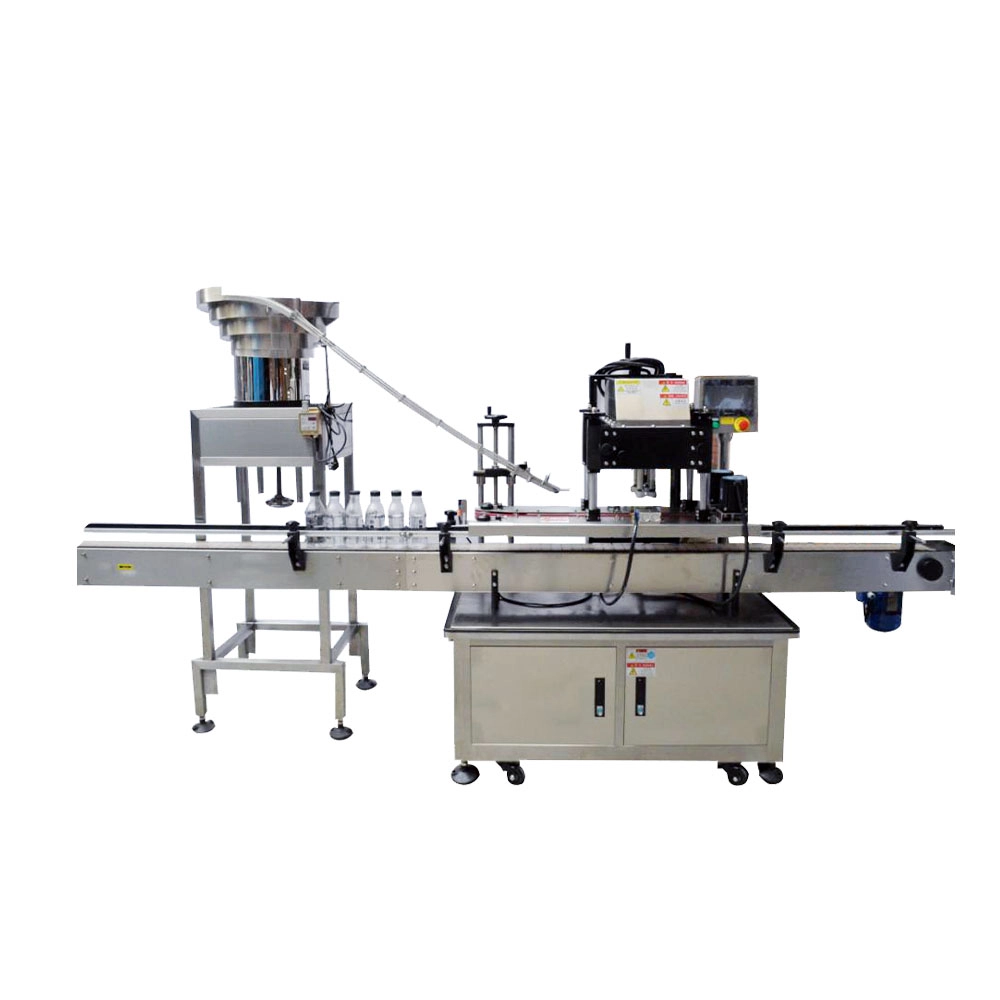
Automatic Plastic Caps Capping Machine with Vibrating Cap Feeder for Sale
Yuanyang automatic screw capping machine is a kind of four-wheel bottle capping machine. The automatic screw capper is often used to close lids of containers such as bottles and jars, especially for plastic bottles, which are widely used in food, medicine, chemical, cosmetic, and other industries for mass production and continuous production lines.
Features:
⦁ Full pneumatic drive;
⦁ Automated fast speed;
⦁ Suitable for various screw caps, pumps, and spray bottles.
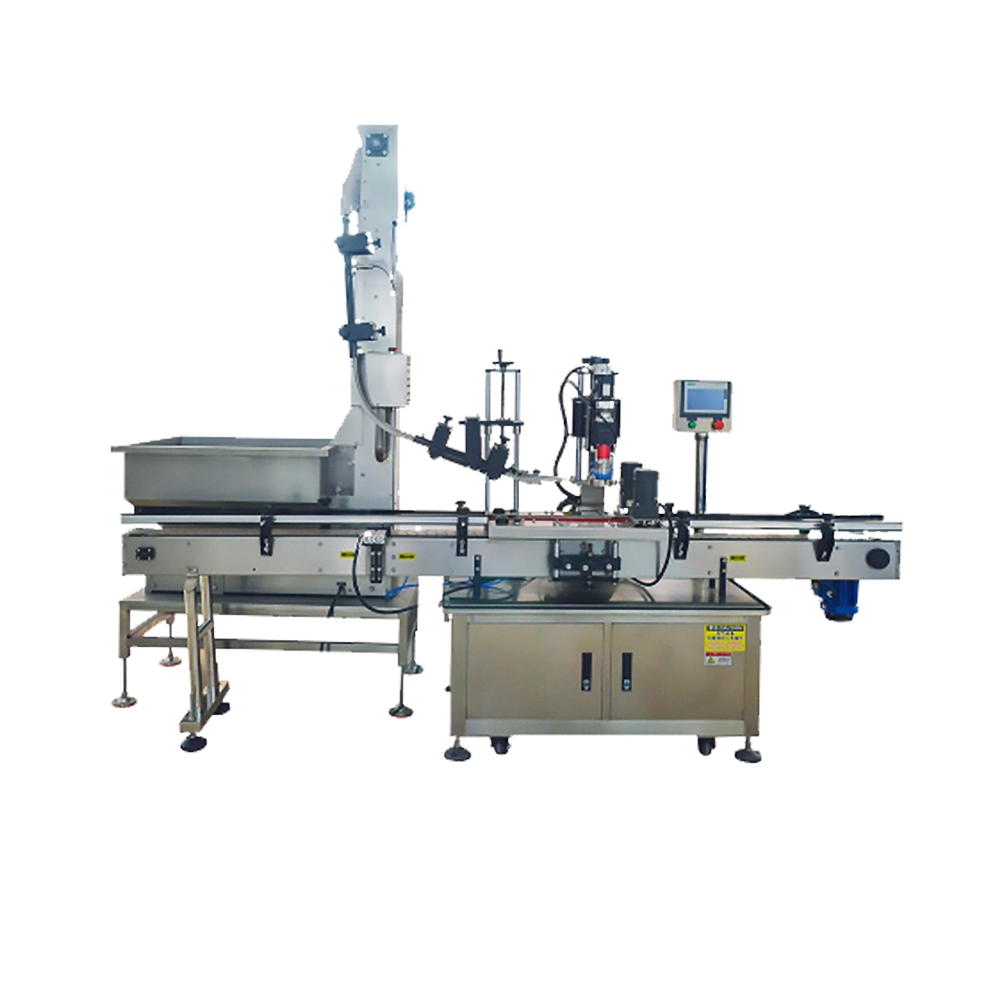
Automatic Metal Caps Capping Machine for Sale
Yuanyang automatic metal cap capping machine is a bottle capper for bottles with metal caps, which is often used to close lids of containers such as bottles and jars. The glass bottle metal capping machine is widely used in food, medicine, chemical, cosmetic, and other industries for mass production and continuous production line .
Features:
⦁ Pneumatic and electric drive;
⦁ Automated fast speed;
⦁ Suitable for glass bottles with metal caps.
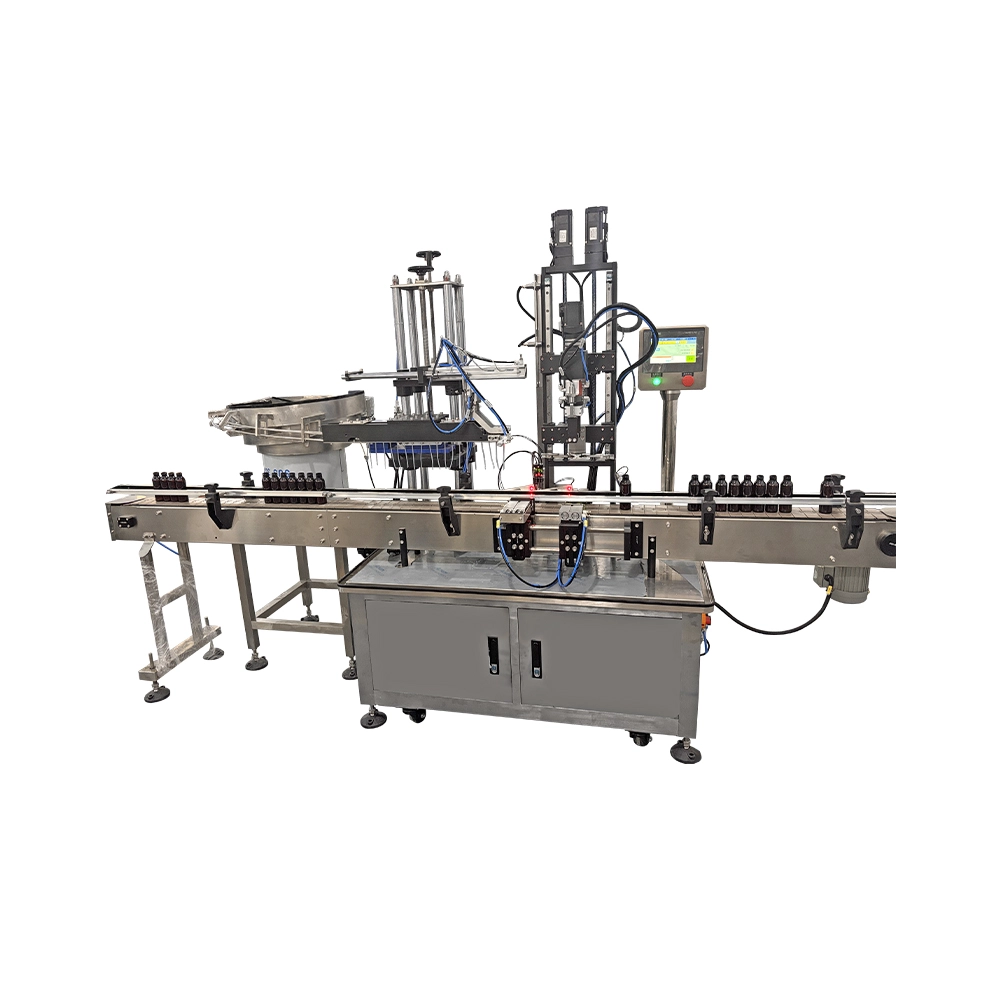
Automatic Pump Head Feeding and Capping Machine for Sale
Yuanyang automatic pump head feeding and capping machine is a bottle cap sorter and capper for bottles with pump heads, which is often used to close lids of containers such as nail polish, sprayers, and shampoo. The capping machine with a pump head feeder is widely used in food, medicine, chemical, cosmetic, and other industries for mass production and continuous production line .
Features:
⦁ Pneumatic and electric drive;
⦁ Automated fast speed;
⦁ Suitable for various types of caps.
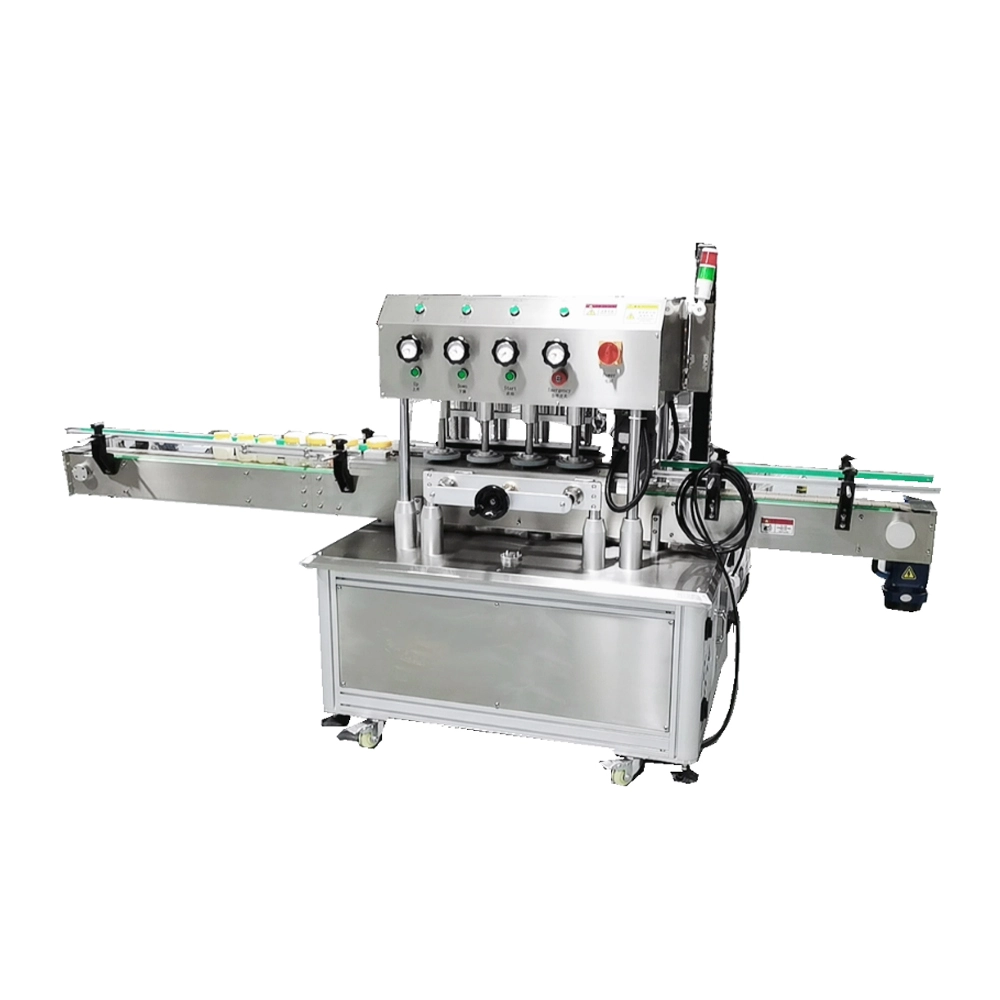
Automatic High Speed Capping Machine for Sale
The Yuanyang automatic high-speed capping machine is a kind of 8-wheel bottle-capping machine with fast working efficiency. The automatic capper is often used to close lids of containers such as bottles and jars, especially for plastic bottles, which are widely used in food, medicine, chemical, cosmetic, and other industries for mass production and continuous production lines.
Features:
⦁ Electric drive;
⦁ Automated fast speed;
⦁ Suitable for various screw caps, pumps, and spray bottles.
 Scan QR Code
Facebook
YouTube
LinkedIn
Whatsapp: +8613434139712
Guangzhou Yuanyang Machinery