





Choosing Mixers for High-Viscosity Products and Emulsions
- Selecting the Right Mixing Tank and Homogenizer for Thick Liquids
- Understanding high-viscosity mixing challenges
- Core selection criteria: shear, torque and heat transfer
- Relevant standards and references
- Mixing Tank Design Elements that Matter
- Tank geometry and baffles
- Wall scrapers, jackets and sanitary finish
- Material selection and CIP considerations
- Choosing the Right Agitator and Homogenizer Combination
- High-shear rotor-stator homogenizers vs. low-speed agitators
- Inline vs. batch homogenization
- Impeller types and performance comparison
- Process Parameters and Practical Tips for Emulsions
- Controlling shear rate and droplet size
- Temperature, viscosity and phase inversion
- Practical workflow for a typical liquid soap or shampoo batch
- Case Study: Homogenizing Mixer for Sale — Product Overview
- Why this configuration works for viscous emulsions
- Application examples and expected performance
- Maintenance, Safety and Scale-Up Considerations
- Maintenance and wear parts
- Scale-up principles
- Safety and regulatory notes
- Brand Advantages and Why Choose Yuanyang Homogenizing Mixer
- Engineering for hygienic, efficient mixing
- Operational and economic benefits
- Service, validation and support
- Frequently Asked Questions (FAQ)
- Q1: Do I need a high-shear homogenizer for all thick liquids?
- Q3: Can I retrofit a homogenizer into my existing mixing tank?
- Q4: How do I prevent foaming and air entrapment?
- Q5: What are typical power requirements for high-viscosity mixing?
- Authoritative References
This guide helps engineers, production managers, and formulators select the optimal mixing tank and homogenizer configuration for high-viscosity liquids and stable emulsions. It emphasizes practical criteria — shear rate, tank geometry, rotor-stator vs. low-speed agitators, wall scrapers, heating/cooling jackets, and clean-in-place (CIP) — so you can reduce batch time, improve uniformity, and scale reliably. The content uses semantic keywords like mixing vessel, high-shear homogenizer, shear rate, wall scrapers, rotor-stator, and sanitary design to support discoverability and provide actionable, E-E-A-T-aligned guidance. Handling challenging formulations increases wear, which is why a clear maintenance checklist for homogenizing mixers and mixing tanks is vital.
Selecting the Right Mixing Tank and Homogenizer for Thick Liquids
Understanding high-viscosity mixing challenges
High-viscosity products (e.g., concentrated shampoos, body washes, thick detergents, sauces) behave differently from low-viscosity fluids. They resist flow, require higher torque, and are prone to incomplete dispersion and air entrainment. Key issues include insufficient shear to break agglomerates, dead zones near the tank wall, and long residence times that increase thermal exposure. Using the right mixing tank geometry and drive system reduces these problems.
Core selection criteria: shear, torque and heat transfer
When choosing equipment, prioritize these measurable factors: shear rate (for emulsification and size reduction), available torque (to move viscous bulk), and heat transfer capability (jacketed mixing vessel for heating/cooling). A high-shear homogenizer delivers localized high shear to form stable emulsions, while an anchor or helical agitator provides bulk movement. Combining both — a mixing tank with a high-shear homogenizer integrated — is often the best solution for very thick liquids.
Relevant standards and references
For technical context on mixing and homogenization, refer to authoritative resources such as Mixing (process engineering) on Wikipedia and Homogenization (chemistry). Industry guidance (e.g., AIChE materials) complements these sources for process-scale decisions.
Mixing Tank Design Elements that Matter
Tank geometry and baffles
Tank shape (cylindrical with dished ends is common) and the presence of baffles influence vortex formation and mixing patterns. For viscous systems, vertical baffles help disrupt swirling and promote axial and radial flow so the entire mixing vessel is engaged. Baffles combined with proper impeller selection reduce dead zones and improve homogeneity.
Wall scrapers, jackets and sanitary finish
Wall scrapers (e.g., PTFE wall scrapers stirring at top) prevent product build-up on the tank wall, ensuring consistent mixing and heat transfer. A heating/cooling jacket accelerates temperature control for viscosity-sensitive formulations. For hygienic products (shampoos, hand sanitizers, food sauces), a polished sanitary finish and CIP capability are essential.
Material selection and CIP considerations
Choose stainless steel (316 or 304 depending on chemistry) for corrosion resistance and cleanability. Ensure the mixing tank includes ports for CIP nozzles, drainability, and access for manual cleaning when necessary. Sanitary valves and tri-clamp fittings reduce contamination risk for personal-care and food products.
Choosing the Right Agitator and Homogenizer Combination
High-shear rotor-stator homogenizers vs. low-speed agitators
High-shear homogenizers (rotor-stator designs) create intense local shear that reduces droplet size for stable emulsions. They are ideal for emulsification steps in shampoo and liquid soap production. Low-speed agitators (anchor, paddle) provide bulk mixing, handle high viscosity with low shear, and minimize aeration. Combining both — a high-shear homogenizer at the bottom plus PTFE scrapers and a top agitator — provides the best of both worlds.
Inline vs. batch homogenization
Inline (recirculation) high-shear units can process continuously through a rotor-stator or high-pressure homogenizer, reducing batch time and improving repeatability. Batch homogenization with an integrated high-shear head inside the mixing tank is simpler for small to medium batches and easier to maintain. Choose inline when scalability and continuous processing are priorities.
Impeller types and performance comparison
Different impellers are optimized for different tasks. Below is a comparison to guide selection.
| Impeller Type | Best For | Strengths | Limitations |
|---|---|---|---|
| Rotor-stator (high-shear) | Emulsification, dispersion | High shear, small droplet size, fast | High energy use, localized heating |
| Anchor / Scraper | Very high viscosity bulk movement | Low shear, prevents wall build-up | Slow mixing for emulsions |
| Paddle / Turbine | Medium viscosity blends | Good balance of shear and flow | Less effective for very thick systems |
| Planetary / Double planetary | High-viscosity, solids-containing pastes | Excellent for kneading, dispersion | Complex and more expensive |
Process Parameters and Practical Tips for Emulsions
Controlling shear rate and droplet size
Droplet size distribution defines emulsion stability. Control rotor speed, gap in rotor-stator elements, and residence time to reach the target droplet size without over-shearing. For many personal-care emulsions, a rotor-stator homogenizer adjusted to medium-high shear provides the optimal balance between size reduction and product integrity.
Temperature, viscosity and phase inversion
Temperature affects viscosity and emulsifier performance. Use the mixing tank’s jacket to adjust temperature and reach ideal viscosity for dispersion. Watch for phase inversion: if the continuous phase changes (oil-in-water to water-in-oil), product properties shift dramatically. Maintain controlled addition rates, pre-wetting solids, and correct emulsifier concentration.
Practical workflow for a typical liquid soap or shampoo batch
A recommended sequence using a homogenizing mixer in a mixing tank:
- Charge water and preheat to process temperature via heating jacket.
- Pre-disperse powders or thickeners using low-speed agitation while avoiding dusting.
- Activate high-shear homogenizer to wet and break agglomerates; recirculate as needed.
- Add surfactants and active phases slowly while homogenizing to prevent local concentration spikes.
- Finish with low-speed anchor/scraper agitation to adjust viscosity and remove air pockets.
Case Study: Homogenizing Mixer for Sale — Product Overview
Product Name: Homogenizing Mixer for Sale
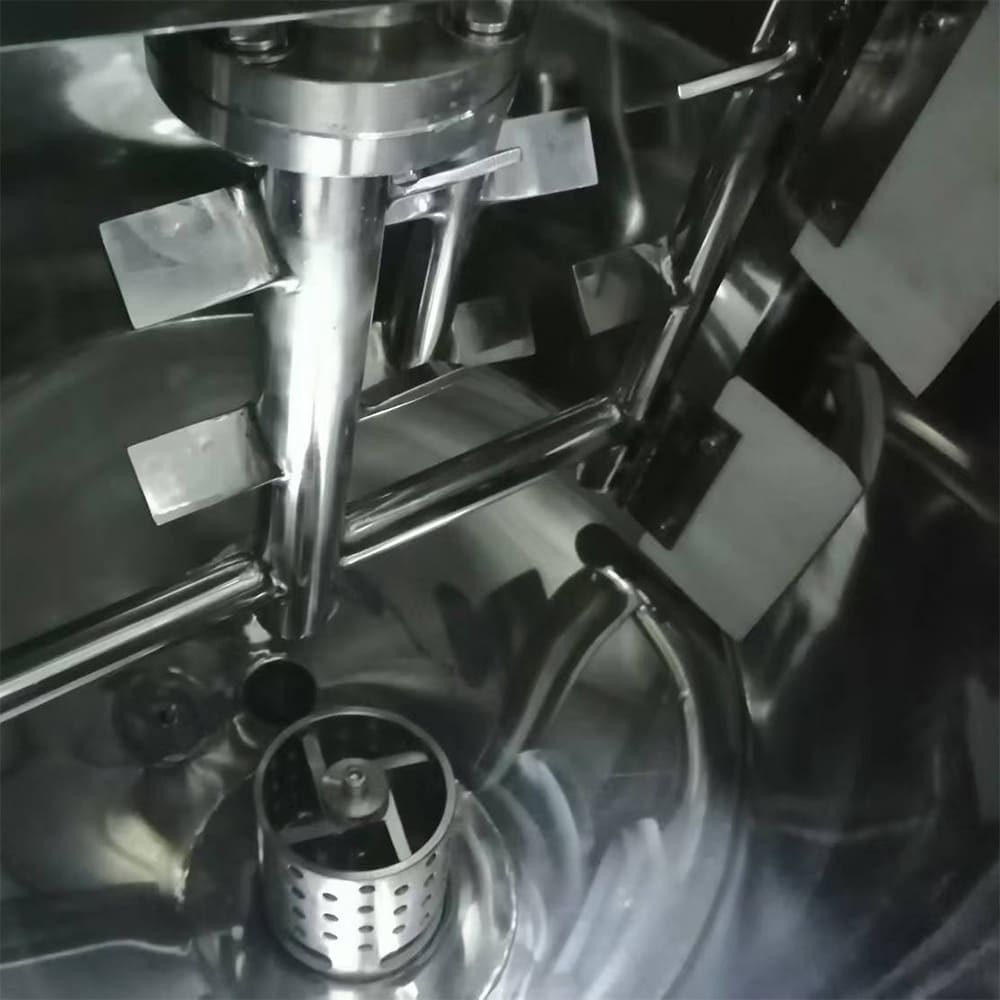
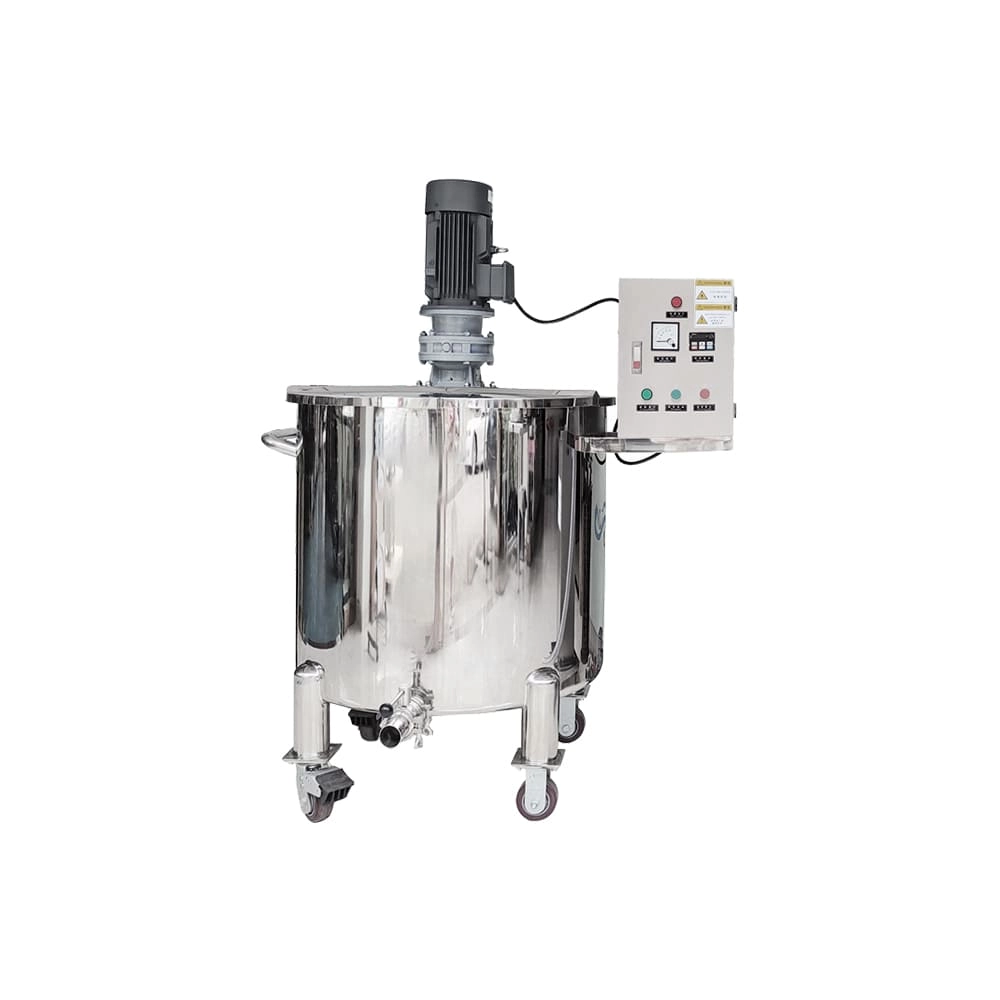
Yuanyang homogenizing mixer is a liquid mixing tank with a high-shear homogenizer. The homogeneous mixing machine is the core part for the liquid soap production line for shampoo, body wash, laundry detergent, dish soap, hand sanitizer, and other thick liquids.
Features:
⦁ Flat top half-open lid, electric control system.
⦁ Suitable for various liquid cleaning products and sauces.
⦁ PTFE wall scrapers stirring at top, high shear homogenizer at bottom.
Why this configuration works for viscous emulsions
The Yuanyang homogenizing mixer integrates a high-shear homogenizer at the bottom of the mixing tank for droplet break-up and intense dispersion, while PTFE wall scrapers and a top agitator ensure uniform bulk movement and prevent fouling. The flat top half-open lid eases ingredient charging and cleaning. This balanced approach reduces batch time and improves the reproducibility of products like thick detergents and shampoos.
Application examples and expected performance
Typical applications include personal care (shampoo, body wash), household cleaners (laundry detergent, dish soap), and food sauces. Users report improved emulsion stability, shorter mixing cycles versus low-shear-only systems, and reduced post-mixing screening due to fewer agglomerates.
Maintenance, Safety and Scale-Up Considerations
Maintenance and wear parts
High-shear components (rotor/stator) and seals require routine inspection. Use wear-resistant materials for rotors and easy-to-replace stator inserts. Check PTFE scrapers for abrasion and ensure drive bearings are lubricated per manufacturer instructions.
Scale-up principles
Scale-up requires preserving shear environment and mixing dynamics. Maintain similar tip speed or energy per unit volume when increasing tank size. Consider pilot trials or computational fluid dynamics (CFD) to predict mixing patterns. Inline homogenizers can offer easier scale-up by using proportional flow rates and maintaining device geometry.
Safety and regulatory notes
For products intended for skin contact or food, ensure materials are food-grade and validated for hygienic design. Maintain documentation for cleaning validation and batch records. Refer to regulatory guidance for specific claims and safety testing.
Brand Advantages and Why Choose Yuanyang Homogenizing Mixer
Engineering for hygienic, efficient mixing
Yuanyang combines a dedicated high-shear homogenizer with PTFE scrapers and a top agitator in a stainless mixing vessel to deliver efficient emulsification and bulk handling. The design reduces dead zones, speeds heat transfer via the tank jacket, and supports CIP for sanitary production.
Operational and economic benefits
Faster batch times, improved product uniformity, and reduced rework save operational costs. The integrated design minimizes footprint versus separate inline and batch units, and the flat top half-open lid simplifies manual charging and inspection.
Service, validation and support
Choose a supplier offering technical support for process setup, spare parts for rotors/stators, and documentation for cleaning and validation. Yuanyang provides factory support and configuration guidance for liquid soap and detergent production lines.
Frequently Asked Questions (FAQ)
Q1: Do I need a high-shear homogenizer for all thick liquids?
A1: Not always. If your product is extremely thick and requires gentle bulk movement (e.g., some pastes), a planetary or anchor mixer may suffice. For stable emulsions, droplet size control, and fast dispersion of powders/surfactants, a high-shear homogenizer is typically necessary.
Q3: Can I retrofit a homogenizer into my existing mixing tank?
A3: Many tanks can accommodate a bottom- or side-mounted rotor-stator unit, but structural and drive capacity must be checked. Ensure the tank has proper supports, seals, and access for the homogenizer. Consult a qualified supplier for retrofit assessments.
Q4: How do I prevent foaming and air entrapment?
A4: Use low-shear bulk agitation after high-shear steps, add defoamers if compatible, control addition rates, and design charging to minimize splash. Vacuum deaeration can also help for very sensitive products.
Q5: What are typical power requirements for high-viscosity mixing?
A5: Power depends on batch size, viscosity, and impeller type. High-viscosity mixing often requires higher torque but lower tip speed. Specify mixers with adequate gear/motor sizing and variable frequency drives (VFDs) to adapt torque and speed.
If you’d like product details, pricing, or a process consultation, please contact our sales team or view the Homogenizing Mixer for Sale to discuss your formulation and production needs.
Authoritative References
How to Choose Right double side labeling machine manufacturer and supplier in Africa?
Customization Options and Accessories for Agitator Tanks
The 10 Key Factors in dip seal melting tank That Affect Cost
How to manufacturing bottle filling capping machine in Europe
Portable Storage Tank
Can you make the leg longer, I need a higher discharge outlet?
Yes, the tank legs length is customized as well as the discharge outlet height.
Liquid Soap Mixer Machine
When shall we choose electric heating or steam heating?
The electric heating is with bottom electric tubes, the cost is lower compared with steam heating, which requires a steam generator and needs steam pipes. So we recommend small business choose electric heating for small capacity.
Liquid Soap Making Machine
Does the stainless steel mixing tank for liquid soap has jacket?
The mixing tank can be customized single layer, double layers, or three layers. The double layers type has one jacket for cooling purpose. The three layers type has double jacket, inner jacket for heating/cooling, outer jacket for insulation and protection purpose.
High shear homogneizer
How does the rotor and stator work?
When the equipment is running, the rotor drives the blade to rotate at a high speed, generating a strong centrifugal force field, and forming a negative pressure zone in the center of the rotor, which inhales the material liquid. Under the action of centrifugal force, the material spreads from the center to the four sides, and is subjected to the stirring and shearing action of the blades during the diffusion process. The material is subjected to further shearing action in the narrow gap between the end face of the blade and the inner side of the stator tooth ring, and then enters the narrow gap between the rotating tooth and the fixed tooth of the inner ring, and is affected by mechanical force and hydrodynamics effect, resulting in shearing, friction and impact, so that dispersed phase particles or droplets are broken. As the linear speed of the tooth is gradually increased from the inner ring to the outer ring, the crushing environment of the material is continuously improved, and the purpose of homogenizing emulsification is finally achieved.
Automatic Servo Motor Capping Machine
Is the servo capper be compatible for different bottle size and shapes?
Yes, the capping wheels can be adjusted higher or lower for different bottle height. The distance between wheels can be wider or closer for different cap diameter.
Automatic Plastic Caps Capping Machine with Vibrating Cap Feeder for Sale
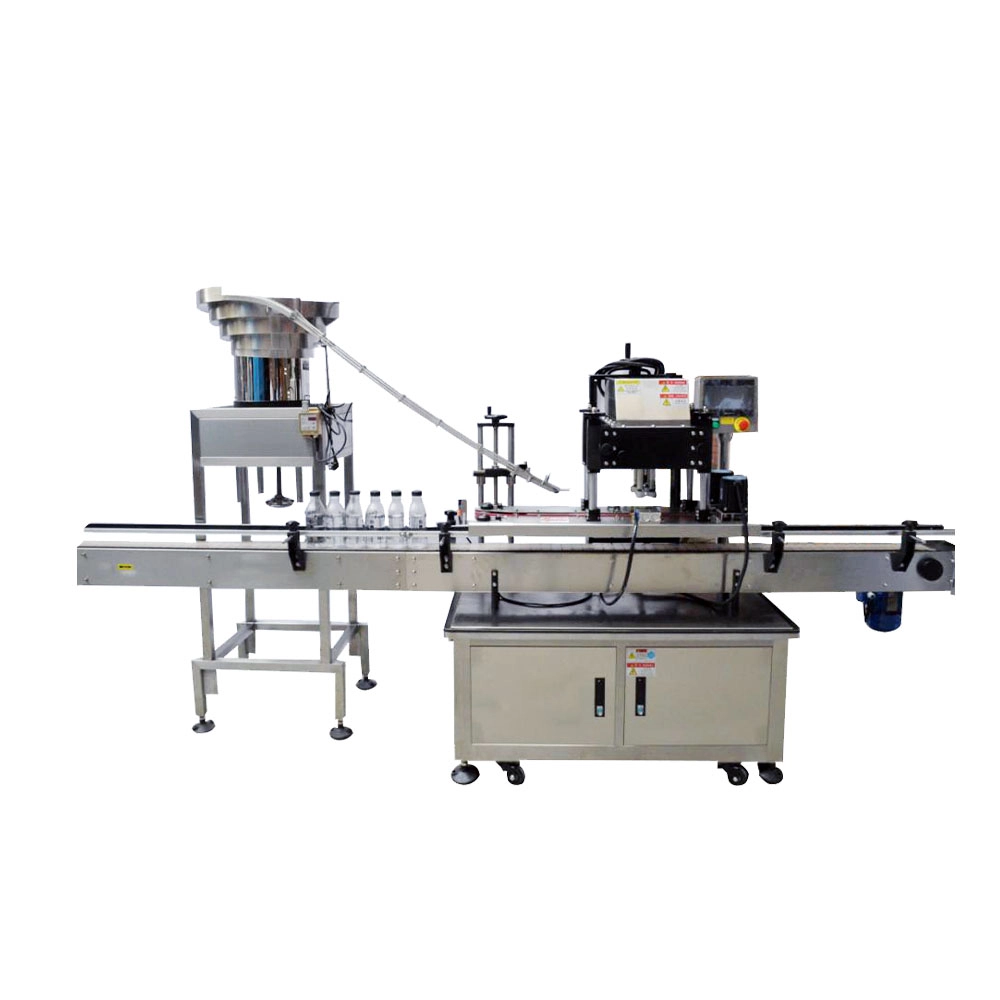
Yuanyang automatic screw capping machine is a kind of four-wheel bottle capping machine. The automatic screw capper is often used to close lids of containers such as bottles and jars, especially for plastic bottles, which are widely used in food, medicine, chemical, cosmetic, and other industries for mass production and continuous production lines.
Features:
⦁ Full pneumatic drive;
⦁ Automated fast speed;
⦁ Suitable for various screw caps, pumps, and spray bottles.
Automatic Metal Caps Capping Machine for Sale
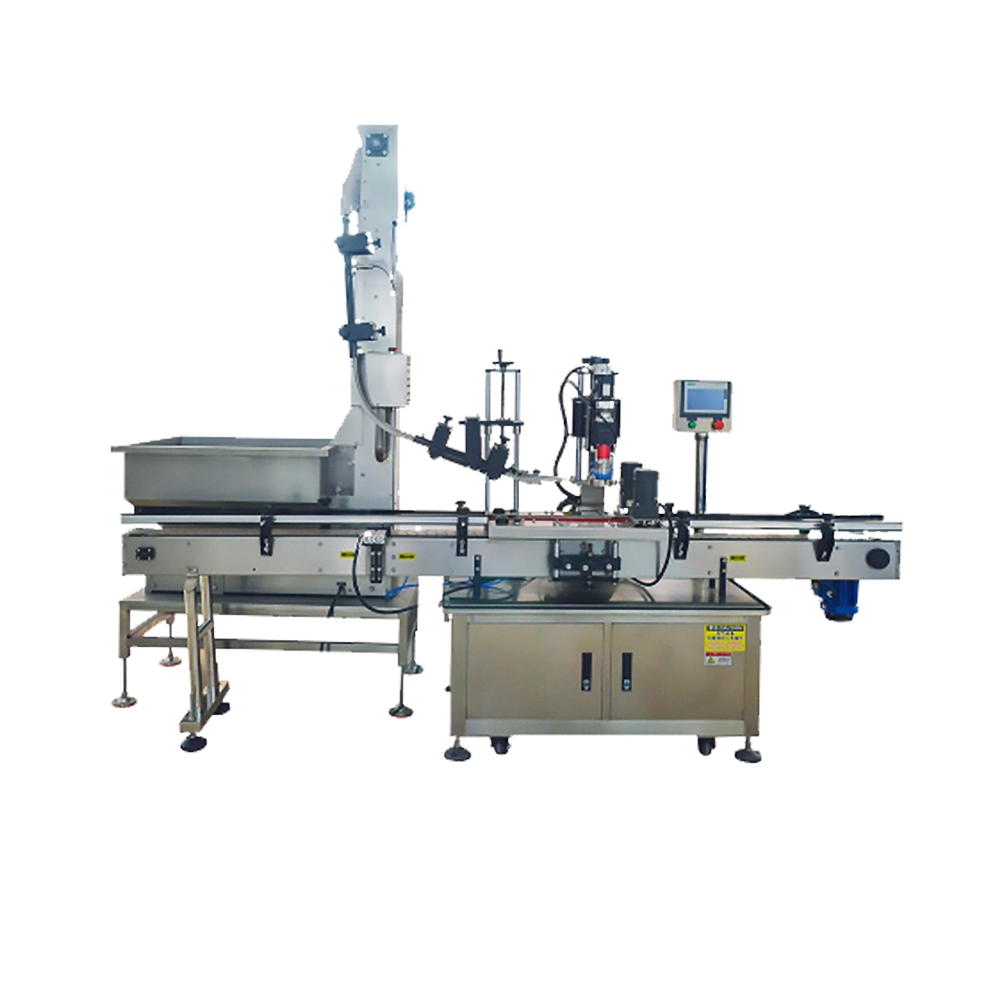
Yuanyang automatic metal cap capping machine is a bottle capper for bottles with metal caps, which is often used to close lids of containers such as bottles and jars. The glass bottle metal capping machine is widely used in food, medicine, chemical, cosmetic, and other industries for mass production and continuous production line .
Features:
⦁ Pneumatic and electric drive;
⦁ Automated fast speed;
⦁ Suitable for glass bottles with metal caps.
Automatic Pump Head Feeding and Capping Machine for Sale
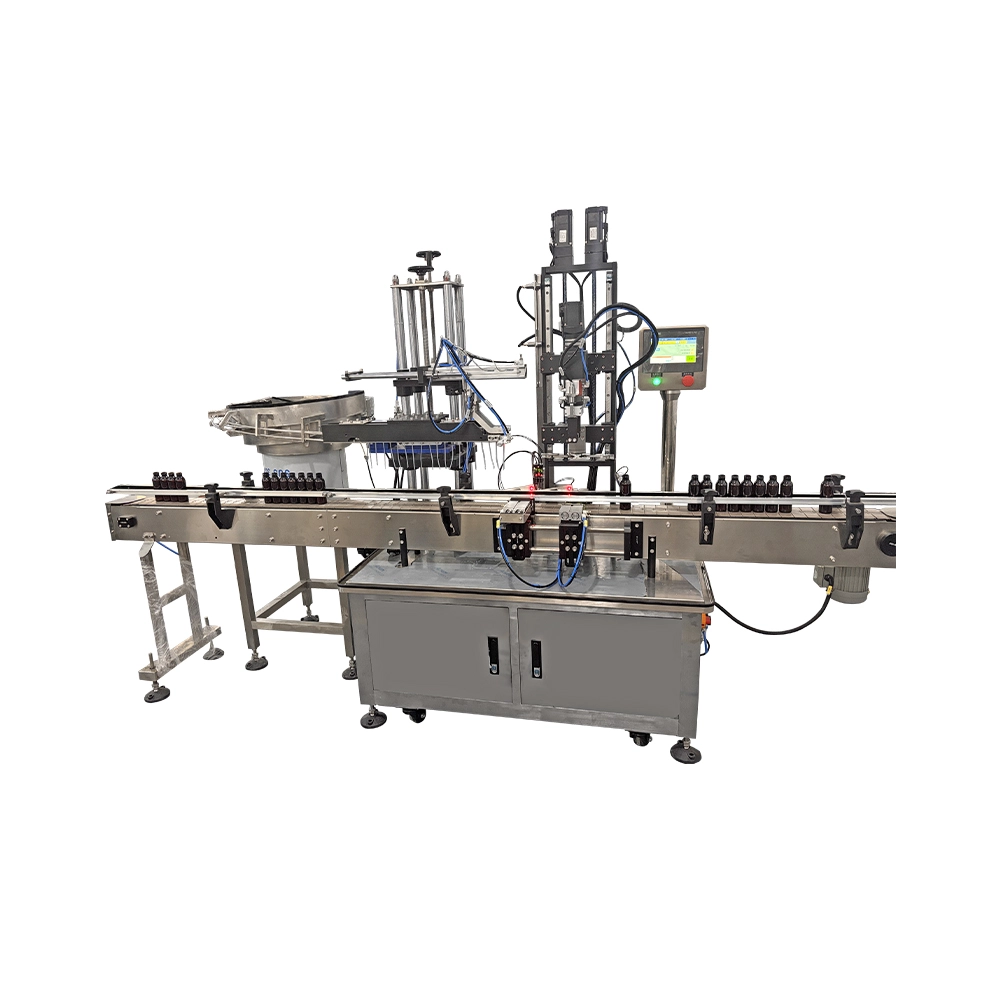
Yuanyang automatic pump head feeding and capping machine is a bottle cap sorter and capper for bottles with pump heads, which is often used to close lids of containers such as nail polish, sprayers, and shampoo. The capping machine with a pump head feeder is widely used in food, medicine, chemical, cosmetic, and other industries for mass production and continuous production line .
Features:
⦁ Pneumatic and electric drive;
⦁ Automated fast speed;
⦁ Suitable for various types of caps.
Automatic High Speed Capping Machine for Sale
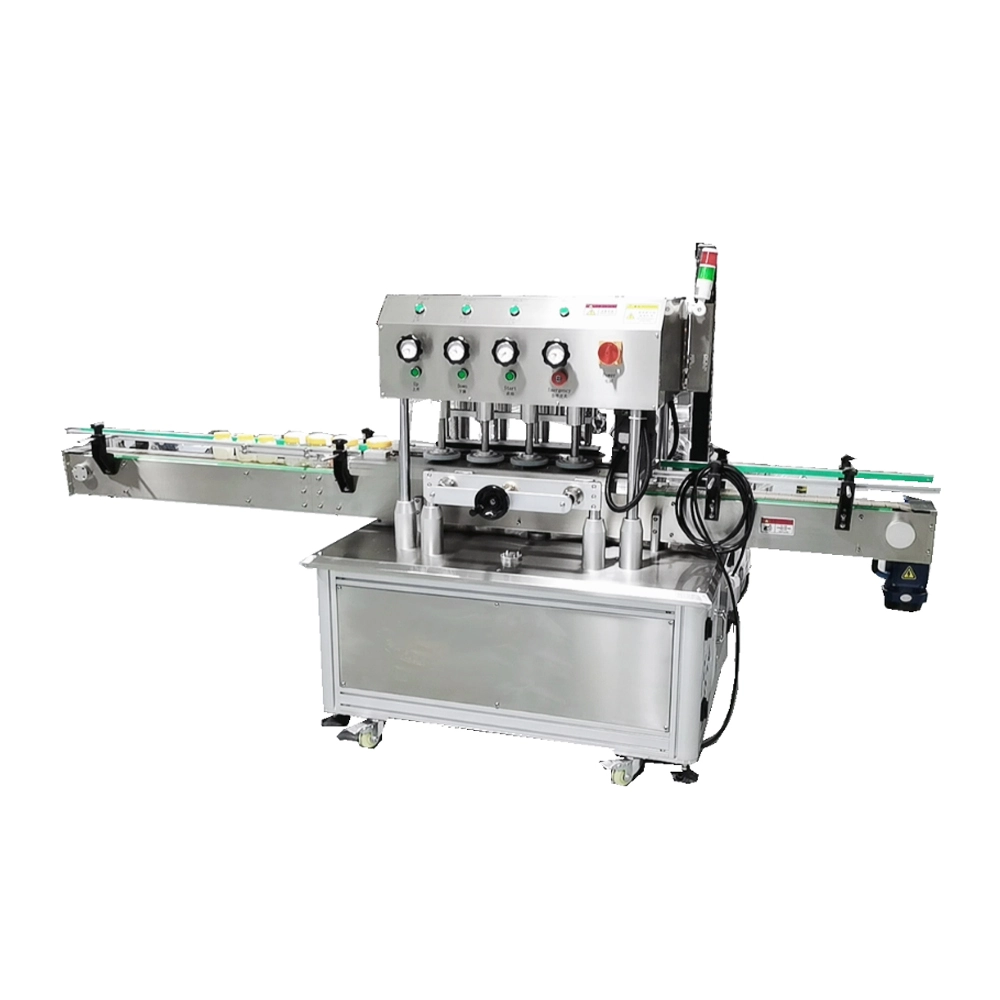
The Yuanyang automatic high-speed capping machine is a kind of 8-wheel bottle-capping machine with fast working efficiency. The automatic capper is often used to close lids of containers such as bottles and jars, especially for plastic bottles, which are widely used in food, medicine, chemical, cosmetic, and other industries for mass production and continuous production lines.
Features:
⦁ Electric drive;
⦁ Automated fast speed;
⦁ Suitable for various screw caps, pumps, and spray bottles.
 Scan QR Code
Facebook
YouTube
LinkedIn
Whatsapp: +8613434139712
Guangzhou Yuanyang Machinery