





Key Features to Look in a Homogenizing Mixer for Sale
- Key Features to Look in a Homogenizing Mixer for Sale
- Understand the role of the mixing tank and homogenizer in your process
- Why high-shear homogenization matters for product quality
- Rotor-stator design and shear mechanism
- Mixing tank design: shape, lid, scrapers and jackets
- Wall scrapers and internal agitators
- Jacketed tanks and thermal control
- Material compatibility, finishes and compliance
- Power, controls and automation
- Control features to prioritize
- Sanitation, CIP capability and maintenance
- Recommended sanitary features
- Safety, instrumentation and regulatory compliance
- Energy efficiency and operating cost considerations
- Sizing your mixing tank and homogenizer for throughput
- Applications: what products benefit from a homogenizing mixer
- How to evaluate suppliers when buying a Homogenizing Mixer for Sale
- Commercial and service criteria
- Why choose Yuanyang Homogenizing Mixer for Sale
- Installation, commissioning and operator training
- Frequently Asked Questions
- Contact us and view the product
- Authority references and further reading

Key Features to Look in a Homogenizing Mixer for Sale
Choosing the right Homogenizing Mixer for Sale is critical for manufacturers of shampoo, body wash, laundry detergent, dish soap, hand sanitizer and other high-viscosity liquids. The correct mixing tank and homogenizer combination determines product quality, process efficiency, sanitation, and operating cost. This article, written for production managers, engineers, and procurement teams, explains the essential features to evaluate when buying a homogenizing mixer so you can match equipment to product, throughput and regulatory requirements.
Understand the role of the mixing tank and homogenizer in your process
The core function of a homogenizing mixer is to create a stable, uniform product by applying shear and agitation to disperse, emulsify, and de-aerate liquid components. In most liquid cleaning product lines the homogenizing unit is integrated with a mixing tank. The mixing tank is where bulk ingredients are combined, heated or cooled, and held while shear from a high-shear homogenizer produces the final particle or droplet size distribution. Proper selection of both the tank and homogenizer is required to reach the target viscosity, clarity, and stability for consumer products.
Product example: Yuanyang homogenizing mixer is a liquid mixing tank with a high-shear homogenizer. The homogeneous mixing machine is the core part for the liquid soap production line for shampoo, body wash, laundry detergent, dish soap, hand sanitizer, and other thick liquids.
Features:
⦁ Flat top half-open lid, electric control system.
⦁ Suitable for various liquid cleaning products and sauces.
⦁ PTFE wall scrapers stirring at top, high shear homogenizer at bottom.
Why high-shear homogenization matters for product quality
High-shear homogenizers reduce droplet and particle sizes rapidly, which improves emulsion stability, texture, opacity and foaming behavior in personal care and household products. Look for homogenizers that offer adjustable shear intensity, predictable energy input per unit volume, and robust rotor-stator geometry. These factors control final product attributes such as smoothness, suspension stability and microbial risk by removing entrained air.
Rotor-stator design and shear mechanism
Key technical considerations for the homogenizer include rotor speed range, stator geometry, clearance between rotor and stator, and construction material. Rotor-stator systems produce intense localized shear at the rotor-stator interface. Choose designs that allow fine-tuning of shear intensity and are easy to disassemble for maintenance. For viscous liquids, a homogenizer optimized for high torque at low speed can be preferable to a very high-speed design.
Mixing tank design: shape, lid, scrapers and jackets
Tank design directly affects heat transfer, mixing uniformity and cleaning. Important features to evaluate include vessel shape, presence of a half-open or full lid, wall scrapers, and jackets for heating or cooling. The Yuanyang unit offers a flat top half-open lid and PTFE wall scrapers, which are beneficial for viscous liquids that tend to stick to the walls and for easier manual addition of raw materials.
Wall scrapers and internal agitators
Wall scrapers maintain contact between the agitator and the tank wall, preventing dead zones and ensuring uniform thermal transfer. PTFE scrapers provide low friction and chemical resistance, which is helpful when processing surfactants or acidic additives. Look for scraper clearance adjustability and food- or cosmetic-grade materials when applicable.
Jacketed tanks and thermal control
Accurate temperature control is essential for dissolving solids, reducing viscosity for pumping, and controlling reaction kinetics. Choose a mixing tank with a jacket sized for your heat transfer needs and with ports for steam, hot water, or glycol depending on the process. PID temperature control integrated into the electric control system improves repeatability.
Material compatibility, finishes and compliance
Material selection affects product safety, corrosion resistance, and cleaning. For most liquid cleaning products and sauces, stainless steel 316L is recommended for its corrosion resistance and weldability. Surface finish matters: a 0.6 to 0.8 micron Ra polished interior reduces residue adhesion and microbial harborage, and complies with many hygiene standards. Verify certifications like 3-A sanitary standards or similar industry norms if you produce food or pharma-adjacent items.
Power, controls and automation
Motor power, gearbox design, and control systems determine how easily you can scale, replicate batches and maintain consistent product attributes. Choose a homogenizing mixer with a VFD (variable frequency drive), an electric control system with clear interface and PLC options for recipe control. The Yuanyang unit lists an electric control system which helps automate start/stop sequences, homogenizer speed profiles and temperature control.
Control features to prioritize
Look for: programmable recipes, motor overload protection, sealed electrical cabinets rated for the environment, remote monitoring capability and simple human-machine interfaces. These features increase reproducibility and reduce operator error.
Sanitation, CIP capability and maintenance
Cleaning in place (CIP) and ease of maintenance are major drivers of uptime and product safety. Homogenizing mixers with accessible rotor-stator assemblies, hygienic seals, and ports for CIP spray nozzles reduce cleaning time and contamination risk. Consider mechanical seal vs lip seal tradeoffs and whether seals are compatible with your product chemistry and CIP media.
Recommended sanitary features
Sanitary tri-clamp ports, sloped bottoms for drainability, smooth welds, and easily removable scrapers and agitators are beneficial. For food or cosmetic manufacturing, ensure documentation for cleanability and material traceability is available.
Safety, instrumentation and regulatory compliance
Safety features protect personnel and product integrity. Required items include pressure and temperature sensors, safety interlocks on lids, emergency stop functions, and explosion-proofing where flammable solvents are present. Ensure electrical components meet local hazardous area classifications and that the supplier provides compliance documentation for CE, UL or other regional marks as needed.
Energy efficiency and operating cost considerations
Operational cost is not just purchase price. Evaluate energy consumption of the motor and homogenizer, heat usage for jackets, and maintenance cost of seals and spare parts. High-efficiency motors, optimized homogenizer geometry that achieves required results at lower energy, and systems that minimize rework can lower total cost of ownership.
Sizing your mixing tank and homogenizer for throughput
Correct capacity sizing prevents under- or overloading equipment. Typical rules of thumb: design the tank to operate between 30 and 80 percent of full volume during mixing to allow headspace for foaming and addition of ingredients. Match homogenizer power to batch volume and viscosity. The table below provides a simplified sizing guide; use it only as a starting point and consult vendors or process engineers for precise calculations.
| Batch size (L) | Typical tank size (L) | Homogenizer motor (kW) | Top agitator motor (kW) | Common use |
|---|---|---|---|---|
| 50 - 500 | 100 - 750 | 1.5 - 7.5 | 0.37 - 1.5 | R&D, small batch custom productions |
| 500 - 2,500 | 750 - 3,200 | 7.5 - 30 | 1.5 - 5.5 | Medium scale manufacturing |
| 2,500 - 10,000+ | 3,200 - 12,000+ | 30 - 150+ | 5.5 - 30+ | Large plants, continuous processing |
Note: Motor sizes vary with viscosity and target shear; heavy paste-like formulas require higher torque even at lower speeds. For continuous production, consider inline homogenizers and recirculation loops for more uniform results.
Applications: what products benefit from a homogenizing mixer
Homogenizing mixers are widely used across personal care, household care and food industries. Typical applications include shampoo, body wash, liquid hand soaps, laundry detergents, dish soap, hand sanitizer gels, sauces, dressings and certain pharmaceutical suspensions. The Yuanyang homogenizing mixer explicitly lists suitability for various liquid cleaning products and sauces, highlighting its versatility.
How to evaluate suppliers when buying a Homogenizing Mixer for Sale
Beyond technical specifications, supplier evaluation is essential. Assess warranty terms, spare parts availability, lead times, installation and commissioning services, training, and after-sales technical support. Request references from similar customers and ask for factory acceptance testing or video demonstrations of the exact unit you will receive.
Commercial and service criteria
Good suppliers provide clear documentation, maintenance schedules, access to replacement rotor-stator sets, and option lists for material upgrades or sensor additions. Verify that the supplier can provide compliance certificates relevant to your market and that they offer preventative maintenance contracts if needed.
Why choose Yuanyang Homogenizing Mixer for Sale
Yuanyang offers a homogenizing mixer integrated into a mixing tank with practical features for liquid soap and sauce production lines. Strengths include a flat top half-open lid for easy addition of ingredients and operator access, PTFE wall scrapers to prevent wall build-up, and a bottom-mounted high-shear homogenizer for effective dispersion and emulsification. The inclusion of an electric control system helps standardize batches and simplifies operator training.
For companies producing a range of viscous liquid products, these combined features reduce manual labor, improve product consistency and simplify cleaning and maintenance — all contributors to better yield and lower operating cost.
Installation, commissioning and operator training
Proper installation and commissioning ensure the machine meets performance claims. Request that the supplier include FAT documentation, detailed P&ID, electrical wiring diagrams, and commissioning checklists. Training for operators and maintenance staff should cover safe operation, routine maintenance, seal replacement and basic fault diagnosis. Ask for spare parts kits to be supplied at start-up to reduce downtime in the first production runs.
Frequently Asked Questions
Q: How do I know what homogenizer power I need for my mixing tank?
A: Start from batch viscosity and target throughput. Use the table in this article as a rough guide, then consult the supplier with your product rheology data. They can recommend a rotor-stator size and motor power based on required energy input per unit volume.
Q: Can a homogenizing mixer process both detergents and food sauces?
A: Technically yes, but cross-contamination risk requires dedicated equipment or strict cleaning validation. If you plan dual-use, ensure materials and seals are compatible with both chemistries and that you have validated CIP protocols.
Q: What maintenance items are most important?
A: Regular inspection and replacement of mechanical seals, rotor-stator wear parts, scraper edges and V-belts or couplings. Keep a maintenance log and follow supplier service intervals.
Q: How important is surface finish inside the mixing tank?
A: Very important. A smooth finish reduces product build-up and microbial harboring, shortens cleaning time, and is often required for regulatory compliance in food or cosmetic production.
Q: Is a half-open lid suitable for automated production?
A: A half-open lid is beneficial for manual additions and visual monitoring, but fully automated lines may prefer enclosed lids with ports for in-feed to control emissions and maintain a closed sanitary environment. Choose based on your production layout.
Contact us and view the product
Mixer performance is closely tied to construction quality, which makes mixing tank materials and selecting stainless steel and coatings essential to long-term reliability.If you are considering a Homogenizing Mixer for Sale for your production line, contact our technical sales team for a process review and quotation. We can provide process trials, FAT documentation, spare parts kits and commissioning support. View the product details or request a quote to evaluate how a Yuanyang homogenizing mixer and mixing tank can improve your product quality and reduce cycle time.
Authority references and further reading
Reliable industry references used for best practices in selection and sanitary design:
- Homogenizer overview, Wikipedia: https://en.wikipedia.org/wiki/Homogenizer
- Mixing and agitation process engineering, Wikipedia: https://en.wikipedia.org/wiki/Mixing_(process_engineering)
- 3-A Sanitary Standards, sanitary equipment guidance: https://www.3-a.org
- ASME Boiler and Pressure Vessel Code, for pressure-rated tanks: https://www.asme.org
- FDA Guidance for Food Contact and Sanitation, when applicable: https://www.fda.gov
What are the application scenarios of reverse osmosis water treatment equipment?
Tips for buy batch coding machine for pouch
How to start a semi auto labeling machine business in Europe
Top Energy-Efficient Vacuum Emulsifying Mixers 2026 Guide
Automatic Screw Capping Machine
Can this capping machine for bottles be connected with filling machine,or labeling machine?
Yes, if client already has an old automatic labeling machine, just tell the conveyor height, we will customize our capping machine height.
Ribbon mixer
How to dry the mixed powder?
If the raw powder is not dry, and client wants to dry it during mixing, a jacket will be added with heater to achieve drying purpose.
Sachet Packaging Machine for Granules
Can packing machinery be used for different film size?
The sachet packing machine for powders is suitable for different film width, but need to customize the bag-former for specific film width, then clients just need to replace the corresponding model for another film width.
Vertical Filling Machine
Can it fill the paste like dough?
No, the dough is too viscous and can’t flow down. The materials must be easy to flow down for this vertical filling machine. And for too viscous paste, pressure filling machine or heating mixing filling machine will be recommended based on materials.
Vacuum Homogneizer
Can you explain the difference between homogenizer mixing tank and agitator mixing tank?
Homogenizer mixer is also called high shear mixer, whose core function is micronization and homogenization. The homogenization process enables the dispersion size in the suspension or emulsion to be micron fine particles by mechanical force of rotor and stator, thereby improving the stability and uniformity of the product.
The agitator mixing tank is just with normal blending function, just mix different materials together, but can’t mix two incompatible liquids together.
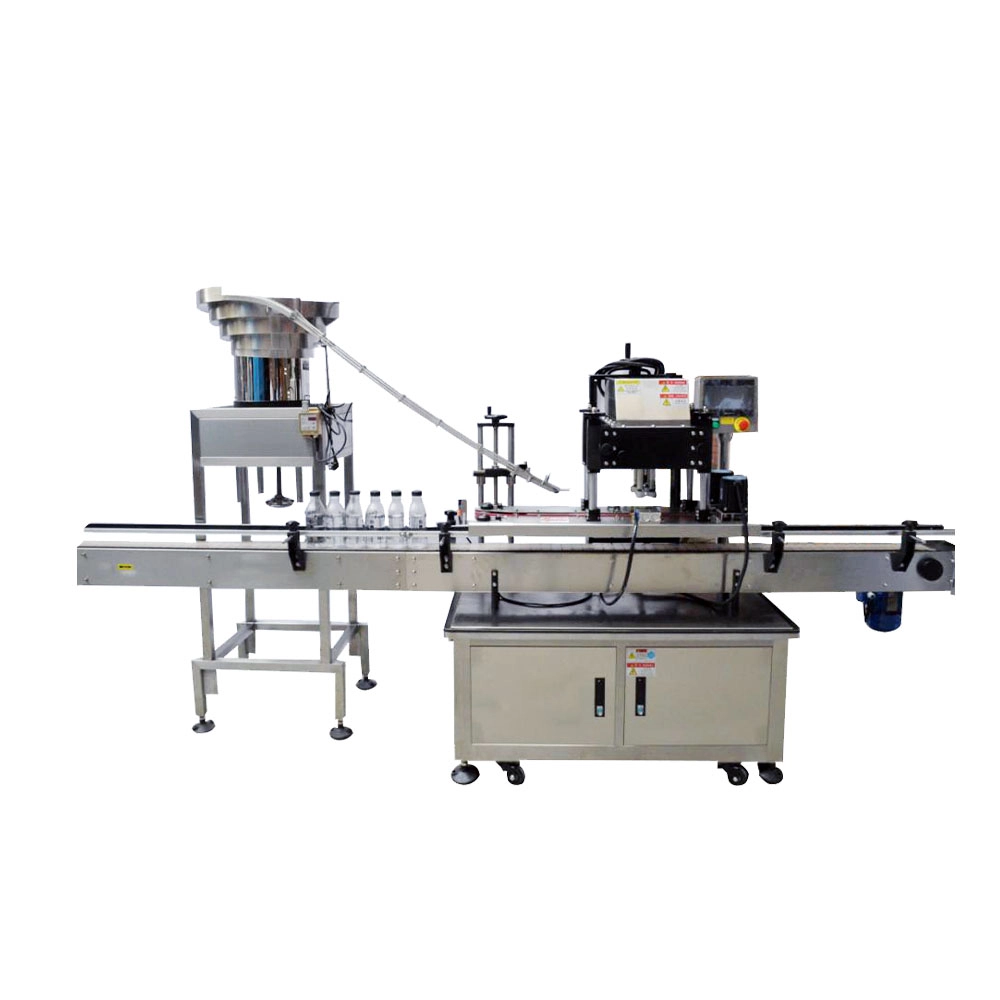
Automatic Plastic Caps Capping Machine with Vibrating Cap Feeder for Sale
Yuanyang automatic screw capping machine is a kind of four-wheel bottle capping machine. The automatic screw capper is often used to close lids of containers such as bottles and jars, especially for plastic bottles, which are widely used in food, medicine, chemical, cosmetic, and other industries for mass production and continuous production lines.
Features:
⦁ Full pneumatic drive;
⦁ Automated fast speed;
⦁ Suitable for various screw caps, pumps, and spray bottles.
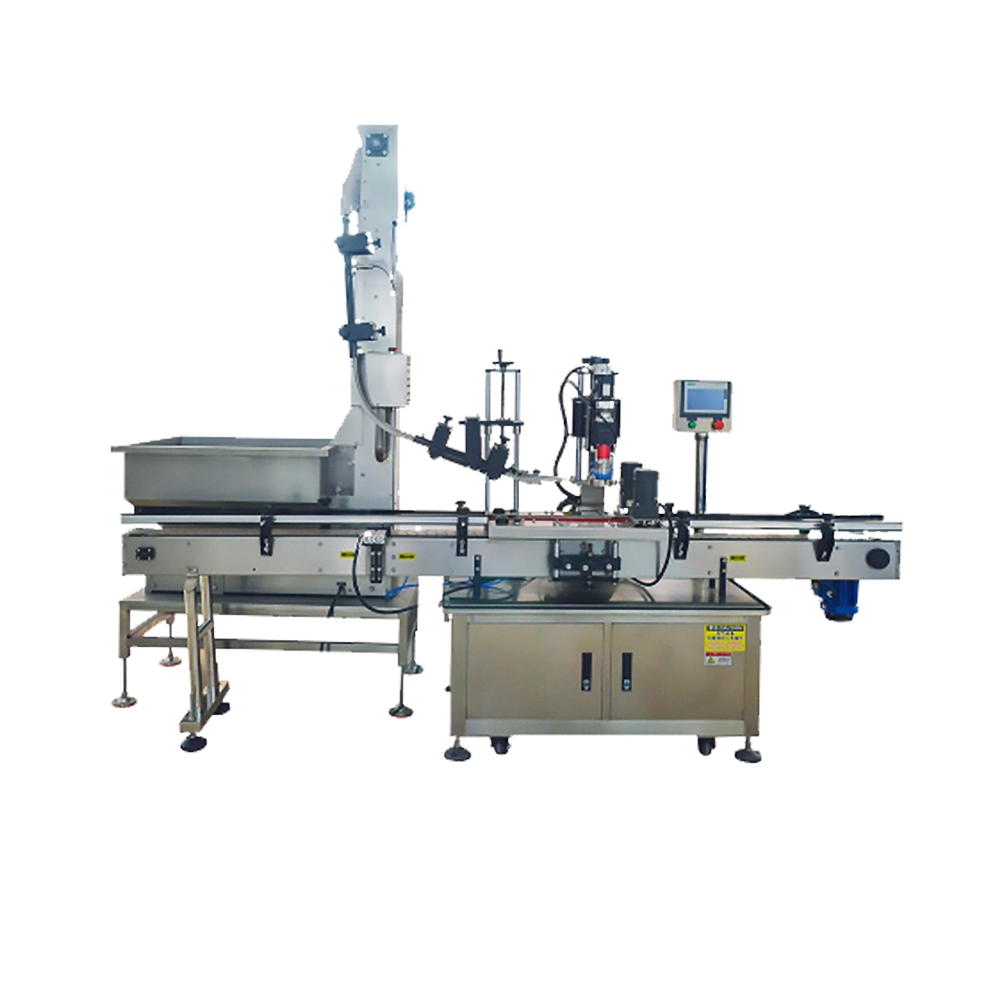
Automatic Metal Caps Capping Machine for Sale
Yuanyang automatic metal cap capping machine is a bottle capper for bottles with metal caps, which is often used to close lids of containers such as bottles and jars. The glass bottle metal capping machine is widely used in food, medicine, chemical, cosmetic, and other industries for mass production and continuous production line .
Features:
⦁ Pneumatic and electric drive;
⦁ Automated fast speed;
⦁ Suitable for glass bottles with metal caps.
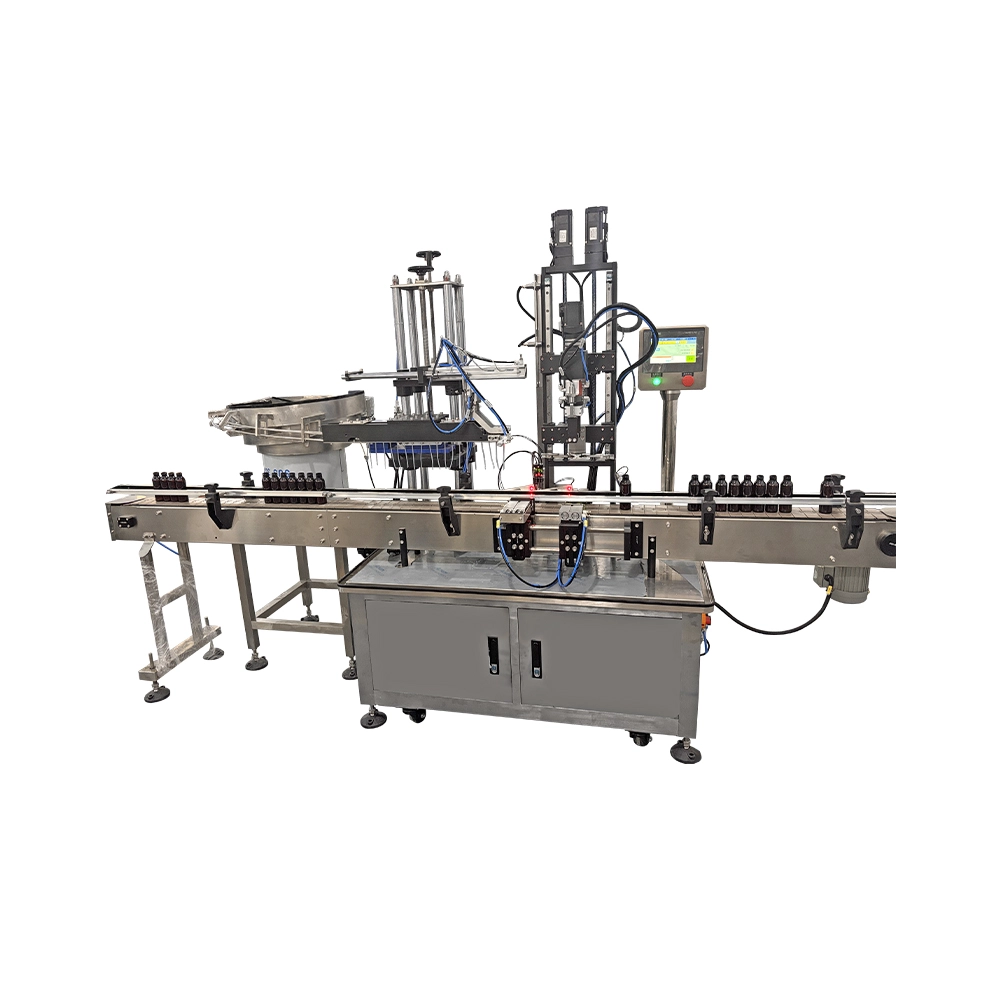
Automatic Pump Head Feeding and Capping Machine for Sale
Yuanyang automatic pump head feeding and capping machine is a bottle cap sorter and capper for bottles with pump heads, which is often used to close lids of containers such as nail polish, sprayers, and shampoo. The capping machine with a pump head feeder is widely used in food, medicine, chemical, cosmetic, and other industries for mass production and continuous production line .
Features:
⦁ Pneumatic and electric drive;
⦁ Automated fast speed;
⦁ Suitable for various types of caps.
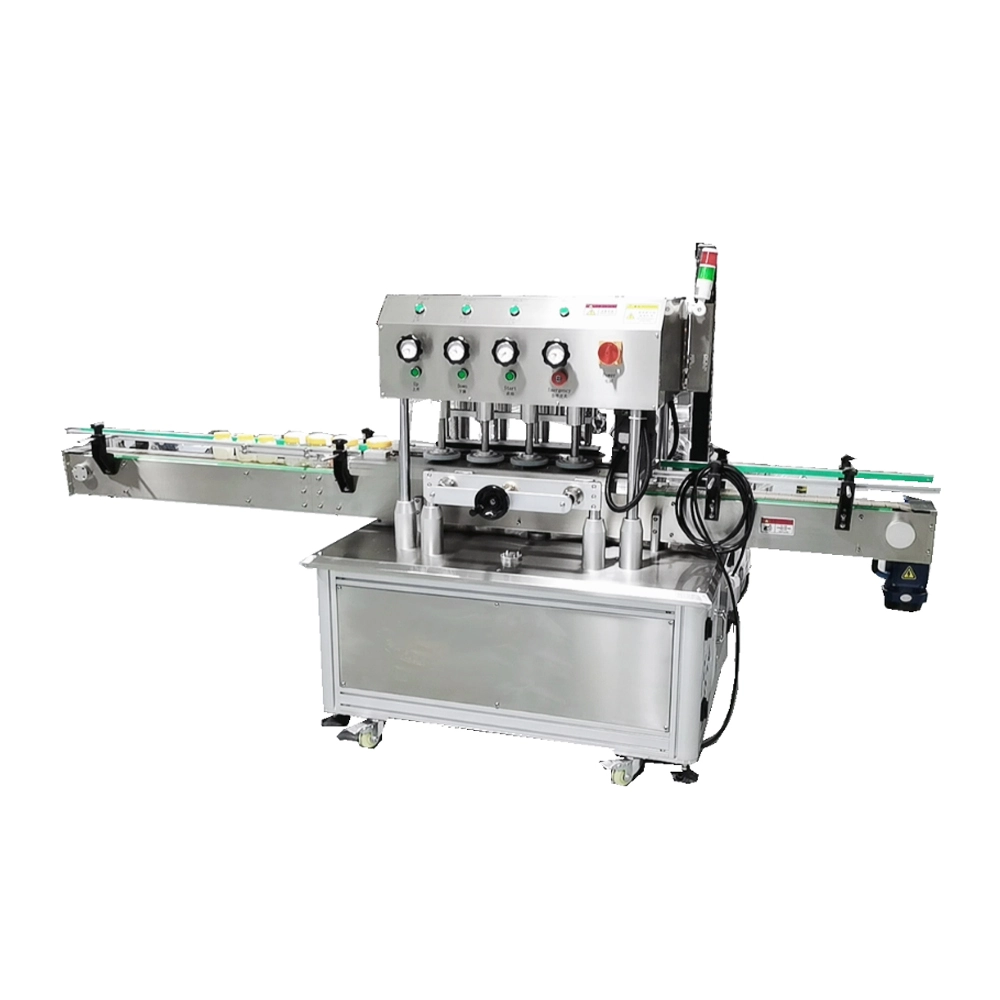
Automatic High Speed Capping Machine for Sale
The Yuanyang automatic high-speed capping machine is a kind of 8-wheel bottle-capping machine with fast working efficiency. The automatic capper is often used to close lids of containers such as bottles and jars, especially for plastic bottles, which are widely used in food, medicine, chemical, cosmetic, and other industries for mass production and continuous production lines.
Features:
⦁ Electric drive;
⦁ Automated fast speed;
⦁ Suitable for various screw caps, pumps, and spray bottles.
 Scan QR Code
Facebook
YouTube
LinkedIn
Whatsapp: +8613434139712
Guangzhou Yuanyang Machinery