





50L Hydraulic Vacuum Emulsifier: Key Features Overview
- 50L Hydraulic Lift Vacuum Emulsifier: Key Features Overview
- Quick overview of this emulsifying machine
- Product description: 50L Hydraulic Lift Vacuum Emulsifier
- Key components and how they make this emulsifying machine effective
- Performance specifications: what to expect from a 50L unit
- Comparison table: 50L vs common alternative capacities
- How vacuum-assisted homogenization works in this emulsifying machine
- Materials, hygiene, and cleaning considerations
- Control, automation, and recipe management
- Applications and suitable product types
- Process optimization and scale-up tips for manufacturers
- Common issues and troubleshooting
- Regulatory and safety considerations for different industries
- Why choose the Yuanyang 50L Hydraulic Lift Vacuum Emulsifier — brand advantages
- Frequently Asked Questions (FAQ)
- Q1: Is the 50L Hydraulic Lift Vacuum Emulsifier suitable for pharmaceutical products?
- Q2: What maintenance is needed for the rotor–stator assembly?
- Q3: Can this emulsifying machine achieve sub-micron particle sizes?
- Q4: How do I choose rotor speed and vacuum level?
- Q5: What are the typical energy and utility requirements?
- References and sources
50L Hydraulic Lift Vacuum Emulsifier: Key Features Overview
Quick overview of this emulsifying machine
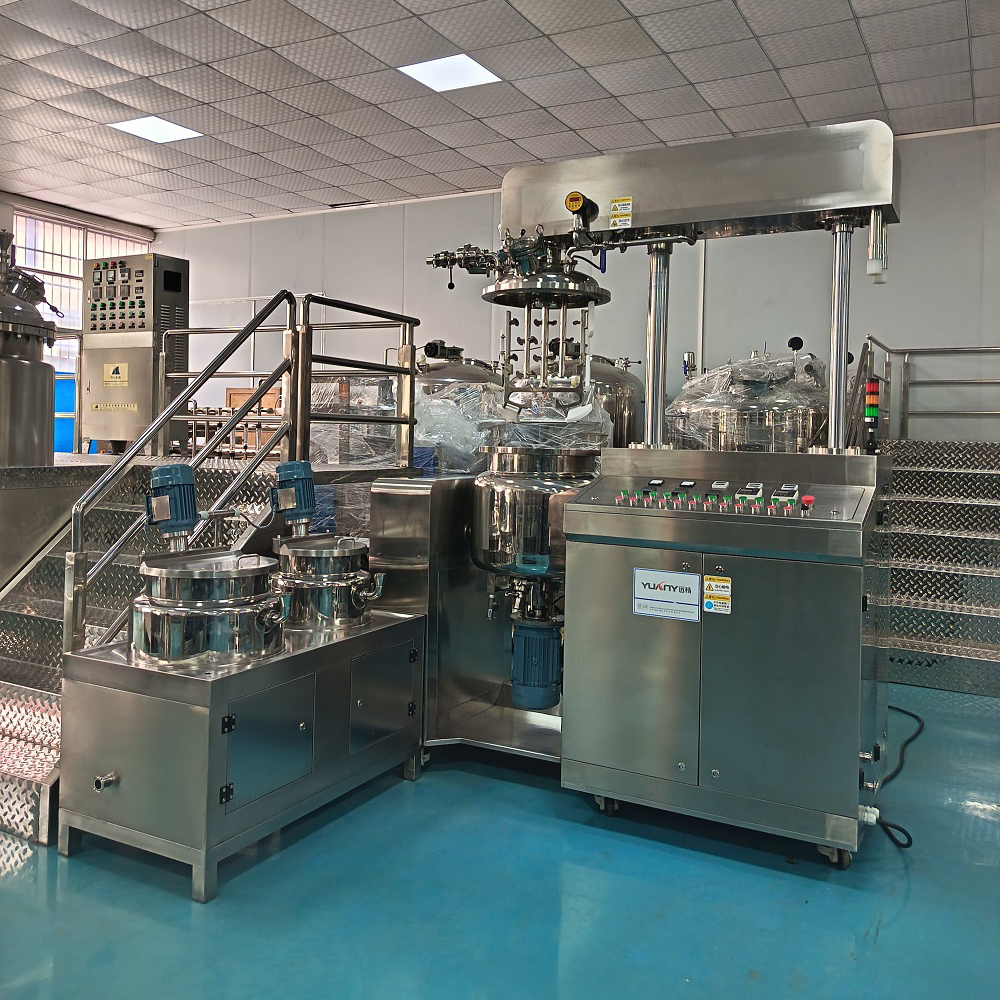
The 50L Hydraulic Lift Vacuum Emulsifier is a compact yet capable emulsifying machine engineered for stable, repeatable production of creams, lotions, ointments, sauces, and specialty chemical emulsions. It combines a main vacuum homogenizer tank with separate water and oil tanks to support controlled heating, high-shear homogenization, and vacuum deaeration — all in one integrated unit. This article explains why this model is suited to laboratory and small-scale production environments, highlights key technical features, and gives practical guidance for selection, operation, and troubleshooting. After understanding the overall structure and performance of the machine, it’s worth exploring how the lifting mechanism adds value—especially the hydraulic lift benefits for 50L vacuum emulsifiers in daily operation and maintenance.
Product description: 50L Hydraulic Lift Vacuum Emulsifier
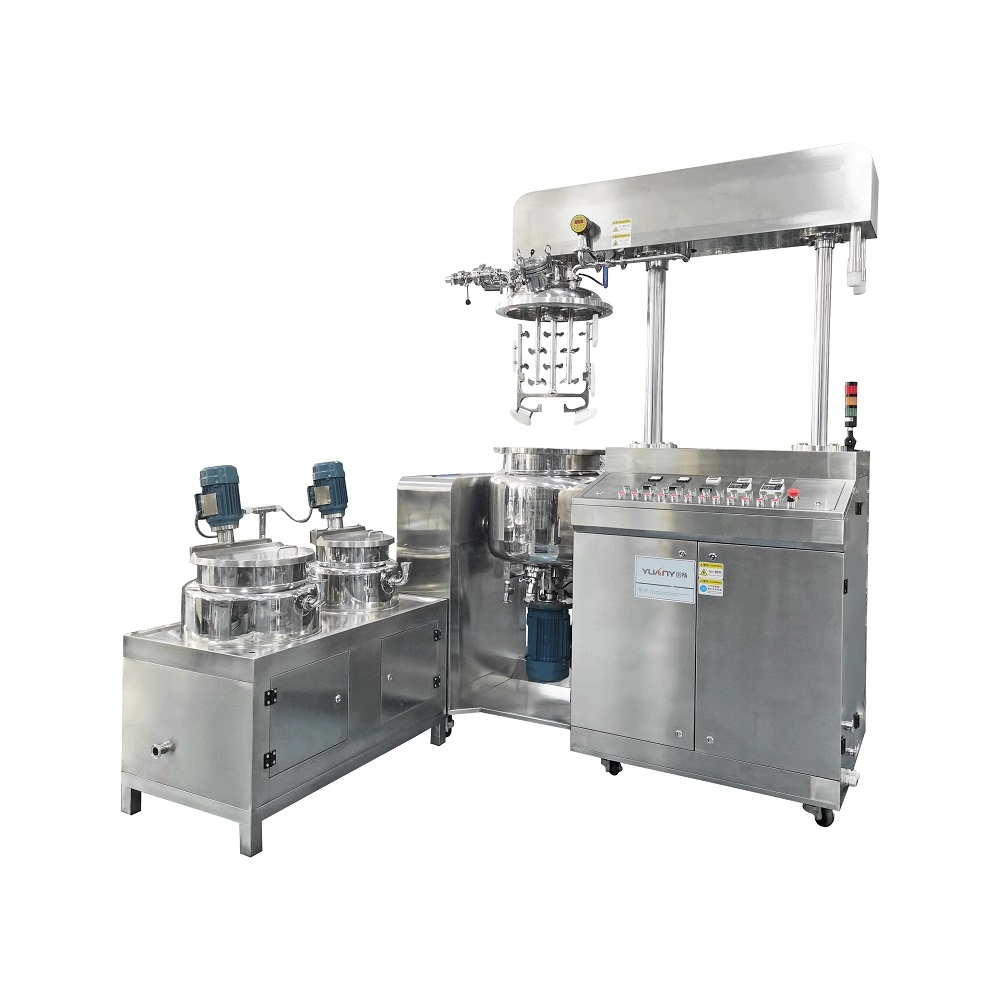
Yuanyang hydraulic lift vacuum emuslifier is a combined mixing equipment with a main vacuum homogenizer tank, a water tank, and an oil tank, which is an integrated equipment with a mixing, dispersing, homogenizing, emulsifying, vacuumizing and powder absorption system that is widely used in cosmetics, food, pharmaceutical, and chemical fields.
Features:
⦁ With a hydraulic lift lid & tilting pot, vacuum system, and electric control system.
⦁ Suitable for products of 10,000~50,000 cps viscosity.
⦁ Perfect particle size of 2 microns and evenly distributed.
Key components and how they make this emulsifying machine effective
Understanding the major assemblies clarifies capability and maintenance needs:
- Main vacuum homogenizer tank — stainless steel vessel with jacketed heating/cooling and an internal rotor–stator homogenizer. The vacuum capability removes trapped air and lowers boiling points for safer, gentler heating.
- Water and oil tanks — dedicated pre-heating and metering tanks for continuous or batch feed into the main tank, allowing accurate phase addition and temperature control.
- Hydraulic lift lid & tilting pot — simplifies loading, cleaning, and discharge, lowering manual handling risk and speeding batch turnaround.
- Vacuum system — essential for degassing, preventing oxidation, and reducing foam formation during high-shear mixing.
- Electric control system — PLC or inverter controls enable programmable speed profiles, temperature settings, and vacuum/pressure monitoring for repeatable processing.
Performance specifications: what to expect from a 50L unit
This emulsifying machine is tailored to small-scale production and pilot plants. Typical performance attributes include:
- Batch volume: nominal 50 liters (useful fill ~60–80% depending on process).
- Viscosity handling: suitable for products from approximately 10,000 to 50,000 cps (as specified), covering many creams, gels and syrups.
- Particle size: capable of delivering typical droplet/particle size down to ~2 microns with a properly specified rotor–stator assembly and process profile.
- Heating/cooling: jacketed vessel for steam or hot water heating and chilled water cooling for tight temperature control.
Comparison table: 50L vs common alternative capacities
Below is a practical table comparing key attributes to help choose the right capacity for your operation.
| Attribute | 20L (Lab) | 50L (This model) | 100L (Pilot/Small Prod) |
|---|---|---|---|
| Typical batch volume (usable) | 4–16 L | 30–40 L | 60–80 L |
| Viscosity range handled | 1,000–30,000 cps | 10,000–50,000 cps | 10,000–100,000+ cps |
| Typical applications | R&D, formulations | Small batches, pilot runs, cosmetics | Low-volume production |
| Equipment footprint | Small | Compact footprint; floor-mounted | Larger; requires more floor space |
| Cost | Lowest | Moderate | Higher |
Sources: Manufacturer datasheets and industry norms (see references section).
How vacuum-assisted homogenization works in this emulsifying machine
The process combines mechanical shear (rotor–stator or high-shear blades) with controlled phase addition and vacuum deaeration:
- Preheat the oil and water phases separately to the target temperatures in their tanks.
- Start agitation in the main tank under low vacuum; introduce the oil phase while the homogenizer operates to create initial dispersion.
- Increase rotor speed and adjust gap/clearance to reach target droplet size; vacuum removes air, preventing foam and improving stability.
- Cool under vacuum while maintaining shear to lock in emulsion microstructure and reduce particle size to ~2 microns.
This sequence reduces oxidation, improves heat transfer, and yields a fine, stable emulsion suitable for sensitive products.
Materials, hygiene, and cleaning considerations
For cosmetics, food, and pharmaceutical manufacturing, material selection and cleanability are critical:
- Vessels and wetted parts should be stainless steel (SS304 or SS316L commonly) and mirror-polished to minimize product adherence and ease cleaning.
- Sanitary seals and hygienic mechanical seals reduce contamination risk. Ensure seals are compatible with cleaning agents and process temperatures.
- CIP (clean-in-place) and SIP (sterilize-in-place) compatibility: design the tank geometry, spray balls, and pipework so CIP cycles fully reach all wetted surfaces.
- Hydraulic lift and tilting features simplify manual cleaning when full access is required, reducing downtime.
Control, automation, and recipe management
Modern emulsifying machines include PLC-based controls that allow recipe storage and repeatable runs. Key control features to look for:
- Programmable speed profiles for the homogenizer and agitator.
- Temperature control with PID loops for jacketed heating/cooling.
- Vacuum monitoring and interlocks to prevent operation outside safe vacuum levels.
- Batch logging for traceability — essential for regulated industries (pharma, some food lines, certifiable cosmetics).
Applications and suitable product types
The 50L Hydraulic Lift Vacuum Emulsifier is well-suited for:
- Cosmetics: creams, lotions, sun care products, hair conditioners where fine droplet size and low air content are critical.
- Pharmaceutical topical formulations: ointments and gels that require controlled particle size and aseptic conditions where possible.
- Food: sauces, dressings, and spreads that benefit from stable emulsions and controlled texture (ensure food-grade certification).
- Chemicals: lubricants, polymer dispersions, and specialty adhesives requiring homogeneous particle distribution.
Process optimization and scale-up tips for manufacturers
To reliably transition a formulation from lab to 50L production, follow these practical tips:
- Establish clear target droplet/particle size and viscosity, then develop process windows (shear speed, time, temperature, and vacuum level) that produce consistent results.
- Run multiple trials varying one parameter at a time (e.g., rotor speed) to quantify effect on particle size and stability.
- When scaling up from smaller lab units, use geometric similarity where possible but expect to adjust shear and mixing time — rotor tip speed and residence time are usually the key scaling parameters.
- Document batch records and integrate process controls to reduce operator variability.
Common issues and troubleshooting
Operators frequently encounter several issues; here is how to diagnose and fix them:
- Air entrainment / foaming: Ensure vacuum level is adequate before high-shear stage. Reduce speed while under vacuum and check inlet feed points.
- Poor droplet size: Verify rotor–stator wear and correct gap, increase shear or modify surfactant/emulsifier levels.
- High final viscosity / gelation: Check cooling profile and polymer hydration schedule; slow cooling or incorrect order of addition can cause over-thickening.
- Seal leaks or contamination: Inspect mechanical seals regularly and replace with OEM-approved parts; confirm CIP reach and cycle parameters.
Regulatory and safety considerations for different industries
Depending on the intended application, additional compliance requirements may apply:
- Food-grade production requires compliance with local food safety authorities (e.g., FDA, EU food regulations) and use of food-grade materials and adhesives.
- Pharmaceutical topical products may require cGMP practices, validated cleaning, and documented batch records.
- Cosmetics may need to follow local cosmetic regulation for labeling and ingredient lists; manufacturing best practices and traceability remain essential.
Why choose the Yuanyang 50L Hydraulic Lift Vacuum Emulsifier — brand advantages
When evaluating vendors, Yuanyang stands out in several ways relevant to purchase decision:
- Integrated design: The main vacuum homogenizer with separate oil/water tanks and hydraulic lifting reduces footprint and simplifies production flow.
- Process capability: Ability to process viscosities up to 50,000 cps and achieve ~2 micron particle size addresses a wide range of formulations.
- Operator ergonomics and maintenance: Hydraulic lid and tilting pot improve safety, speed cleaning, and reduce downtime.
- Service and customization: Ability to offer different rotor–stator configurations, control package upgrades (PLC, recipe management), and optional sanitary upgrades for pharmaceutical/food use.
- Value for small-scale production: Balanced capital cost vs capability for R&D, pilot runs, and boutique production.
Frequently Asked Questions (FAQ)
Q1: Is the 50L Hydraulic Lift Vacuum Emulsifier suitable for pharmaceutical products?
A1: Yes — when configured with sanitary fittings, SS316L wetted parts, validated seals, and appropriate documentation (IQ/OQ/PQ), this unit can be used for topical pharmaceutical products. For sterile products, additional containment and aseptic design are required.
Q2: What maintenance is needed for the rotor–stator assembly?
A2: Inspect for wear regularly (visual and dimensional checks), replace mechanical seals per schedule, and follow lubrication guidelines for bearings. Keep spare parts (rotor, stator, seals) on hand for rapid changeover.
Q3: Can this emulsifying machine achieve sub-micron particle sizes?
A3: The specified typical particle size is ~2 microns. Achieving sub-micron (nanoemulsions) usually requires specialized high-pressure homogenizers or ultrasonic systems. For many cosmetic and food applications, 1–2 microns is sufficient for perceived smoothness and stability.
Q4: How do I choose rotor speed and vacuum level?
A4: Start with manufacturer-recommended baseline recipes. Monitor droplet size and adjust rotor speed incrementally; higher speeds increase shear but may generate heat. Vacuum levels should be sufficient to remove entrained air without causing excessive boiling of volatile components — a controlled low-pressure environment is best.
Q5: What are the typical energy and utility requirements?
A5: Utility needs include electrical supply for motors and control panel, steam/hot water and chilled water for jacketed heating/cooling, and a vacuum pump. Exact requirements depend on motor sizes and auxiliary systems; consult the technical datasheet for detailed specifications.
Ready to evaluate or buy? Contact our sales team to request a detailed datasheet, quote, or to schedule a demo. Request product information or pricing and discuss custom options such as sanitary upgrades, automation packages, or specific rotor–stator sets.
References and sources
- Silverson Machines — Application notes and vacuum emulsions overview. https://www.silverson.com
- IKA — Dispersing and emulsifying technology product information. https://www.ika.com
- McClements, D. J. (2015). Food Emulsions: Principles, Practices, and Techniques. CRC Press. (Foundational text on emulsion science and homogenization principles.)
- Industry equipment datasheets and common manufacturer specifications for vacuum homogenizers (manufacturer websites and product manuals).
Top 10 pouch filling machines Manufacturers and Supplier Brands in Asia
Cleaning and CIP Tips for 50L Vacuum Emulsifiers
Top 10 chemical dispersing machine factories Manufacturers and Supplier Brands in America
How to start a semi auto labeling machine business in Europe
Automatic Round Bottle Labeling Machine
Can you add a date printer for the labeling machine?
Yes, a coding machine for date printing can be added with labeling machine. It can print date on labels with ink. But for more functions,such print code, pictures, bar code, it is suggested to buy a separated ink jet printer.
Semi Automatic Capping Machine
What type of bottles can it be suitable for ?
The screw capping machine is mainly used for plastic bottles. The cap can be pump head, sprayer, triggers, and various other screw caps.
Horizontal Filling Machine
What’s the filling range of this semi auto filler?
There are different sizes of air cylinders. Therefore there are the following filling range:5-60g, 10-120g, 20-200g, 30-300g, 50-500g, 100-1000g, 200-2000g, 300-3000g, 500-5000g. Please tell the minimum bottle and maximum bottle capacity, suitable types of filling machine model will be recommended.
Semi automatic powder filling machine
Can you customize the nozzle size to fit my different container?
Yes, we customize nozzle for clients according specific packages.
Homogenizing Mixer
For the electric heating liquid soap mixing tank, where do you install the heater, how does it work?
The heater tube is installed at bottom. The heating operation is controlled on the control box. Before operation, add tap water into jacket from heater container’s inlet valve. The heater heat water, the hot water conduct heat through inner layer to materials in the tank.
Automatic Plastic Caps Capping Machine with Vibrating Cap Feeder for Sale
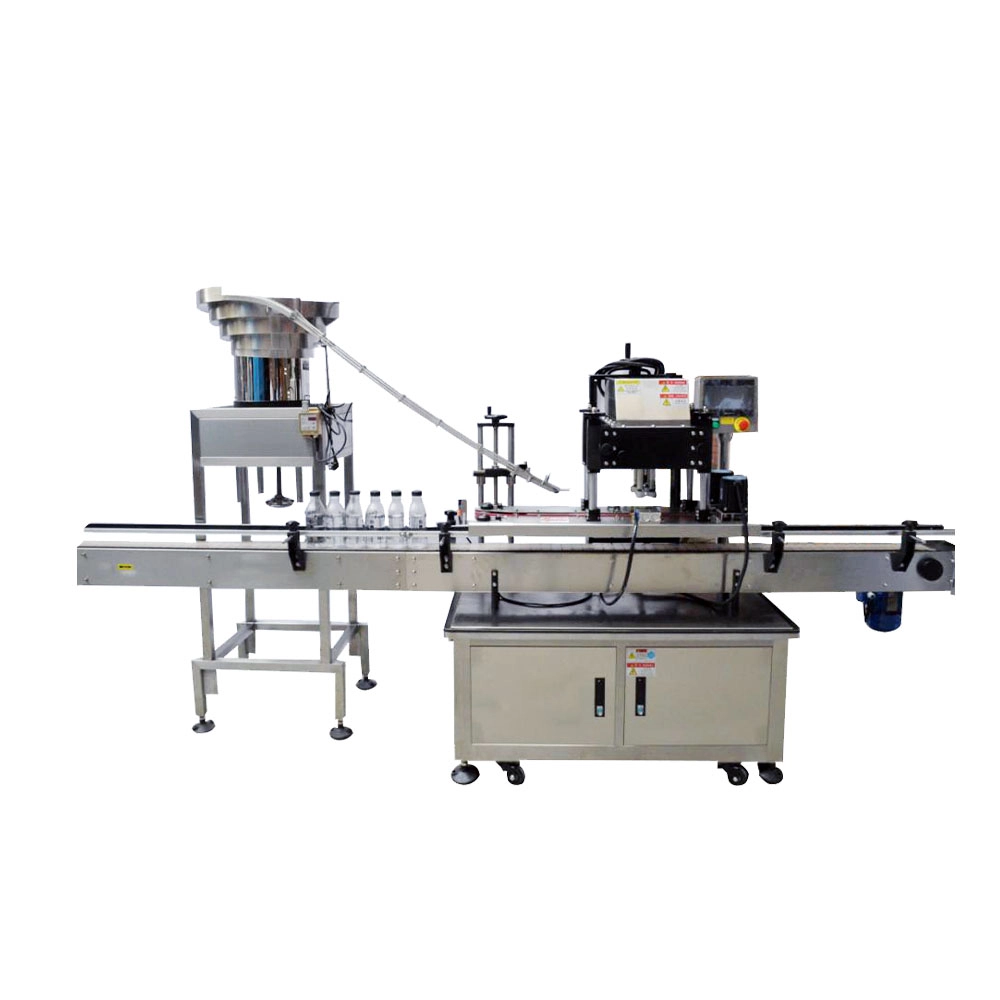
Yuanyang automatic screw capping machine is a kind of four-wheel bottle capping machine. The automatic screw capper is often used to close lids of containers such as bottles and jars, especially for plastic bottles, which are widely used in food, medicine, chemical, cosmetic, and other industries for mass production and continuous production lines.
Features:
⦁ Full pneumatic drive;
⦁ Automated fast speed;
⦁ Suitable for various screw caps, pumps, and spray bottles.
Automatic Metal Caps Capping Machine for Sale
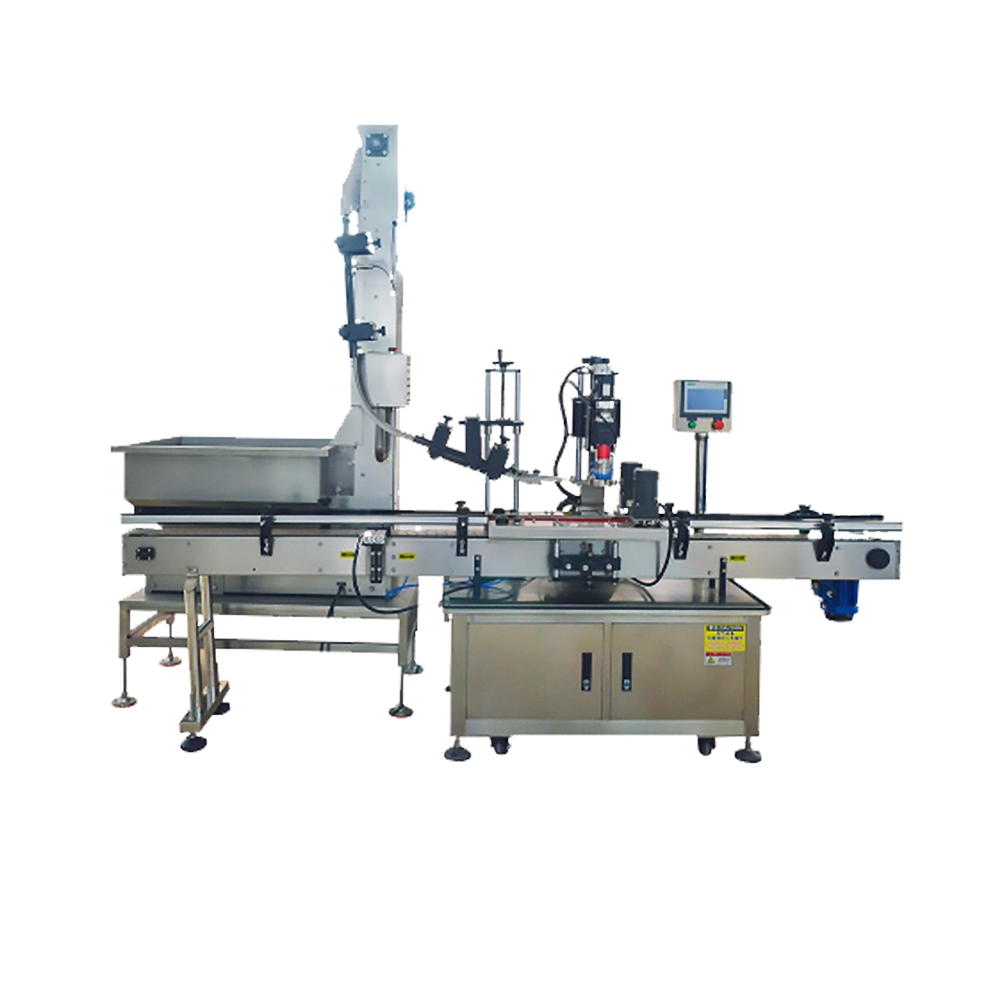
Yuanyang automatic metal cap capping machine is a bottle capper for bottles with metal caps, which is often used to close lids of containers such as bottles and jars. The glass bottle metal capping machine is widely used in food, medicine, chemical, cosmetic, and other industries for mass production and continuous production line .
Features:
⦁ Pneumatic and electric drive;
⦁ Automated fast speed;
⦁ Suitable for glass bottles with metal caps.
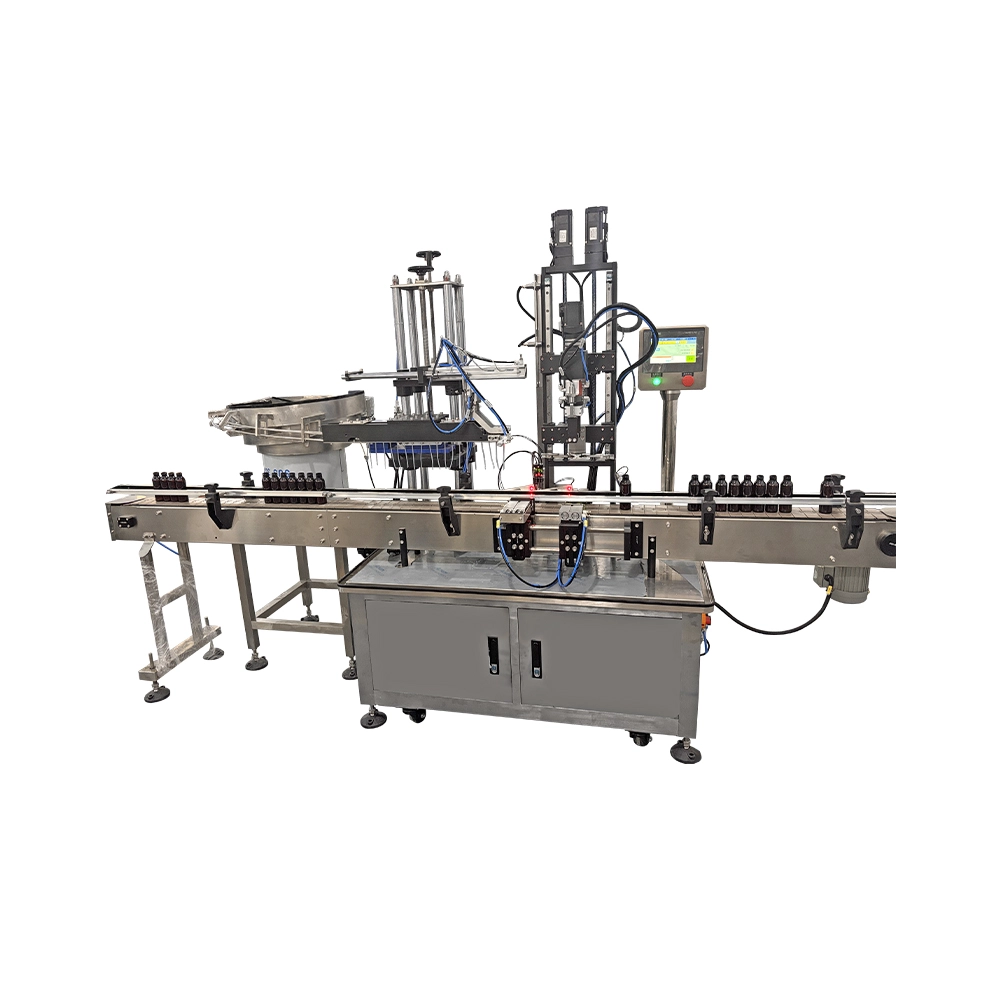
Automatic Pump Head Feeding and Capping Machine for Sale
Yuanyang automatic pump head feeding and capping machine is a bottle cap sorter and capper for bottles with pump heads, which is often used to close lids of containers such as nail polish, sprayers, and shampoo. The capping machine with a pump head feeder is widely used in food, medicine, chemical, cosmetic, and other industries for mass production and continuous production line .
Features:
⦁ Pneumatic and electric drive;
⦁ Automated fast speed;
⦁ Suitable for various types of caps.
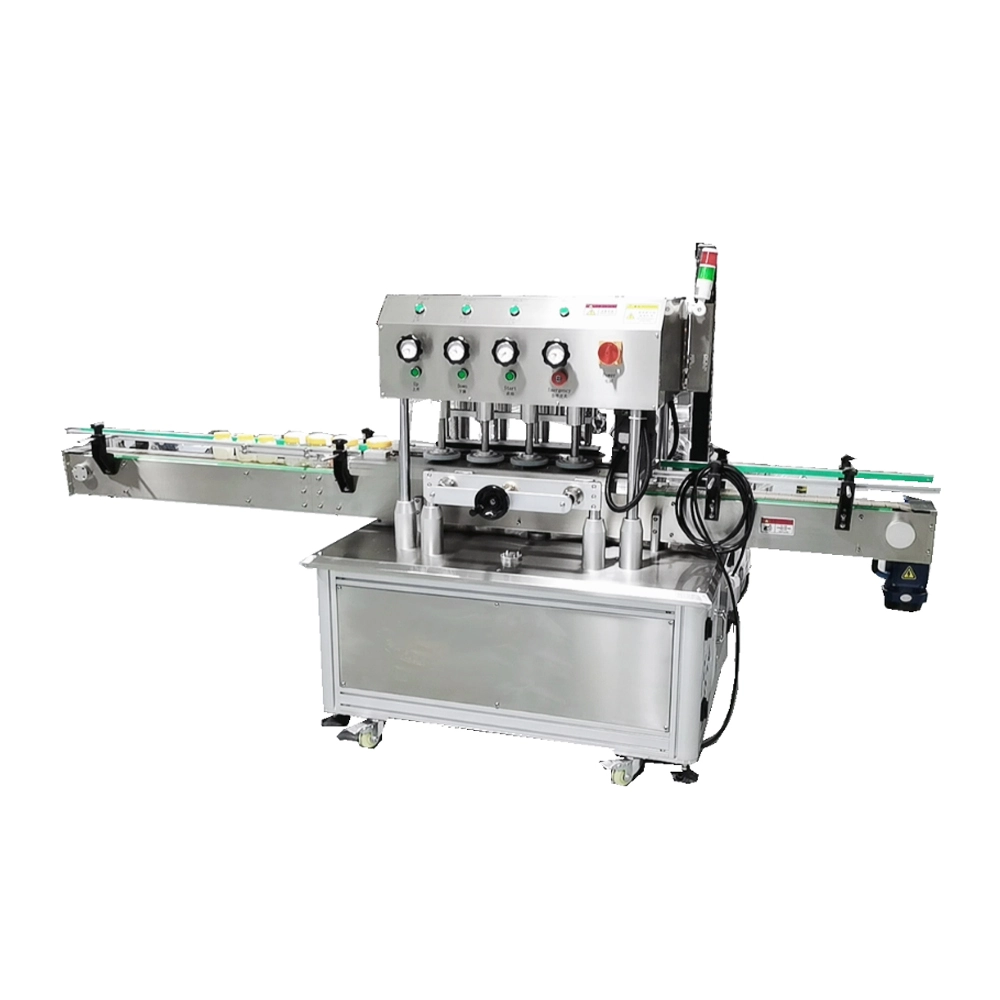
Automatic High Speed Capping Machine for Sale
The Yuanyang automatic high-speed capping machine is a kind of 8-wheel bottle-capping machine with fast working efficiency. The automatic capper is often used to close lids of containers such as bottles and jars, especially for plastic bottles, which are widely used in food, medicine, chemical, cosmetic, and other industries for mass production and continuous production lines.
Features:
⦁ Electric drive;
⦁ Automated fast speed;
⦁ Suitable for various screw caps, pumps, and spray bottles.
 Scan QR Code
Facebook
YouTube
LinkedIn
Whatsapp: +8613434139712
Guangzhou Yuanyang Machinery