





Scale-Up Strategies: From Pilot to Production Mixing Tanks
- Scaling Principles and When to Move Beyond Pilot
- Understanding scale-up objectives
- Common scale-up criteria
- Pilot triggers and go/no-go decisions
- Designing Production Mixing Tanks for Homogeneous Results
- Tank geometry and internal fittings
- Agitators, impellers, and homogenizers
- Scrapers, seals, and material compatibility
- Homogenizing Mixer for Sale: Product Fit and Features
- Why a hybrid approach works best
- Use cases and product match
- Practical Scale-Up Steps: From Data to Implementation
- Collect pilot data systematically
- Scaling calculations and rules of thumb
- Process control, automation, and recipe transfer
- Operational Considerations: CIP, Safety, and Maintenance
- Sanitation and CIP design
- Maintenance planning and uptime
- Health, safety, and environmental considerations
- Validation, QC, and Troubleshooting
- Key validation tests and acceptance criteria
- Common scale-up challenges and fixes
- Example troubleshooting checklist
- Comparison: Pilot vs Production Mixing Tank Parameters
- Brand Summary: Why Choose Yuanyang Homogenizing Mixer
- FAQ — Frequently Asked Questions
- Q1: How do I choose the right scale-up criterion for my product?
- Q3: Can the Homogenizing Mixer for Sale handle heat-sensitive ingredients?
- Q4: What sanitation validation is recommended?
- Q5: How do PTFE scrapers improve production consistency?
- Contact & Next Steps
Scaling a mixing process correctly bridges lab success and reliable mass production. This article explains scalable strategies for mixing tanks, focusing on high-shear homogenization for viscous cleaning liquids and sauces. It provides actionable steps—tank geometry, impeller selection, power scaling, shear control, and sanitation—so R&D teams, process engineers, and plant managers can move from pilot batches to continuous, GMP-ready production with predictable quality and yield. As production capacity increases, controlling operating costs requires applying energy efficiency tips for industrial mixing tanks.
Scaling Principles and When to Move Beyond Pilot
Understanding scale-up objectives
Scale-up is not just increasing volume. Goals include maintaining product homogeneity, preserving shear-sensitive ingredients, meeting cycle time targets, and ensuring Clean-In-Place (CIP) and safety compliance. Key process metrics to carry forward from pilot to production are mixing time, shear rate, power per unit volume (P/V), and residence time distribution.
Common scale-up criteria
Engineers usually pick one or a combination of criteria: geometric similarity (constant aspect ratio), constant Reynolds number (fluid-dynamic similarity), constant tip speed, or constant P/V. For high-shear homogenization—typical in liquid soap and detergent—focus on maintaining required shear and dispersion energy rather than purely geometric rules.
Pilot triggers and go/no-go decisions
Move from pilot to production when: product performance metrics are stable across repeated pilot runs, scalability models predict acceptable performance, CIP and cleaning validation are proven, and process control points are defined. A pilot run that mimics fill/empty cycles and cleaning provides the most reliable data.
Designing Production Mixing Tanks for Homogeneous Results
Tank geometry and internal fittings
Tank shape, height-to-diameter (H/D) ratio, baffles, and inlet/outlet placement drive flow patterns. For viscous cleaners and sauces, a common H/D is 1:1 to 1.5:1 to enable efficient top-to-bottom circulation. Baffles reduce vortexing and improve axial mixing. For high-viscosity systems, include strategically placed nozzles for recirculation and break-up zones.
Agitators, impellers, and homogenizers
Production mixing tanks often combine a low-to-medium speed agitator for bulk circulation with a bottom-mounted high-shear homogenizer to disperse phases and break down particles. The agitator provides macro-mixing while the homogenizer provides the micro-shear needed for stable emulsions and uniform viscosity—critical for shampoos and detergents.
Scrapers, seals, and material compatibility
PTFE wall scrapers keep tanks free of build-up and improve heat transfer for temperature-sensitive formulas. Choose seals and wetted materials compatible with surfactants, caustics, and solvents used in the product. Sanitary finishes and rounded welds reduce contamination risk.
Homogenizing Mixer for Sale: Product Fit and Features
Product Overview
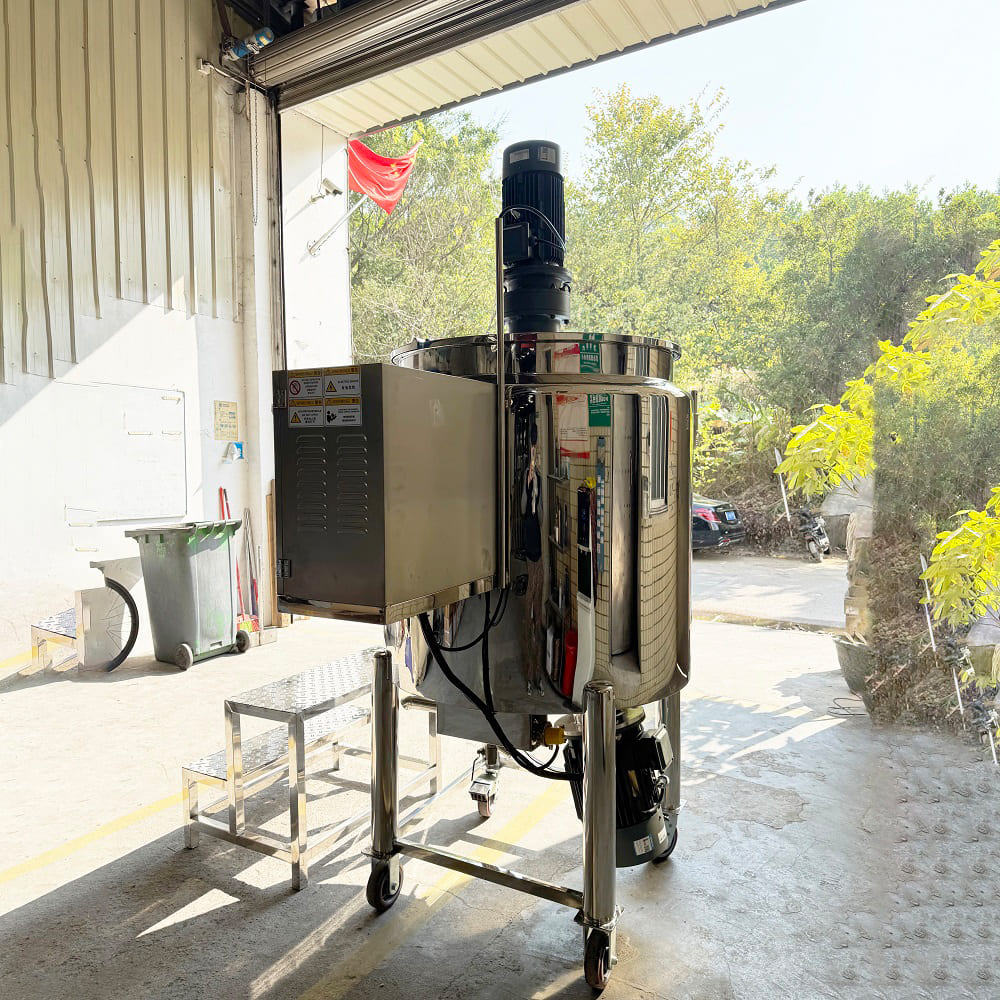
Yuanyang homogenizing mixer is a liquid mixing tank with a high-shear homogenizer. The homogeneous mixing machine is the core part for the liquid soap production line for shampoo, body wash, laundry detergent, dish soap, hand sanitizer, and other thick liquids.
Features:
⦁ Flat top half-open lid, electric control system.
⦁ Suitable for various liquid cleaning products and sauces.
⦁ PTFE wall scrapers stirring at top, high shear homogenizer at bottom.
Why a hybrid approach works best
Combining top-mounted scrapers and a bottom high-shear homogenizer keeps tank walls clean and ensures both macro and micro dispersion. This configuration reduces processing time, enhances product consistency, and simplifies transitions from pilot to production by replicating shear zones.
Use cases and product match
The Yuanyang homogenizing mixer is optimized for viscous liquid cleaners where controlled shear and wall scraping are needed. Typical uses: shampoo phases (aqueous and oil blends), body wash thickeners, detergent active dispersion, and hand sanitizer gel uniformity.
Practical Scale-Up Steps: From Data to Implementation
Collect pilot data systematically
Record mixing time to ±10% across batches, temperature profiles, torque/power draw, particle size distribution (if relevant), and viscosity over time. Use inline sensors like torque meters and particle counters when possible. Pilot data serves as the baseline for P/V and shear scaling.
Scaling calculations and rules of thumb
For high-shear processes, rely on maintaining similar specific energy input (kJ/kg) and shear conditions, rather than strictly geometric scaling. Tip speed scaling (tip speed = π × D_impeller × RPM) helps maintain shear in rotor-stator homogenizers. Where possible, validate predicted mixing time with a small-scale mockup of the production tank.
Process control, automation, and recipe transfer
Automate critical steps: ingredient dosing, homogenizer speed ramps, and temperature control. Recreate the same recipe staging order used in pilot runs. Store process recipes in the PLC/HMI to reduce operator variability and support batch records for compliance.
Operational Considerations: CIP, Safety, and Maintenance
Sanitation and CIP design
CIP must be validated for chemical compatibility and coverage. Design spray balls and circulation loops to reach dead legs. The presence of PTFE scrapers simplifies manual cleaning but validate that scrapers do not trap residues behind seals. CIP validation protocols can follow guidelines from authorities such as the World Health Organization for pharmaceutical/cleaning processes.
Maintenance planning and uptime
Schedule routine inspection for homogenizer rotors, mechanical seals, and scraper wear. Keep critical spares for rotor-stator sets and bearings. Planned downtime for preventive maintenance reduces the risk of unscheduled production halts.
Health, safety, and environmental considerations
Account for ventilation and spill containment for surfactant and solvent handling. Use secondary containment and proper PPE. Ensure electrical systems conform to local explosion-proof requirements if working with flammable additives.
Validation, QC, and Troubleshooting
Key validation tests and acceptance criteria
Typical acceptance metrics include: viscosity target ±X%, particle size distribution or droplet size D50 within spec, homogeneity index across sampling ports, and microbial counts if applicable. Establish sampling points at top, mid, and bottom to verify vertical homogeneity.
Common scale-up challenges and fixes
Issue: Increased dead zones causing stratification. Fix: Add baffles or improve recirculation loop geometry. Issue: Excessive shear damaging sensitive polymers. Fix: Reduce homogenizer RPM or split the homogenization step (coarse mix first, then controlled high-shear pass).
Example troubleshooting checklist
- Compare pilot vs production P/V and tip speed.
- Check impeller clearances and scraper pressure on tank wall.
- Verify ingredient temperatures and dosing rates.
- Run a short validation batch with tracer dye to visualize mixing.
Comparison: Pilot vs Production Mixing Tank Parameters
| Parameter | Pilot Tank (Example) | Production Tank (Example) |
|---|---|---|
| Volume | 50–200 L | 1,000–10,000 L |
| Impeller type | Lab-scale Rushton/propeller | Large pitched-blade + bottom homogenizer |
| Power per volume (P/V) | 0.5–2 W/L (varies) | 0.2–1 W/L (scale-dependent) |
| Shear source | High RPM mini-homogenizer | Industrial rotor-stator homogenizer |
| CIP capability | Manual cleaning or small CIP | Automated CIP with validated cycles |
Brand Summary: Why Choose Yuanyang Homogenizing Mixer
Yuanyang offers purpose-built homogenizing mixers that combine PTFE wall scrapers and bottom high-shear homogenizers, tailored for liquid soap, detergents, and viscous sauces. Key advantages:
- Process-focused design: Hybrid mixing zones for macro and micro dispersion.
- Sanitation-ready: Flat half-open lid and PTFE scrapers reduce build-up and simplify cleaning.
- Control and repeatability: Electric control systems enable recipe replication from pilot to production.
- Versatility: Suits a range of viscosities and product types—shampoo, body wash, dish soap, and hand sanitizer gels.
FAQ — Frequently Asked Questions
Q1: How do I choose the right scale-up criterion for my product?
A: For surfactant-rich viscous liquids and emulsions, prioritize maintaining shear and specific energy input (kJ/kg) rather than pure geometric similarity. Combine that with practical constraints—tank layout, available power, and CIP requirements—to select the best criterion.
Q3: Can the Homogenizing Mixer for Sale handle heat-sensitive ingredients?
A: Yes. The hybrid design reduces residence time under high shear and often allows temperature control via jacketed tanks. Reduce homogenizer RPM or use staged homogenization to limit thermal rise.
Q4: What sanitation validation is recommended?
A: Validate CIP cycles for chemical concentration, temperature, and exposure time until swab and rinse tests show acceptable residue and microbial levels. Follow established guides and adapt to your product risk—see guidance from organizations like the World Health Organization for sanitary best practices.
Q5: How do PTFE scrapers improve production consistency?
A: PTFE scrapers continuously remove product film from tank walls, preventing hot spots, localized thickening, or burnt material. They help maintain uniform heat transfer and reduce manual cleaning operations, improving batch-to-batch consistency.
Contact & Next Steps
Ready to scale your process? Contact our engineering team to discuss pilot data, perform a scale-up review, or request a quote for a Homogenizing Mixer for Sale. For product details and specifications, contact sales or view the product page.
Authoritative references: For more background on mixing theory and equipment, see Mixing (process) — Wikipedia and Agitator (equipment) — Wikipedia. For standards and engineering resources, consult ASME.
Everything You Need to Know About vacuum and sealing machine
How to manufacturing vacum sealing machine in Asia
What are the application scenarios of reverse osmosis water treatment equipment?
How Much Does a Water Filter Cost? Full Guide & Pricing
Liquid Soap Mixer Machine
Do you also provide liquid soap formula and technical training for a new user?
Yes, Yuany is experienced in liquid soap production for many years. We can provide professional training and teach face to face for clients. Don’t hesitate to contact us.
High shear homogneizer
Can the working head parts be dismountable?
Yes, the homogenizer head is dismountable. If there is any problem of the working head, just disassemble it and check. Videos is provided.
Cosmetic
Do your equipment meet GMP and other industry standards?
Yes. Our equipment fully complies with GMP, ISO, and other international industry standards and can be customized to meet specific regulatory requirements based on different markets and customers.
Homogenizing Mixer
Do you have temperature control system for the shampoo making machine?
Yes, there is temperature probe into tank at bottom. It detects temperature and display on the control panel. What’s more, the target temperature can be set.
Industries
How is installation and commissioning done?
We provide detailed written manuals and remote video guidance, or on-site installation and commissioning services to ensure the equipment is quickly operational.
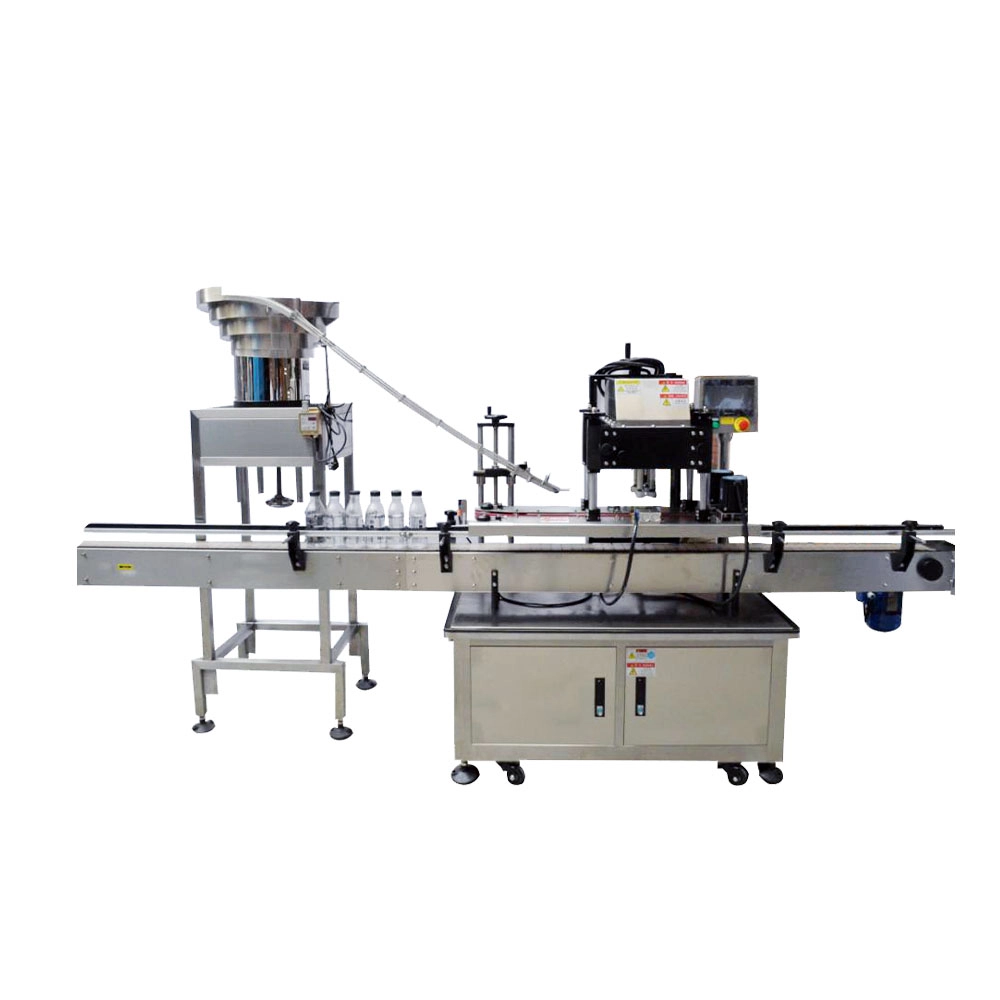
Automatic Plastic Caps Capping Machine with Vibrating Cap Feeder for Sale
Yuanyang automatic screw capping machine is a kind of four-wheel bottle capping machine. The automatic screw capper is often used to close lids of containers such as bottles and jars, especially for plastic bottles, which are widely used in food, medicine, chemical, cosmetic, and other industries for mass production and continuous production lines.
Features:
⦁ Full pneumatic drive;
⦁ Automated fast speed;
⦁ Suitable for various screw caps, pumps, and spray bottles.
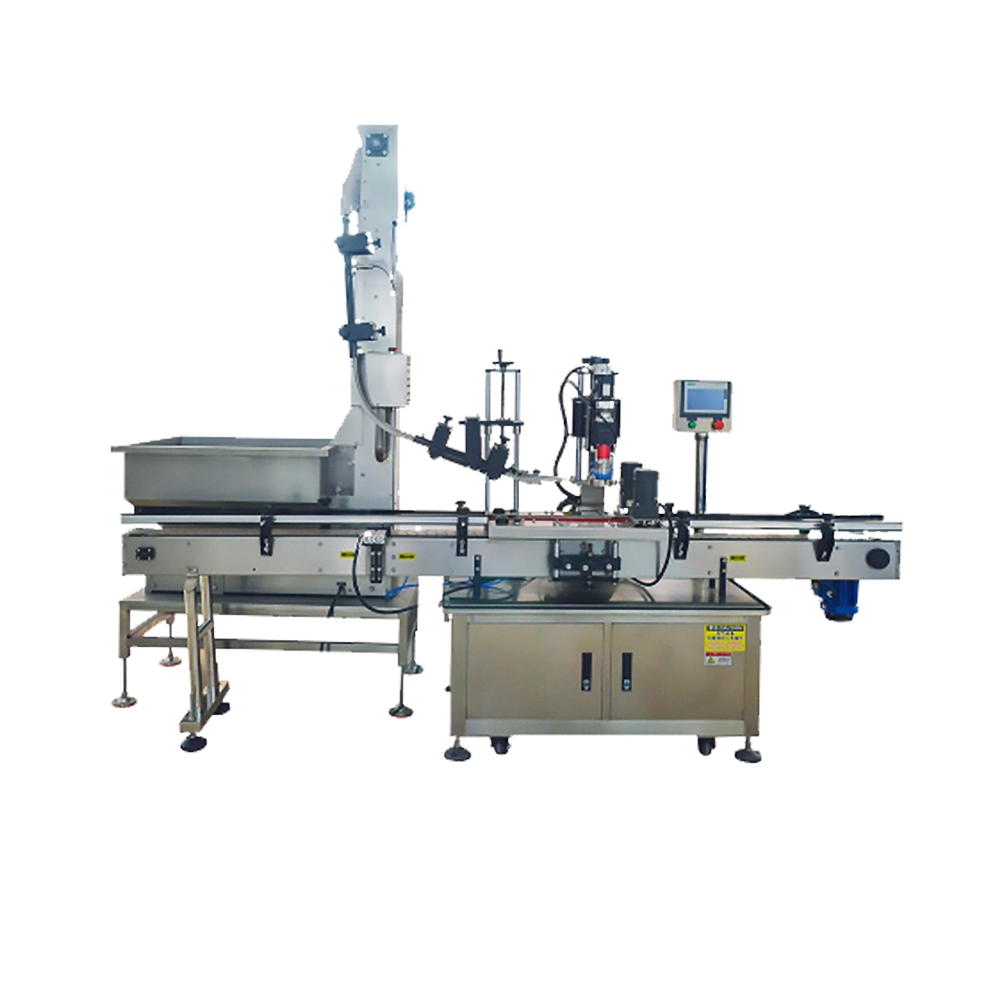
Automatic Metal Caps Capping Machine for Sale
Yuanyang automatic metal cap capping machine is a bottle capper for bottles with metal caps, which is often used to close lids of containers such as bottles and jars. The glass bottle metal capping machine is widely used in food, medicine, chemical, cosmetic, and other industries for mass production and continuous production line .
Features:
⦁ Pneumatic and electric drive;
⦁ Automated fast speed;
⦁ Suitable for glass bottles with metal caps.
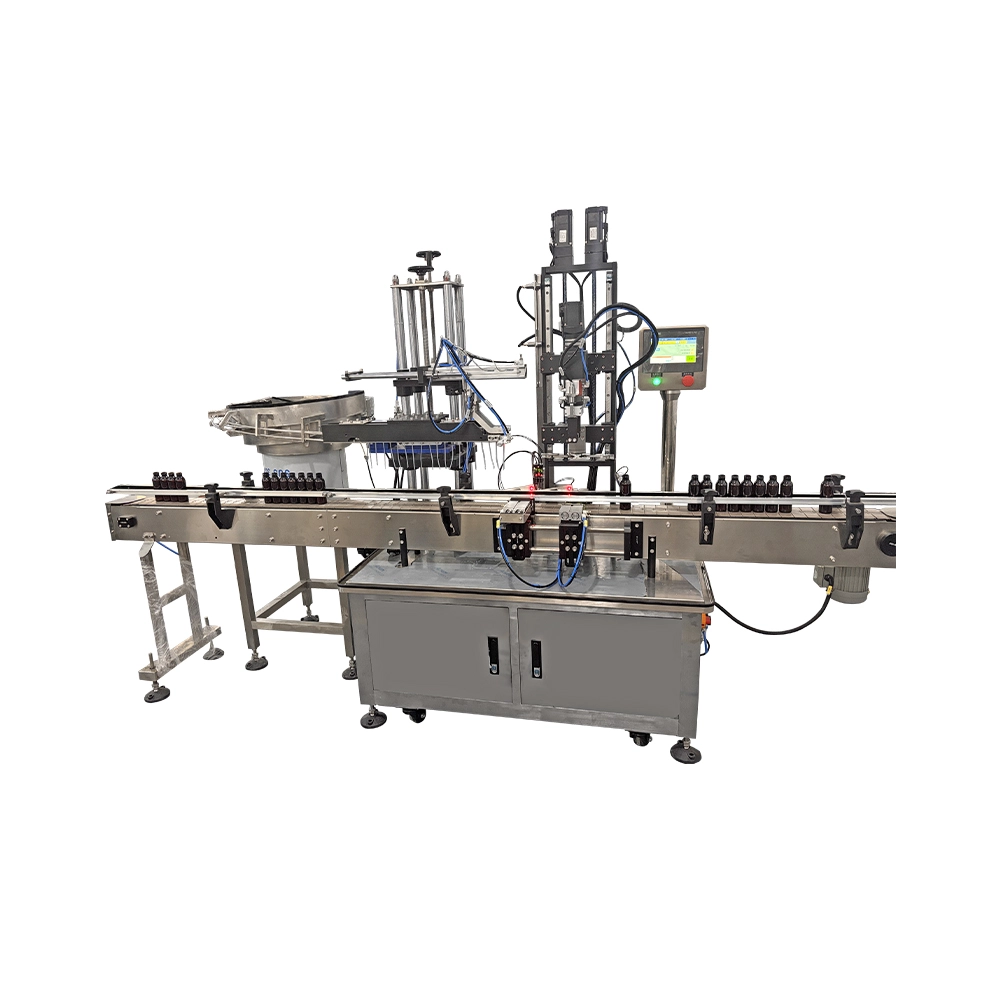
Automatic Pump Head Feeding and Capping Machine for Sale
Yuanyang automatic pump head feeding and capping machine is a bottle cap sorter and capper for bottles with pump heads, which is often used to close lids of containers such as nail polish, sprayers, and shampoo. The capping machine with a pump head feeder is widely used in food, medicine, chemical, cosmetic, and other industries for mass production and continuous production line .
Features:
⦁ Pneumatic and electric drive;
⦁ Automated fast speed;
⦁ Suitable for various types of caps.
Automatic High Speed Capping Machine for Sale
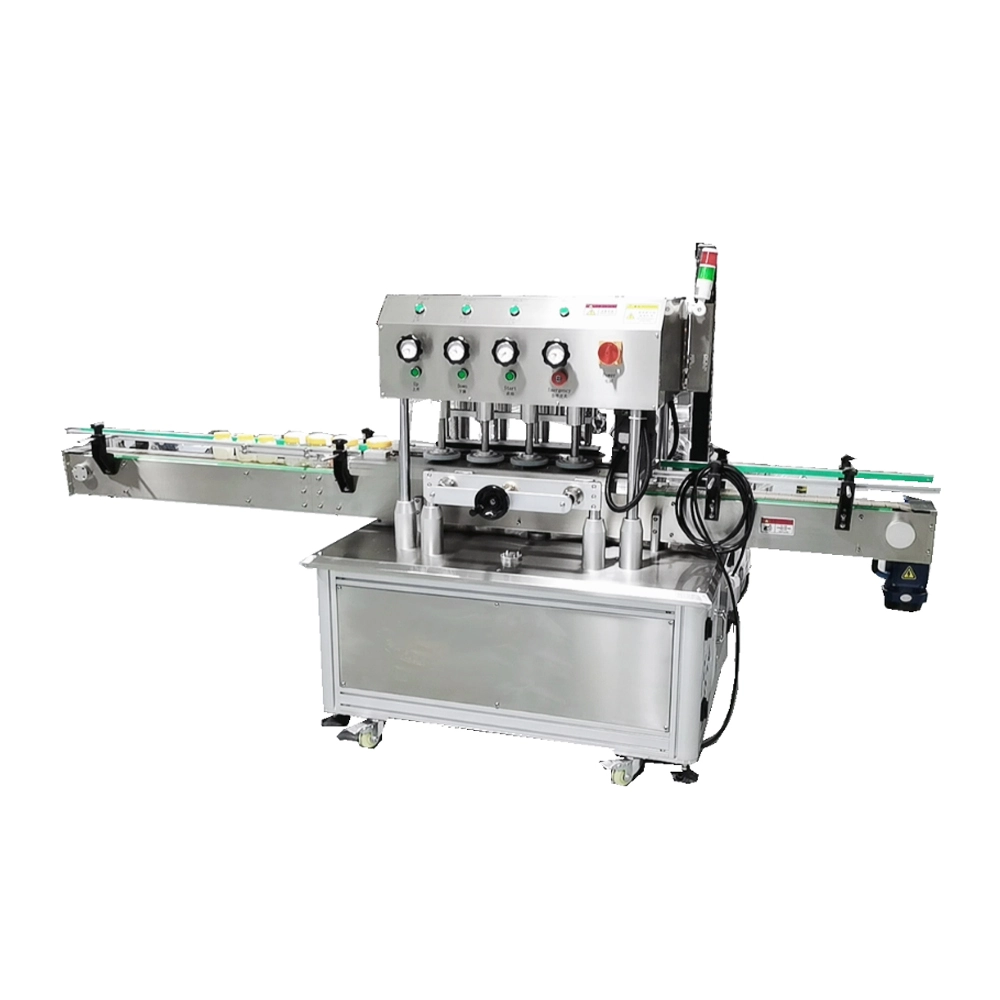
The Yuanyang automatic high-speed capping machine is a kind of 8-wheel bottle-capping machine with fast working efficiency. The automatic capper is often used to close lids of containers such as bottles and jars, especially for plastic bottles, which are widely used in food, medicine, chemical, cosmetic, and other industries for mass production and continuous production lines.
Features:
⦁ Electric drive;
⦁ Automated fast speed;
⦁ Suitable for various screw caps, pumps, and spray bottles.
 Scan QR Code
Facebook
YouTube
LinkedIn
Whatsapp: +8613434139712
Guangzhou Yuanyang Machinery