





Integrating Vacuum Emulsifying Mixers into Automated Lines
- Integrating Vacuum Emulsifying Mixers into Automated Lines
- What is an emulsifying mixer and why automation matters
- Introducing the Vacuum Emulsifying Mixer for Sale: Product snapshot
- Key benefits of integrating a vacuum emulsifying mixer into automated lines
- Technical considerations when selecting an emulsifying mixer for automation
- Batch vacuum emulsifying mixers versus continuous inline systems: a comparison
- How to integrate a vacuum emulsifying mixer into a PLC/SCADA-controlled line
- Quality control, validation, and regulatory considerations
- Utilities, footprint and maintenance planning
- ROI and operational cost considerations
- Implementation checklist: integrating a vacuum emulsifying mixer
- Brand advantages: Why consider the Yuanyang Vacuum Emulsifying Mixer for Sale
- Typical automated line layout example
- Real-world tips from industrial practice
- Frequently Asked Questions (FAQ)
- Q: What is the main difference between a vacuum emulsifying mixer and a standard high-shear mixer?
- Q: Can the Yuanyang Vacuum Emulsifying Mixer be integrated into existing automated lines?
- Q: What product viscosities can this vacuum emulsifying mixer handle?
- Q: How does achieving a 2 micron particle size improve my product?
- Q: What cleaning and maintenance should I plan for?
- Q: Where can I get documentation and tests to support regulatory audits?
- Contact us or view the product
- Authoritative references and further reading

Integrating Vacuum Emulsifying Mixers into Automated Lines
What is an emulsifying mixer and why automation matters
An emulsifying mixer is a specialized industrial mixer designed to combine immiscible liquids into a stable emulsion. In cosmetics, pharmaceuticals, and specialty chemicals, emulsifying mixers are central to producing creams, skin-care products, ointments, pastes, and other emulsions with consistent texture and stability. Integrating an emulsifying mixer into an automated production line reduces labor, improves repeatability, shortens changeover time, and strengthens quality control, making it an essential step for manufacturers scaling production and meeting regulatory demands. As machines are incorporated, understanding emulsifying mixer technologies compared: stability and consistency helps optimize both process and product quality.
Introducing the Vacuum Emulsifying Mixer for Sale: Product snapshot
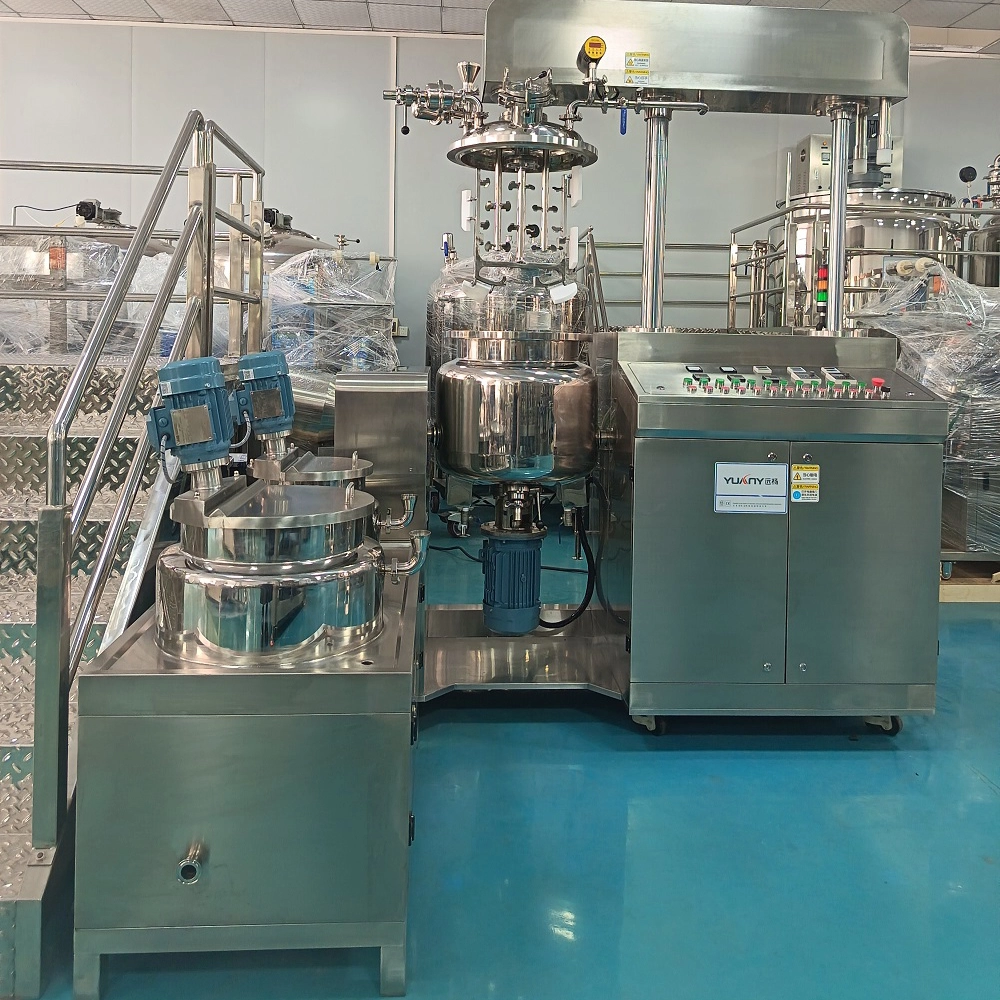
Yuanyang vacuum emulsifying mixer is a kind of emulsifier machine, the most popular cosmetics production equipment for making cream, skin-care products, ointment, paste, and emulsions.
Features:
⦁ Composed of a main emulsifying pot, a water pot, and an oil pot.
⦁ With a hydraulic lifting system, vacuum system, and electric control system.
⦁ Suitable for products of 10,000~50,000 cps viscosity.
⦁ Perfect particle size of 2 microns and evenly distributed.
Key benefits of integrating a vacuum emulsifying mixer into automated lines
Automating emulsification brings quantifiable advantages across production, quality, and compliance. Typical benefits include:
- Consistent product quality and texture through automated dosing, timed homogenizing, and controlled vacuum stages.
- Reduced contamination risk by enabling closed-system vacuum processing and automated CIP (clean-in-place) sequences.
- Improved yield and reduced waste from precise ingredient metering and minimized operator variability.
- Scalable throughput by synchronizing emulsifier cycles with upstream and downstream equipment such as tanks, fillers, and packaging lines.
- Faster time-to-market thanks to repeatable process recipes stored in the PLC or SCADA system.
Technical considerations when selecting an emulsifying mixer for automation
Choosing the right vacuum emulsifying mixer for an automated line requires evaluating several technical parameters that impact integration complexity and final product quality.
Important factors to consider:
- Process capacity and cycle time: Match pot volume and homogenizer power to target batch sizes and desired throughput.
- Viscosity range: Ensure the mixer handles the product viscosity; Yuanyang machines are specified for 10,000~50,000 cps, which covers many creams and ointments.
- Particle size and homogeneity: If sub-5 micron or 2 micron particle size is required, verify the emulsifier's rotor-stator or high-shear system performance.
- Vacuum capability: Vacuum stages reduce air entrainment and improve shelf life; confirm the vacuum system's depth and stability for your formulation.
- Automation interfaces: PLC, SCADA, remote I/O, and recipe management compatibility for seamless integration with plant control systems.
- CIP and SIP readiness: Ability to automate cleaning and sterilization cycles without demanding manual intervention.
Batch vacuum emulsifying mixers versus continuous inline systems: a comparison
When designing an automated line, one of the first decisions is batch versus continuous emulsification. The table below summarizes their strengths and trade-offs.
| Attribute | Batch Vacuum Emulsifying Mixer (e.g., Yuanyang) | Continuous Inline Homogenizer |
|---|---|---|
| Typical use | Cosmetics, small-to-medium runs, complex formulations | High-volume, simple emulsions, continuous processing |
| Flexibility | High - easy recipe changes and cleanouts | Lower - optimized for continuous formulations |
| Particle size control | Excellent - close control with vacuum and high-shear | Good - depends on homogenizer design |
| Automation complexity | Moderate - requires scheduling of batches and CIP | Higher initial integration - steady-state operation is simpler |
| Best for | High Quality cosmetics, small batch customization, sensitive ingredients | Commodity emulsions, high throughput continuous plants |
How to integrate a vacuum emulsifying mixer into a PLC/SCADA-controlled line
Integration steps should be planned with the automation team and equipment vendor to ensure control and data flow align with production goals.
- Define process logic: Map required steps for charging, vacuum, emulsifying, heating/cooling, discharge, and cleaning.
- Interface design: Agree on signals, protocols (Modbus, Profinet, EtherNet/IP), and I/O points. Ensure motor starters, valves, vacuum pumps, and hydraulic systems are addressable from the PLC.
- Recipe management: Implement recipe storage to ensure repeatable sequences, including mixing speed, heating curve, and vacuum setpoints.
- Data logging and traceability: Capture timestamps, batch IDs, temperatures, pressures, shear rates, and operator actions for quality audits.
- Safety and interlocks: Implement safety PLC functions, emergency stops, pressure relief, and lockouts for maintenance.
- CIP automation: Integrate valves, pumps, and heating elements to run automated clean cycles and validate cleaning results.
Quality control, validation, and regulatory considerations
Automated vacuum emulsifying mixers can support regulatory compliance, but the manufacturer and user must demonstrate appropriate controls and validation.
Key QC and compliance actions include:
- Particle size analysis to confirm the target 2 micron distribution where specified.
- Viscosity measurements across batches to ensure consistency within the 10,000~50,000 cps range.
- Temperature and pressure validation during production and cleaning cycles.
- Cleaning validation documentation to prove CIP effectiveness and absence of cross-contamination.
- Traceability records for raw materials, batch numbers, and process parameters.
Utilities, footprint and maintenance planning
Plan for utilities and maintenance to prevent downtime and ensure consistent production.
- Electrical: Confirm voltage, phase, and motor starter requirements for agitators, vacuum pumps, and hydraulic units.
- Compressed air and vacuum: Provide a suitably sized vacuum pump and ensure vacuum lines are compatible with food or cosmetic standards.
- Steam, thermal oil, or electric heating: Select heating method for water or oil jackets depending on formulation needs.
- Floor space and lifting: The Yuanyang design includes a hydraulic lifting system; ensure adequate overhead clearance and floor load capacity.
- Maintenance: Schedule mechanical seal checks, rotor-stator inspections, and vacuum pump servicing as part of preventive maintenance.
ROI and operational cost considerations
Investing in an automated vacuum emulsifying mixer should be evaluated using a realistic ROI model that considers:
- Capital cost versus expected throughput and production yield improvements.
- Labor savings from reduced manual mixing and monitoring.
- Raw material savings due to more consistent formulations and less rework.
- Energy costs for heating, vacuum, and mixing versus manual or less efficient systems.
- Maintenance and spare parts lifecycle costs.
Manufacturers typically recover equipment costs faster when automation reduces rework and increases acceptable yield, especially for high-value cosmetic products.
Implementation checklist: integrating a vacuum emulsifying mixer
A practical checklist for project teams:
- Define product families and batch sizes to confirm machine capacity.
- Confirm viscosity and particle size requirements; ensure the emulsifier meets these specs.
- Design automation architecture and communication protocols with the OEM.
- Plan utilities, foundation, and access for the hydraulic lifting system and vacuum pumps.
- Develop and validate recipes, CIP cycles, and QC sampling plans.
- Train operations and maintenance staff on the vacuum emulsifying mixer and automated systems.
- Run FAT (factory acceptance test) and SAT (site acceptance test) with end-to-end process scenarios.
Brand advantages: Why consider the Yuanyang Vacuum Emulsifying Mixer for Sale
When selecting a supplier for an emulsifying mixer to include in an automated line, consider vendor experience, product design, and post-sales support. Yuanyang offers a purpose-built vacuum emulsifying mixer with features that suit automated cosmetic production:
- Complete system design: main emulsifying pot plus dedicated water and oil pots simplify charging and heating steps.
- Hydraulic lifting: facilitates safe discharge and maintenance, and integrates well with automated transfer conveyors or pumps.
- Built-in vacuum and electric control system: reduces integration points and simplifies PLC interfacing.
- Designed for common cosmetic viscosities: supports 10,000~50,000 cps, covering many creams and ointments.
- Proven emulsification performance: capability to achieve a 2 micron particle size distribution for stable, High Quality-feel products.
Typical automated line layout example
A typical automated cosmetics line using a vacuum emulsifying mixer might include:
- Raw material storage and dosing stations feeding oil and water pots via metered pumps.
- Yuanyang vacuum emulsifying mixer for mixing, homogenizing and vacuum deaeration.
- Automated transfer pump or valve to a holding tank with temperature control and recirculation.
- Inline filling machine synchronized with the emulsifier output and CIP return loop.
- Central PLC/SCADA for recipe management, traceability, and production reporting.
Real-world tips from industrial practice
Practical lessons learned from integrators and plant engineers:
- Validate small-scale recipes on production equipment where possible, because large-scale shear and vacuum behave differently than lab mixers.
- Ensure piping between vessels has gentle slopes and appropriate diameters to avoid product trapping with high-viscosity creams.
- Include sample ports and in-line sensors for real-time monitoring of temperature, pressure, and viscosity to shorten troubleshooting time.
- Work with equipment suppliers to customize PLC screens and alarms to operators expectations and SOPs.
Frequently Asked Questions (FAQ)
Q: What is the main difference between a vacuum emulsifying mixer and a standard high-shear mixer?
A: A vacuum emulsifying mixer includes an integrated vacuum system to remove entrained air, a high-shear homogenizing zone that reduces particle size (often to sub-5 micron levels), and usually multiple pots for controlled heating and charging. Standard high-shear mixers often lack deep vacuum capability and precise homogenization control required for High Quality cosmetics.
Q: Can the Yuanyang Vacuum Emulsifying Mixer be integrated into existing automated lines?
A: Yes. The Yuanyang unit features electric control systems and interfaces suitable for PLC/SCADA integration, and the hydraulic lifting and vacuum systems are commonly adopted into modern automated production lines. Work with your automation integrator to match communication protocols and I/O mapping.
Q: What product viscosities can this vacuum emulsifying mixer handle?
A: The Yuanyang vacuum emulsifying mixer is specified for products of 10,000~50,000 cps, making it ideal for creams, ointments, and dense pastes. Confirm your specific formulation properties during selection and FAT/SAT testing.
Q: How does achieving a 2 micron particle size improve my product?
A: Smaller and more uniform particle sizes improve sensory attributes such as smoothness and spreadability, enhance product stability by reducing coalescence, and can improve active ingredient bioavailability in topical formulations.
Q: What cleaning and maintenance should I plan for?
A: Implement automated CIP cycles for the main pot and piping, and schedule inspections for rotor-stator components, mechanical seals, vacuum pumps, and hydraulic systems. Maintain a spare parts inventory for critical components to minimize downtime.
Q: Where can I get documentation and tests to support regulatory audits?
A: Work with your equipment supplier to obtain design documentation, FAT reports, material certificates for wetted parts, calibration reports for sensors, and validation data for CIP cycles. These documents support audits and quality system requirements.
Contact us or view the product
To discuss how a Vacuum Emulsifying Mixer for Sale can be integrated into your automated production line, request a quote, or schedule a factory acceptance test, contact our sales team or visit the product page. Our experts can help size equipment, plan automation interfaces, and run process validation to meet your production goals.
Authoritative references and further reading
Below are authoritative sources consulted for best practices and technical background:
- Emulsion - Wikipedia: https://en.wikipedia.org/wiki/Emulsion
- Mixing (process) - Wikipedia: https://en.wikipedia.org/wiki/Mixing_(process)
- US Food and Drug Administration (Cosmetics): https://www.fda.gov/cosmetics
- International Organization for Standardization (ISO): https://www.iso.org
- Occupational Safety and Health Administration (OSHA): https://www.osha.gov
Reducing Batch Time with High-Shear Emulsifying Machines
How to Choose the food labeling machine manufacturer and supplier ?
What are the different types of inline homogenizer?
How to start the commercial water treatment equipment business ?
Industries
Do you offer customization services?
Yes, we support personalized design of equipment and adjustments based on specific customer needs.
Hydraulic Lift Vacuum Mixer
What’s the thickness of the vacuum mixer?
The thickness depends on the machine type, capacity of the tank, and the function. For example the standard 500L vacuum homogenizer tank electric heating with double jackets, there are three layers. The inner layer is 5mm, middle layer is 4mm, the outer layer is 2mm. If clients has special requirement, we can customize accordingly.
FAQs
What’s the guarantee if we purchase from you?
All the equipment ordered from us will be provided with 2 years guarantee from the delivery date. If there is any wearing part broken within the warranty and isn’t caused by improper operation, we would offer the new parts for free.
One Stage Water Treatment
Can you introduce the working process of the water filter?
One stage: raw water - raw water pump - sand filter - carbon filter - softener(optional) - salt tank - high pressure pump - reverse osmosis membrane system - one stage ro system storage tank
Two stage: one stage ro system storage tank - EDI system - EDI storage tank - two stage ro system storage tank - two stage ro water process - pure water pump - UV sterilizer - Finished pure water storage tank
Chemicals
Can Yuanyang's chemical equipment be customized?
Yes, we offer customization services for our equipment to meet your specific production needs.
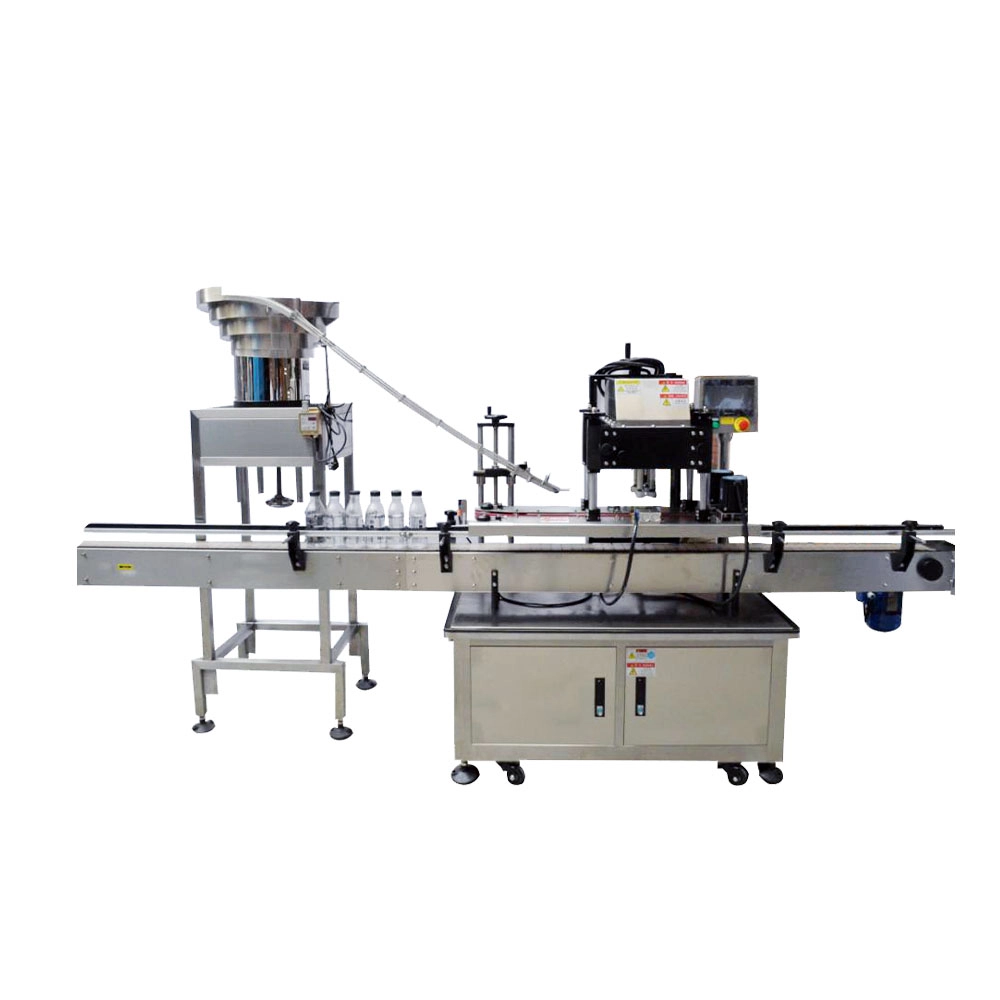
Automatic Plastic Caps Capping Machine with Vibrating Cap Feeder for Sale
Yuanyang automatic screw capping machine is a kind of four-wheel bottle capping machine. The automatic screw capper is often used to close lids of containers such as bottles and jars, especially for plastic bottles, which are widely used in food, medicine, chemical, cosmetic, and other industries for mass production and continuous production lines.
Features:
⦁ Full pneumatic drive;
⦁ Automated fast speed;
⦁ Suitable for various screw caps, pumps, and spray bottles.
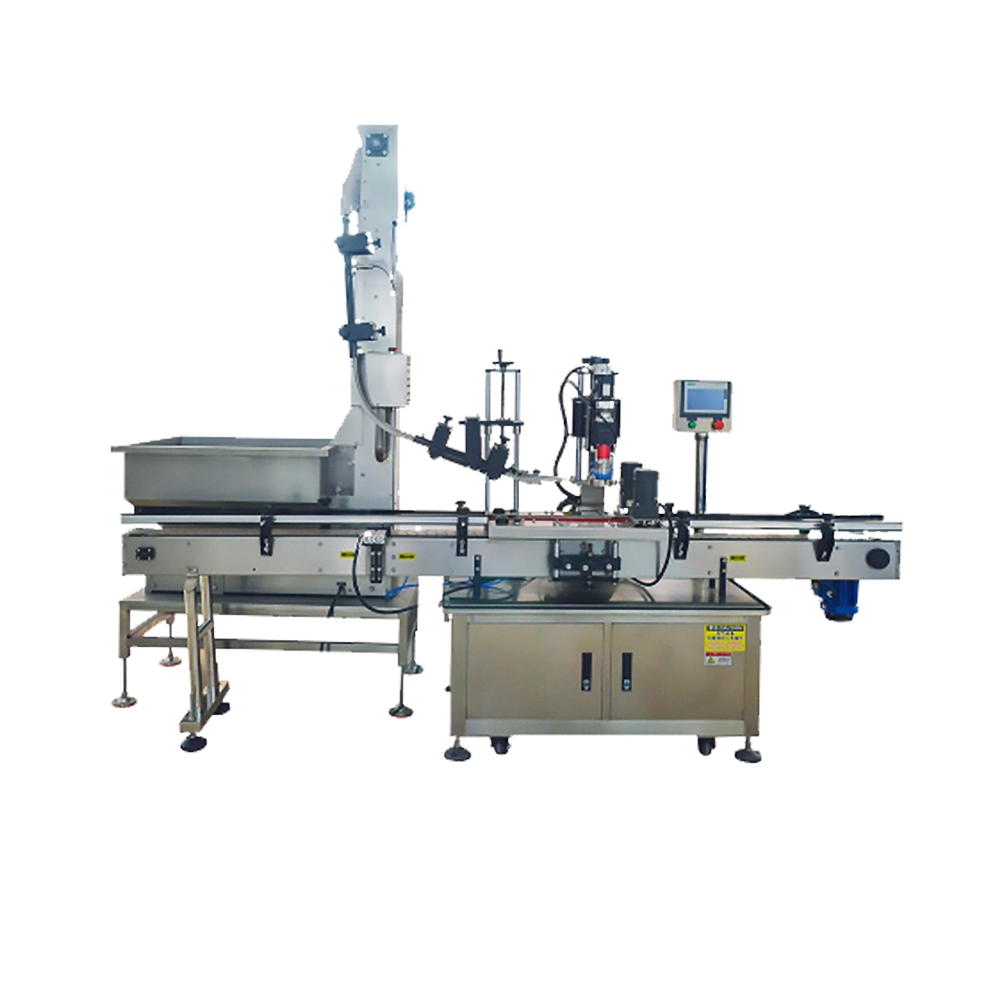
Automatic Metal Caps Capping Machine for Sale
Yuanyang automatic metal cap capping machine is a bottle capper for bottles with metal caps, which is often used to close lids of containers such as bottles and jars. The glass bottle metal capping machine is widely used in food, medicine, chemical, cosmetic, and other industries for mass production and continuous production line .
Features:
⦁ Pneumatic and electric drive;
⦁ Automated fast speed;
⦁ Suitable for glass bottles with metal caps.
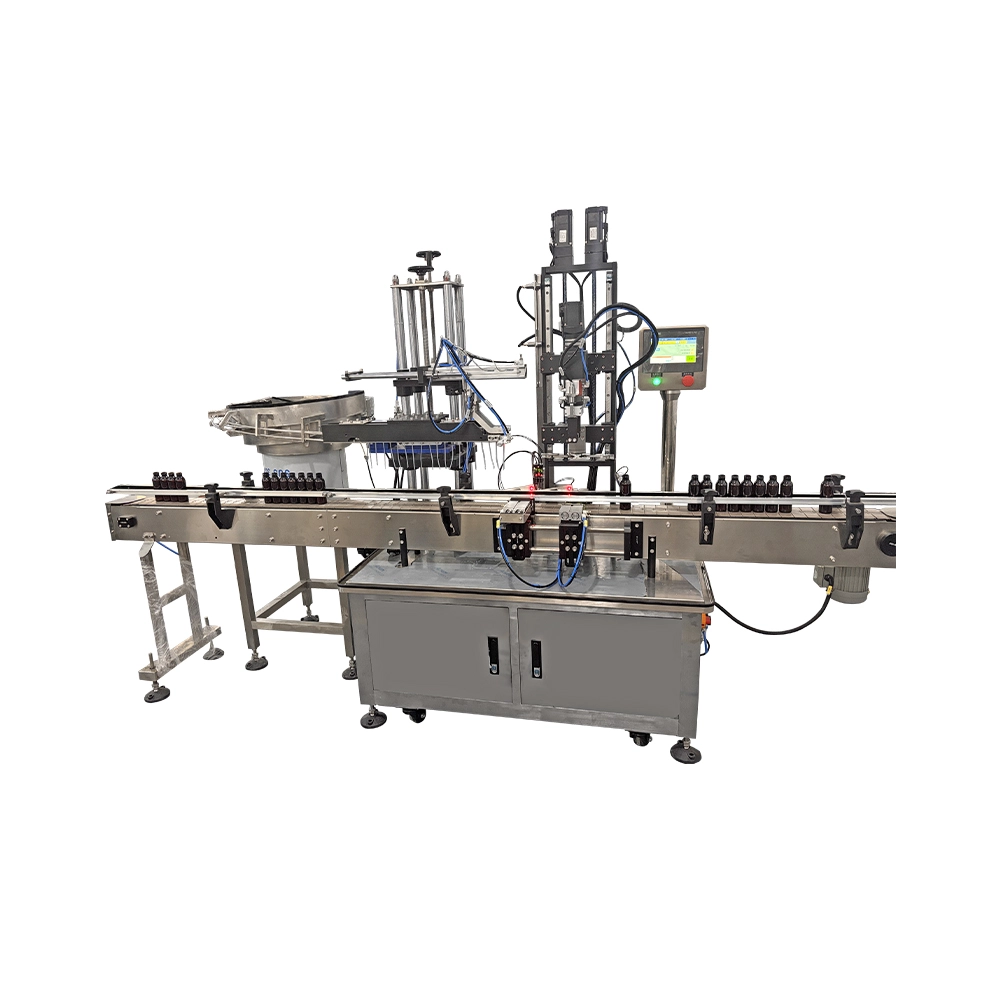
Automatic Pump Head Feeding and Capping Machine for Sale
Yuanyang automatic pump head feeding and capping machine is a bottle cap sorter and capper for bottles with pump heads, which is often used to close lids of containers such as nail polish, sprayers, and shampoo. The capping machine with a pump head feeder is widely used in food, medicine, chemical, cosmetic, and other industries for mass production and continuous production line .
Features:
⦁ Pneumatic and electric drive;
⦁ Automated fast speed;
⦁ Suitable for various types of caps.
Automatic High Speed Capping Machine for Sale
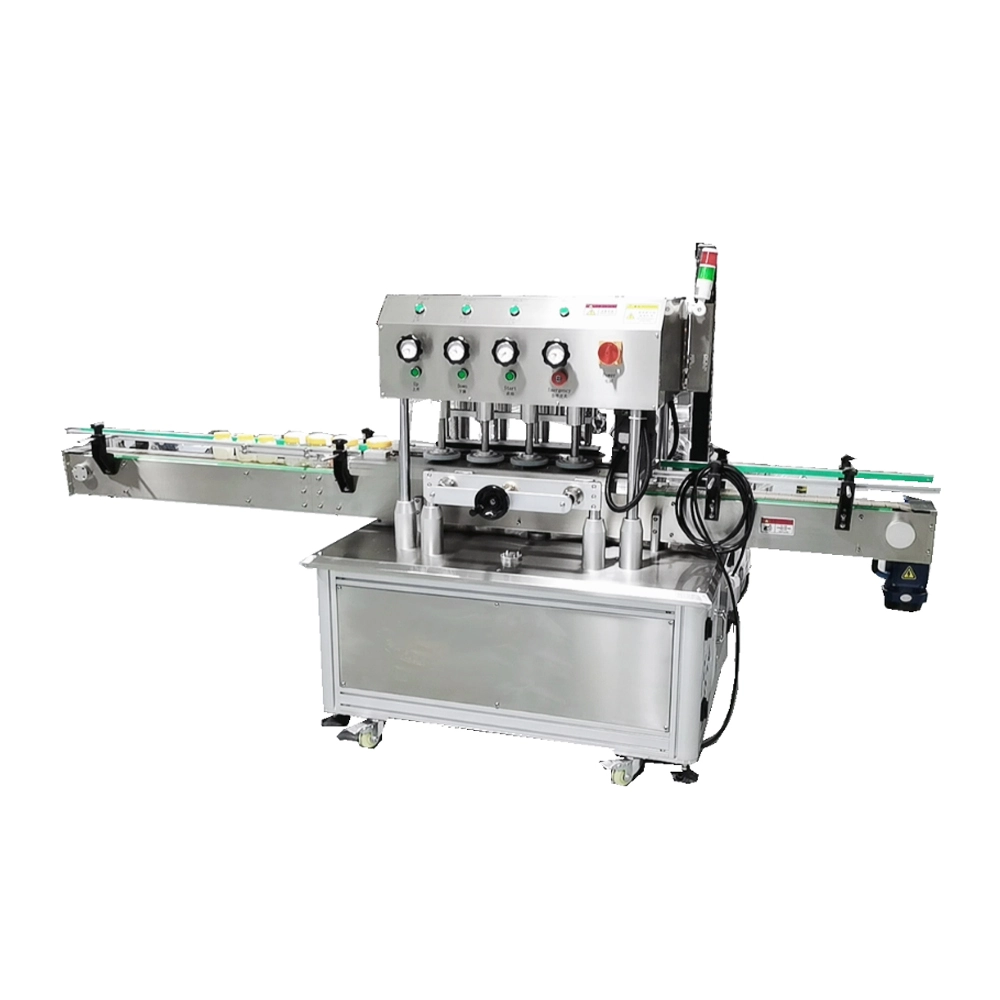
The Yuanyang automatic high-speed capping machine is a kind of 8-wheel bottle-capping machine with fast working efficiency. The automatic capper is often used to close lids of containers such as bottles and jars, especially for plastic bottles, which are widely used in food, medicine, chemical, cosmetic, and other industries for mass production and continuous production lines.
Features:
⦁ Electric drive;
⦁ Automated fast speed;
⦁ Suitable for various screw caps, pumps, and spray bottles.
 Scan QR Code
Facebook
YouTube
LinkedIn
Whatsapp: +8613434139712
Guangzhou Yuanyang Machinery